
Real and fictional characters discuss one of humanity’s worst creations: slavery.
According to the great Egyptian historian Zahir Batin Farouk, the foremost contemporary scholar of regimes of servitude throughout history, the birth of slavery was due to an act of humanity. In this he relies on the ethical theories of the sage Ptahhotep, who, as he approached one hundred years of age, decided to bequeath his Maxims to posterity.
The Idea behind this act of humanism anticipated, by millennia, the utilitarian philosophy conceived by wiser men more modest and more modern. It is an Idea not only utilitarian, but simple: those defeated in war always met the same fate — death. Then some great humanist conjectured that it would be more profitable to both sides — victors and vanquished — not to waste such labor by consigning it to annihilation, but to put it to some useful purpose. Useful, of course, to the victors.
I do not know whether this theory explored the possibility of giving the defeated a choice: were they compelled to live, or could they prefer annihilation?
Whether that thesis was true is not for me to decide. I intend only to record the metamorphosis of certain ideas, doing justice to the teachings of Ortega y Gasset1, who, when speaking of this initial humanitarianism of slavery, warned that all human things must be seen from this double perspective: the aspect they have on arriving and the aspect they have on departing.
This humanism ended up being practiced on a large scale in Mesopotamia, Egypt, early Greece and the beginnings of ancient Rome.
But there is no human idea that cannot be made worse.
From a humanitarian act, it became a mercantilist act, given the great profit involved. The wise administrators of Classical Greece were the first to make the calculation, and the practical Romans — who did nothing but expand all Greek calculations to infinity — transformed it into an enterprise in Rome’s expansionist age.
Wars then came to have as their purpose not only victory, but the capture of slaves: the consequence became the objective. The Idea did not merely worsen; it was transmuted.
What until then had existed in the thousands, Rome raised to the millions. But this had its price. Some economists from the golden age of the Five Good Emperors, especially the most prominent of them all, Publius Claudius Aequitius, insistently warned that the Empire would not survive unless it eliminated slavery — which, according to calculations of the time, had already reached one third of the population.
These economists defended the idea that slavery benefited only the great landowners and did not allow the ordo equester, the decurions, the assidui, the opifices and mercatores — something like a modern middle class — to grow in number, prosper and become the engine of the economy. Worse still: it created unfair competition with small rural producers, who had no way to compete with slaveholding latifundia.
They were not heard, and the year 476 A.D. exacted its price2.
Until then, slaves could rise socially, buy their freedom or integrate into society, as did the prominent Roman economist himself, who eventually adopted the name of the royal family in whose house he had served for seven years as a domestic slave.
But the Idea only kept getting worse.
In Tsarist Russia, the same institution returned under another name: peasant serfdom. If Rome raised the scale of slavery into the millions, Russia performed the feat of raising it above ten million — for the first and only time in human history.
In that same Tsarist Russia, the greatest human captivity in history, the serfs were white, Slavic, Caucasian — exploited not because of skin color, but because of hereditary social position. Perhaps for that reason the euphemism “serfdom” was used instead of “slavery,” to give it a more acceptable air.
Call it serfdom if you prefer; the label consoles grammar, not the serf.
When, in 1861, Tsar Alexander II decided to put an end to that euphemism — then called krepostnichestvo — his signature freed about half the population: something around twenty-three million people!
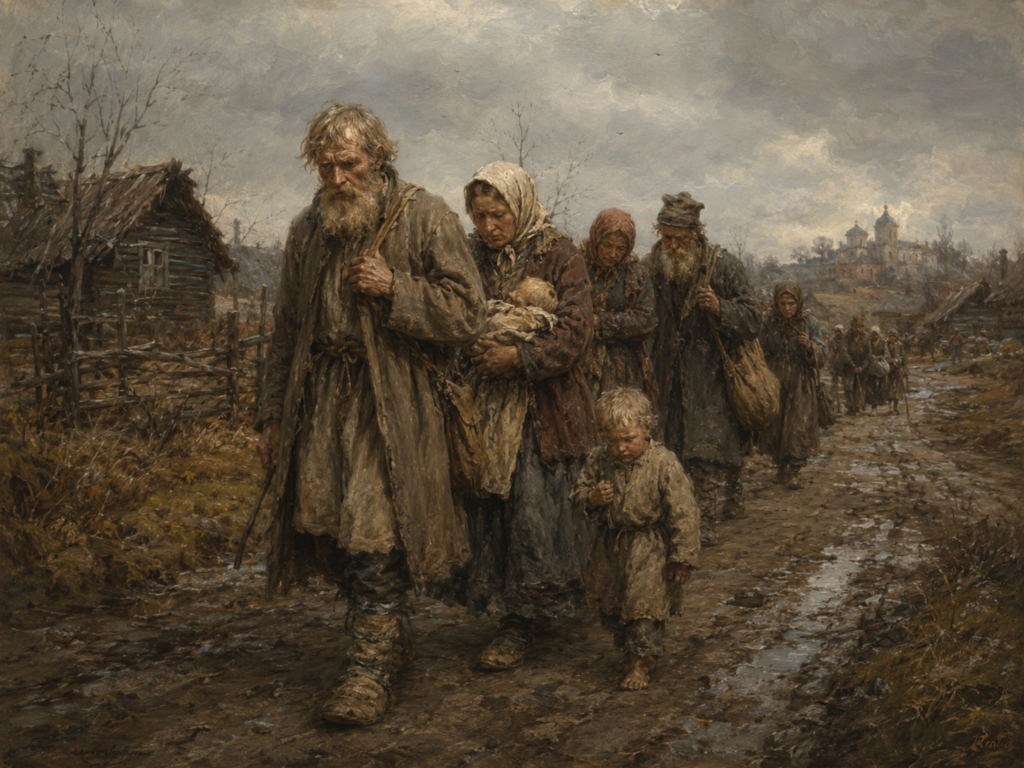
At that point, slavery was already so distant from that supposed initial humanitarian Idea that it now served to illustrate Plato’s intuition: everything that exists in the Sensible World is always degenerated in relation to the Intelligible World, that is, to the original model.
And one should never doubt the human capacity to make worse something that is already bad.
Alongside Russian serfdom there arose the transatlantic form: racialized slavery — the worst of all. Now the slave was marked by color and heredity: the child was born a slave, captivity was eternal. It was the most brutal and dehumanizing form of the institution, because it transformed ethnic differences into a permanent ideological justification for exploitation, with no possibility of liberation or incorporation into the societies that practiced it: the Americas, especially the United States and Brazil.
The Idea then reached its climax and, at last, began to lose strength: the possibility of manumission, the prohibition of the transatlantic slave trade, until its definitive extinction. Brazil was the last to abolish this sad human invention — which uninvented the human.
There is no need to resort to historical laws to classify this Idea as one of the worst ever invented. A simple mathematical equation is enough — at least mathematics is an exact science and admits no polarization:
Slavery = perverted mimesis3.
But it seems that only a century after the Lei Áurea — Brazil’s Law of abolition — did Brazilians remember that they should seek a few other attributes of this Idea, lost over time: to integrate the freed people into society and grant them rights, more or less as the ancient Greeks and Romans did.
At the same time that lost attributes of the original Idea were being resurrected, other parts of it resurfaced spontaneously — as if human thoughts could be reduced not only to mathematics, but also to chemistry. As if the Idea were a kind of solid that evaporated and continues circulating out there, haunting humanity. As if it obeyed the entropy of ideas: from stable form to vapor that permeates everything.
In the Egyptian past, when it was still in its humanitarian phase — that is, before it became business — slavery came accompanied by religious attributes and protection. Peoples were subjected — some even surrendered themselves spontaneously, given the precarious living conditions of the time — to servility before the pharaoh, in exchange for food, land and protection. Maat4 legitimized corvée5 labor and slavery properly so called.
The same Idea resurfaced as pizzo6 in Italy and was taken by the Italian mafia to the United States, changing its name to shakedown or protection money. It also resurfaced in Brazil, though without a specific name — practiced on a large scale by militias, especially in Rio de Janeiro, where residents pay fees for security, gas, transportation, cable television and so on, with no real alternative.
The modern justification is also quite humanitarian: to protect people from the dangerous criminals who surround them.
The strangest transformation of the Idea, however, has been occurring silently: voluntary servitude. If the Romans took slavery to the scale of millions and the Russians to the tens of millions, this new form has already passed into the scale of billions. More and more people surrender to it deliberately.
Examples are not lacking, and to enumerate them all would exceed the scope of this brief account. Recently it was reported that several people, voluntarily, are going to a small Italian commune in search of an elderly woman who dresses as in ancient times. They knock from door to door and, when they find her, take a selfie. It is not known what ancient time the clothing in the photograph represents. Other details do not matter either. The idea is to capture the instant. Pure servitude! Clearly, freedom is renounced in favor of spectacle.
Others spend hours and hours, voluntarily, working at something they do not like in order to buy what their children do not need. They say their children are what matter most in their lives. If, even so, they give up all the time they could spend with them in favor of this project, it can only be synonymous with total servitude.
There is a curious case that became a Hollywood story: a man became the servant of flowers; when he grew old, he became the servant of drug trafficking, which led him to prison for the rest of his life. A life dedicated to chains, masterfully told by the talented hands of Clint Eastwood7.
Before, there were the whip and the pillory; now the lash is more subtle: targets and pills. They say the latter result from the former; without them, not even at night, in bed, are the chains undone.
How this Idea will continue to haunt humanity cannot be calculated. For that it would be necessary to resort to some formula, but in this field they do not exist or have not yet been invented — there is only the stubborn message of the past.
Besides, when the wise heresiarch of Uqbar8 said that mirrors and copulation are abominable, I think he did not wish, in themselves, to condemn copulation or the multiplication of human beings, but only to warn that such multiplication is disastrous if it means the infinite perpetuation of an unsustainable structure and the repetition of absurd inventions — such as slavery.
Porto Velho, July 2025.
Libersum
Also read the author’s short story: THE GAIA HYPOTHESIS – a cosmic report in which Earth, humanity and time are examined from the archives of the Universe.
NOTES:
- The Revolt of the Masses — José Ortega y Gasset ↩︎
- Date of the fall of the Western Roman Empire. ↩︎
- Mimesis means “imitation/representation.” In Plato, mimesis has an inferior status: it is a copy of the sensible world, which is already a copy of the Ideas, and, if not used for an educational purpose, it leads away from truth (cf. Republic III and X). In Aristotle, mimesis is a natural path to learning: by representing human actions, tragedy produces recognition and may generate catharsis (Poetics). ↩︎
- In ancient Egyptian religion, Maat or Ma’at had a double meaning: a) as deity: goddess of truth, justice, rectitude and order; b) as principle: Maat is also a term associated with final determination and functions as a concept; the principles of Maat were an integral part of society and guaranteed public order. ↩︎
- In Ancient Egypt, corvée was compulsory and unpaid labor imposed by the State for the construction of public works, such as pyramids, temples and fortifications. It was a labor obligation that the free population, not enslaved, owed to the pharaoh. ↩︎
- Pizzo is an Italian term referring to a system of extortion practiced by mafia organizations to collect a protection fee from businesses and merchants. Refusal to pay may result in violence and murder. ↩︎
- Film The Mule (2018), directed by Clint Eastwood. ↩︎
- From Borges’ short story “Tlön, Uqbar, Orbis Tertius”: one of the heresiarchs of Uqbar declares mirrors and copulation abominable because they multiply the number of men. ↩︎
On Russian serfdom and the emancipation of the serfs in 1861, see Michael Lynch’s article “The Emancipation of the Russian Serfs, 1861”, published by History Today.
On voluntary servitude — the strange human tendency to collaborate with one’s own chains — see Étienne de La Boétie’s classic sixteenth-century essay The Discourse of Voluntary Servitude. Like many early modern texts, it contains moral and political language that may sound harsh or anachronistic to modern readers; its relevance here lies in its central question: why do people so often sustain the very powers that dominate them?