
Allegory of Polarization
An allegory of polarization: two ideals are born from a coin and become rival poles. The tale asks how to live with values in conflict without yielding to the tribes’ noise.
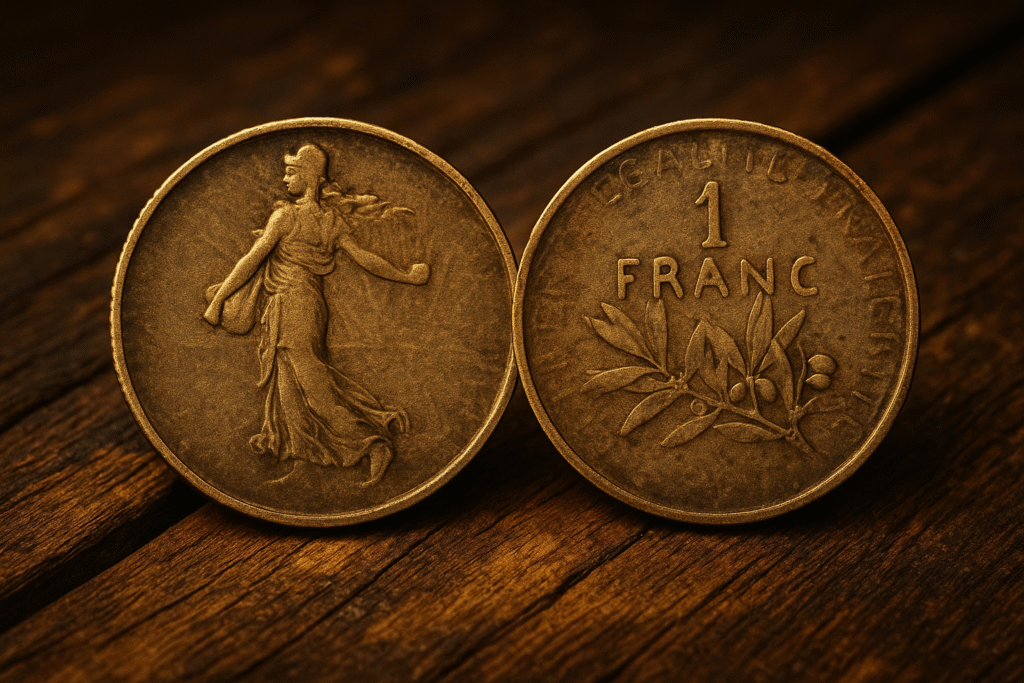
A slight tremor ran through the boards of the empty tavern. The one-franc coin, forgotten on the greasy tabletop, slid as if finding its destiny and rolled toward a hole exactly its size—not wide enough to swallow it, only to hold it halfway, as if the earth wanted to keep it without losing it.
From the bottom of that hole, which seemed to descend into the entrails of the world, a viscous, hot liquid rose, a very bright gold. It embraced the metal and lit it. The glare was so sharp it woke the drunk leaning against the wall across the street. He rubbed his eyes, ready to blame the wine, but the light had a design of its own: an inverted triangle, the size of a person.
On the coin’s obverse, a woman sows to the wind. On the reverse, a solitary numeral at the center and an olive branch, flanked by three words almost erased by time—worn letters that still whispered as if an ancient oath. The drunk swore he had seen in them the promise of a new world, but the glow was stronger than the letters.
They say Hephaestus struck that coin; Hermes, grinning, was the author of the tremor that cast it to the floor, curious to see into whose hands it would fall.
The Coin then hooked its own image and pulled it outward, like yanking a cloth from under glasses. The metal twisted in silence. The triangle of light projected one body, then another, like pages that come unstuck.
Two female bodies emerged—exactly like the female figure portrayed on the coin. The first wore blue; the second, white. They placed themselves to the left and right of the man who watched the scene. His gaze, trying to take them both in at once, blurred. The brightness grew until it blinded him. The two smiled and reached for a touch; they were repelled. They tried again; repelled once more, like the same poles of a magnet. The gesture turned to strangeness and, in an instant, to an inaugural hatred—if love at first sight exists, there its opposite was born.
They gave themselves names. The one in white called herself Anne. The one in blue called herself Maria.
They had come out of the Coin as if they were the same face split in two. In the sheen of their skin they still carried the memory of a lost unity—as if in some remote time they had been a single woman. Now, however, they answered to different names: Maria and Anne.
The gleam at the rim of the hole faltered, like a flame before the wind, and nearly went out. Even so, something struggled to be born. A third figure dug her hands into the metal ring and pulled herself out with the effort of labor: a red cloth, a tired face, a breath. Philotes.
Philotes found no place. She wandered aimlessly, invisible enough that only one or another felt a shiver at her passing. The world, at that moment, was relatively at peace: no Terror, no great wars, no cataclysm underway. And it was in that calm that she began to come undone. She discovered, with a quiet sadness, that her strength depended on the blaze: her flame grew under ruins, under sirens, under hands pulling stones from rubble. At rest, she turned to rumor.
At the edge of an ancient pinot noir vineyard, one of those whose roots seem sunk in memory, Philotes began to drink until she lost her composure. She fell and, in the last stumble, drowned in her own vomit. The body broke into golden particles that the wind scattered among the vines. Some passersby swore they saw, for a second, a glittering dust cling to the skins of the grapes. Others not even that.
Maria headed West. She met a fox—who knew many things—and adopted it as an inseparable companion. They never left each other. Farther and farther West, the prairie wind greeted her with dust and bones. She walked among bison that looked at her with respect and wolves that followed her with devotion. The wolves came in packs, asking for roads, clamoring for space, but always with wet mouths. Maria knew that, alone, she ran the risk that devotion would turn to hunger. The fox warned her in short phrases, sharp as teeth: “too much road becomes an abyss.”
The wolves, however, always came. They surrounded her, asking favors and protection. Maria warned them:
— If you do not contain your appetite, there will be no sheep left for you.
They laughed, wet teeth bared:
— If they end here, we will look to the South. They say in the South there are many, and easier to take.
Maria shuddered. Any ideal without brakes, she thought, is also hunger in disguise.
Anne advanced to the East with her white robe already marked by dust.
She then met a hedgehog, which immediately curled up in her white skirt. She took him in. The hedgehog always accompanied her, with short, stubborn steps. He whispered in her ear a great thing he knew. Anne was impressed by his intelligence.
It was then that Anne met a woman with oblique eyes and a modulated voice, capable of bewitching even the birds that flew above her. Her name was Pisinoe. Her song was not aimed at the senses, but at intelligence: a melody woven of concepts, hypotheses, and promises. It made the obscure clear, the complex simple, the improbable inevitable.
— Who is she? — Maria asked the fox when she heard rumors coming from the East.
— She is the siren of the learned — the fox replied. — Her name is ancient. She does not enchant sailors, but intellectuals. Her magic reaches only privileged minds.
Pisinoe became intimate friends with Anne. She gave her not only companionship but a gift: it was enough to pronounce Anne’s name in certain assemblies for everything to become evident, as if a veil fell from eyes. Professors repeated her formulas with the devotion of initiates; brilliant youths believed they had found the definitive map of humanity.
This gift was a kind of invisible opium—it did not stupefy, but made one believe that every problem had a single perfect solution, provided the correct theory were discovered—easily found by the elect who know how to read the laws of history. This opium did not act on the senses; it acted on the mind: it did not bring forgetfulness, but the illusion of absolute clarity. Those who inhaled it no longer accepted doubts; every question had an answer, every shadow had light, every pain had a calculation.
The learned invoked it without thinking: when they found themselves without arguments, they murmured Anne’s name—and suddenly everything seemed clear. Students repeated formulas like sacred verses: “minority, oppressor, neoliberalism.” No one had ever seen a neoliberal in the flesh, but the word, spoken in solemn tone, was enough to command applause or boos.
It was a discreet spell: a mere breath from Pisinoe turned vocables into answers in themselves, closing the doors of thought. Those who asked “why?” were seen as naïve; those who requested definitions were accused of bad faith. The enchanted words dispensed with study, history, nuance. They shone like counterfeit coins so perfect they deceived even goldsmiths.
Yet Maria also perceived something that not even Anne could see: Pisinoe did not give answers, she merely fed the addiction to certainty. Each new explanation demanded another, and another still, in an endless chain. The sirens’ song, Maria thought, does not drown; it intoxicates to unconsciousness.
Anne followed ever closer to Pisinoe. She no longer spoke with peasants or proletarians, nor heard the voices of the streets; she spent her days in assemblies and nights in libraries, repeating words that seemed to have lives of their own: revolution, structure, power. Those who listened felt illuminated, as if each term were a key. But no key opened doors; they opened only other words.
The hedgehog, always curled at her feet, reminded her with its spines that the world could be reduced to a single great idea—and that ideas also wound. Anne believed this: that if humanity surrendered to formulas, everything would be solved. Pisinoe smiled and tuned the melody, and the entire East seemed drunk on certainty.
Among the listeners there was always a solitary, silent man who jotted in notebooks what he saw and heard. He did not sneer, did not argue, only recorded with bitterness that theories could be more intoxicating than alcohol and more addictive than any smoke. He always wore a gray coat, an exile among newspapers and lecture halls. He said, in a low voice, that certain myths are seen back to front: great revolutions shine more in the telling than in life, and the heroes of the present often confuse memories with prophecies. Few listened; even so, his warnings stayed in the air like smoke that does not dissipate, like a caution that would echo yet.
Once, in her wanderings through the East, in a Clean Glade, Anne met an old lion who taught poor children. She asked him about the men who followed her with grand plans to transform everything, planners with perfect schemes. The lion replied:
— Do not trust too much those who raise theories like altars. I knew a general named Pfuhl who even rejoiced at failure: he could then say his theory had not been applied correctly. There are thinkers like that; they prefer to save the theory rather than save people.
Anne heard, but did not accept the advice. Pisinoe was already whispering that every failure belonged to practice, not to the idea.
Among those who followed Maria, some began to grow in number and in fury. They were immune to Pisinoe’s song and laughed at those lulled by it, but repulsion turned to anger. They gathered in bands, first with torches, then with luminous screens. They marched in the street and also in the invisibility of the networks, multiplying symbols, slogans, threats.
They spoke of purity, of defending borders, of raising walls against foreigners. They rejected alliances, mocked treaties, proclaimed that strength and will sufficed.
Maria looked at them with fear. She knew they used her name as a standard, but she did not recognize in them the fox that advised her or the wind that guided her. They were closer to the wolves that had always surrounded her: they sought not paths but targets; they did not wish to be freed from restraints, but to wage war. They began to tear names from bridges and in their place put numbers. Where names are lacking, targets abound.
The two sisters, unbeknownst to each other, visited, at different times, three houses of the nineteenth century. In one lived a count without an army who dreamed of organizing the world’s trades like a workers’ choir; in another, a man in a dark jacket who collected orders and classifications, convinced that a society could be guided like an observatory; in the third, a watchmaker of historical gears, for whom the hands were classes and time was captive to necessity. In all of them, the price was small and ancient: to sacrifice the present to buy an impeccable tomorrow.
Anne was tempted by those total plans. Maria, however, was divided: part of her also found such projects tempting, but another part warned her that the sacrifices demanded were not worth it, for the future is uncertain and human beings do not suffer hypothetically: their pains are real, of real people and not ideals.
Later, in a stone square, they saw men with equal steps, chins and slogans raised, dressed in symbols. They seemed to offer meaning to those hungry for belonging. They seduced entire cities—until, when asked for bread, they offered claws.
Along the journeys, three voices spoke to them at different times. The first came from a man who saw the world in perfect forms: ideals, he said, could fit together like reflections of a hidden model. The second was that of a master of proportions, who walked in the middle of a road with a compass in hand: human ends were compatible, it only required the right measure. These two voices were merely echoes that had circulated the world for two thousand years—as a solid perennial philosophy—pronouncing: there are no contradictory ideals.
Much later they heard a third voice: that of a Latvian who had settled in the City of the Towers of Dreams, on the great island the tide separates and history connects. He fixed himself beneath towers shrouded in mist, raised in the distant year of 1096. His lesson promised no comfort: some ideals clash irreconcilably; to choose one is to renounce another; since values collide, politics is the art of tragic choices, not perfect engineering; therefore we must make constant choices and agreements so that people can understand one another and civilization can be maintained. They are always fragile agreements, requiring vigilance and ceaseless renewal.
Maria and Anne recognized in that whisper a sentence: even if they desired the same destiny, their paths would never be one.
If Anne had Pisinoe to grant her a dangerous power, Maria, for her part, had a kind of double power, or double personality: a negative side and a positive side, always in conflict. Her negative side conferred a kind of shield on whoever invoked it: it guaranteed the absence of external impediments or coercions, even on the part of the all-powerful State; her positive side conferred the possession of resources to control one’s own destiny and flourish.
Anne was interested only in Maria’s positive side, while her negative side repelled her. Maria, in turn, understood that what Anne represented was within everyone’s reach, provided the road were left free and a kind of invisible hand would do the rest. Maria strove to let her negative power prevail, faithfully believing in that invisible hand as the rule for everything, even aware of the wolves’ risks—they were especially interested in that negative side of hers.
In the West, Maria offered space—a territory where no one ruled beyond their own stride. The prairie wind whispered that dignity costs risk. In the East, Anne offered guidance—charted paths, bridges so that no one would be left behind. The cities whispered that justice costs restriction.
The two, each on her way, nevertheless suffered the same loneliness: Maria with her wolves, Anne with her siren. The world listened to them, but neither of them was whole.
Only in northern lands could Anne and Maria, for brief instants, draw near. There, between fjords that sliced the earth and auroras that streaked the sky like colored veils, the force that had repelled them since birth grew milder. Perhaps it was the cold, which brings even opposites closer; perhaps it was simply the silence of the mountains that accept no quarrels.
There, by ancient custom, whoever spoke first repeated fairly what the other had said—before replying. And, on a certain night, they read names in the square; the siren lost a tone, and a wolf closed its mouth.
A fisherman from those parts even swore he had seen the two walking hand in hand along the narrow beach, while he left his fish drying in the salty wind. He told this in the village, but they laughed at him: they said it was invention, like so many other fishermen’s tales. Even so, his testimony spread as a legend.
And perhaps it was indeed invention. But some, on hearing the account, felt a secret hope in their chest: that, somewhere far away, the two might still walk together, even if only for an instant.
He also said, in his tavern conversations:
— It is strange that from two such beautiful mothers such corrupted offspring have arisen. One gave rise to bands marching with torches and symbols, eager for walls and purity. The other fed disciples who knelt before formulas and dogmas, believing words worth more than people.
While these offspring dispute who shouts louder, no one listens to the mothers anymore. And thus what was born to be foundation became ruin.
Indeed, the two met in those cold regions. Anne, still wrapped in Pisinoe’s song, with the hedgehog curled in her skirt, whispered in her sister’s ear what she most desired: a world where no one is forgotten, where every voice has shelter, where no one is without letters, roof, or bread. Maria, with the fox at her side, replied softly that her dream was exactly the same, but in her world each person would walk without chains until, alone and by their own means, they reached those ends.
Surprised, they asked themselves how they could desire the same thing and yet repel each other.
Maria said:
— I believe each one must arrive on their own, without anyone imposing the way.
Anne replied:
— I believe we will only arrive together, even if we must guide one another.
The silence between them weighed like snow. They recognized each other as indispensable, yet incompatible. The Coin’s magnetism, though weakened, still pushed them apart. And yet the whisper of both contained the same spark: the desire for a better world, only trodden by different roads.
It was then they accepted the fatality: they could not unite, but they could walk side by side. Proximity did not erase differences, but made them bearable. They discovered, at last, that the only reconciliation possible was tolerance—but this was not possible while they existed as they did, drawn from the Coin, autonomous entities.
Separated, embodied, they turned into almost divine entities, objects of true human worship. At first they felt pride and vanity and wanted as many followers as possible. But after so many wanderings through the world, they realized that, apart, they had caused more suffering than benefit, more wars than peace, more rifts than union.
Then the two looked at each other—not with rancor, nor with tenderness, but with the silent recognition of those who have completed a cycle.
The wind began to blow in a new way, warm, full of omens.
They stretched out their hands, and from their bodies a golden dust began to loosen, tenuous, luminous.
It was as if the sun’s own light were breaking apart into tiny grains.
They dissolved completely. A golden dust rose, swirled over cities and fields, entered through windows, mouths, eyes.
It touched kings and beggars, children and soldiers, without distinction.
And when everything finally grew still, there was no longer Maria or Anne—only the tawny dust settling on the world’s shoulders.
They say that since then each person carries within a particle of that glow: Maria and Anne no longer reign outside, but burn within.
And whoever tries to possess them entirely—to turn them again into Coin—will repeat the primordial error: trading the living gold of the soul for the coldness of metal.
But avoiding that error demands constant effort. Unfortunately, it is a cyclical error that always returns to haunt humanity. Vigilance requires concentrated attention.
The gods, however, love metal and tempt us to melt it again, to strike anew images on that empty Coin. To resist is Sisyphus’ craft: to raise, in silence, the stone of discernment every morning.
And without silence no attentive concentration is possible. But the world invented networks of noise—choirs that sing on separate frequencies. Each choir stops its ears to the neighboring song and, in the dark, raises groups and altars.
This is the intimate mechanics of polarization: reinforcing noises, altars that rise.
Sadly, the noise has been increasing without cease, and Sisyphus’ resistance loses strength by the day. You can already hear the shouts of groups clamoring, some for Maria, others for Anne. The Coin trembles, the restless gold begins to circulate again and may touch it once more. If it touches, the two may return to the Coin and come out of it again.
If they return, will they keep the lessons of the first birth? Only the gods know. And we—have we learned? Silence will tell.
And Philotes? Wisely she chose to become dust before them all. They say her sparks remain scattered, invisible, awaiting the next catastrophe. When the ground trembles and men search for each other again, perhaps she will reappear, reminding that every ash had a face, every number a name, every corpse a hand that once held another hand.
Porto Velho, May 2025.
Libersum.
Also read the following story by the author: Labyrinth of Id
On the allegory of the hedgehog and the fox and its link to political polarization, see the article: The 100 best nonfiction books: No 28 – The Hedgehog and the Fox by Isaiah Berlin (1953). The great historian of ideas starts with an animal parable and ends, via a dissection of Tolstoy’s work, in an existential system of thought.
Comments
You may send comments on this short story using your real name or a pseudonym.
Your email address will not be displayed publicly.
To preserve the atmosphere of Liber Sum, all comments are read and approved by Libersum before being published.
Pingback: The Aesthetic Decline - The City of the Holly Grove (2025)
Pingback: Amerindia, the Singular — a short story about empire and war (2026)