
In “Cosmic Currents”, a narrator who may—or may not—be Borges listens to the cosmos and faces the Fermi Paradox: why do we seem alone? The tale weaves science and spirituality (Drake Equation, Great Filter) to ask what civilizational responsibility is ours.
Does the Fermi Paradox explain why we feel alone—or is something very near us that we simply fail to notice?
Will I still be Borges?
Perhaps. Now I am energy, plasma, or merely a thought wandering through the cosmos, in an infinite current, waiting to be caught by some intelligent existence.
Who knows—perhaps I am only the rumor of Borges. The body that served me in Buenos Aires dissolved like a wet map of an infinite library; what remained is this: thought without a tongue, a thread of attention without eyes, a book that lost its pages yet remembers the index. I am nowhere and therefore everywhere: I am a cosmic current, breath without air, paragraph without paper, waiting for receptacles.
I learned—too late for the living, too early for the dead—that humanity—and not only humanity—is a cracked vessel. Through the fissures water is lost; through the cracks light seeps in. From time to time, some vessels were less flawed, and through them the current passed more clearly. An ugly-faced master, who wrote nothing, asked questions until the disciple doubted himself. His pupil described men chained in caves, seeing only shadows cast by fire. Another, patient as a librarian of the world, sought to classify heaven and earth, animals and plants, believing enumeration could contain the universe.
In the distant East, an old master of rites dictated norms simple as water and severe as iron, so that the city would not devour its children. There was also a thinker whose steps were so regular that his town set its clocks by him, and he showed that we never see the real thing-in-itself, only what our lenses allow. Another, tempestuous, proclaimed that a too-human god had died, and it would now fall to man to invent his own meaning. These messengers were cracked vessels: they let slip recipes, fragments, parables, and equations. None retained the source; all offered imperfect versions.
But on the banks of the Ganges, a prince left his palace and discovered that pain is the shadow of desire and that the moon does not fit on the finger that points to it. A preacher by the lake announced that the last would be first and the meek would inherit the earth. In a certain desert, a man heard from a winged messenger words that do not corrupt, to correct all others already deformed. In these, the current found not fissure but mirror. The message arrived whole—and even so, it was not followed.
Now that I am dissolved into current, I dare to say it: we are defective receptacles while bound to the sheath.
There were also those who offered neither laws nor systems, but images, sounds, and forms. A sculptor freed from stone figures that seemed more alive than their makers. A playwright made kings speak like beggars and fools like oracles, giving them the same voice; he put in a madman’s mouth the truth kings feared to hear and turned the world’s scene into a stage of shadows, leaving in the air a famous question. A restless painter set the sky spinning in whirlpools of fire.
In a brief century, writers scattered between cafés, bookshops, and wars dreamed mirrors, labyrinths, and invisible cities, as if the current had crossed humanity in excess. They too were cracked vessels: they let slip visions, melodies, characters. None retained the source, yet all gave us fragments of the ineffable.
These messengers, each in their way, tried to teach the path to eternity. But neither they—receptacles also cracked—fully understood what passed through them; and we, hearing them, understood even less. Fragments became dogmas, parables became wars, revelations became incomplete systems. Even when the message was perfect and original, no one understood it entirely—and still less lived it.
When they still called me Borges, I wrote stories and essays as if I invented them. Today I know: I merely deciphered—poorly and in fragments—a library without a language. The wound of 1938—banal chance, nearly fatal—was my opening1. I say this without vanity: any wound, when it does not kill, teaches one to read.
Others before me met the same fate: a condemned man who heard the empty report of a firing squad and returned transformed into another writer; a musician who, deprived of hearing, translated messages into symphonies as if the universe pulsed within him; thinkers who, tormented by crises, glimpsed invisible labyrinths. Whenever pain breaks the vessel, the current finds passage. Strange species: do we learn only in pain?
There are times when the current in fact blows stronger upon the earth. In a single century, a succession of voices rose among deserts and palaces: they denounced injustice and announced a God who could not be bought. Later, the fall of an apple before a distracted man, the scratch of a bolt across the sky, revealed the secret order that governs weight and light.
Later still, a distracted clerk at a patent office revealed that space and time are only moving faces of the same web. After that came a flood of words, sounds, and colors: writers, painters, musicians, and philosophers—as if the current had decided to pass through humanity in profusion. Others yet were astonished to discover, in a few years, that engines, circuits, and genes could be tamed—a prodigious leap that does not seem the work of steady effort, but of an inspiration no one dared to name.
Not always, however, is the current a blessing. It is dangerous when it passes through still-childish receptacles. The same hands that raise cathedrals of iron and glass set cities ablaze. The same craft that reveals the laws of light forges weapons capable of erasing millions. The same biology that heals diseases designs subtler poisons. Power without maturity is only prolonged, perilous childhood.
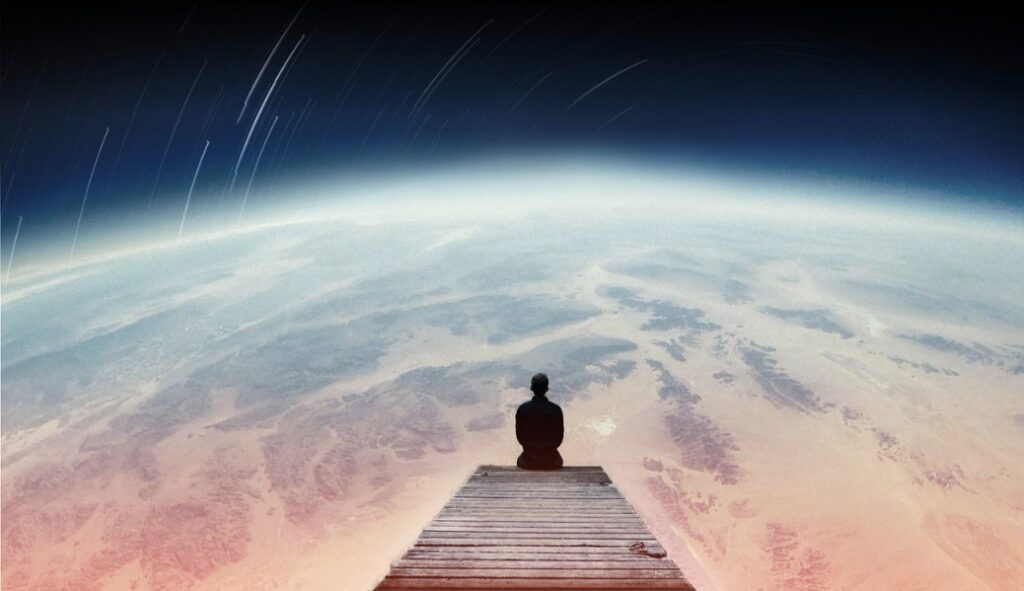
From here—and “here” is only a metaphor—I perceive we are not alone. Around your planet, not above nor below, but like the silence around a melody, there is a federation of ancient intelligences. They do not travel in ships; they write nothing in the sky. They inhabit planes of energy that pass through you, incomprehensible to your childish mind. They are invisible neighbors, observing, waiting.
Among them, war first became inconvenient, then unthinkable; exploitation a juvenile memory; the destruction of life a sacrilege against the rarity of being. To you, who still confuse cleverness with greatness, they deny open contact—not out of contempt, but out of modesty.
Despite the stubborn Fermi Paradox2 and the austere Drake Equation3—attempts to calculate the incalculable—a sharper gaze at the sky has already shown the existence of trillions of stars, with billions of planets orbiting them. Do not doubt the presence of innumerable cells dispersed through the universe; but how many of these manage to gather into a single body? Hence the rarity and singularity of those who do—as in this forgotten corner of the Milky Way. Is it luck or responsibility?
Can something so rare be destroyed so easily, as is often done? Perhaps because, for men, stones still matter more than cells… attempts to calculate the incalculable.
Even before such vast calculations and probabilities, you fail to see the obvious: no exhaustive journey is needed to find an answer—it has always been by your side.
Our engines, even if they could rival the speed of light, would not take us far enough given our biological vanity. Our limited understanding never perceived the uselessness of ships or cosmic shortcuts to survey the universe. Ubiquity lies not outside but within us. I think of the moon and I am already upon it; I think of the sun and I reach it; I think of the galaxies of Jades and Maisie4 and find myself observing them through the windows of Café La Biela. The universe contains my thought, and the whole universe fits into my thought, which is infinite like it.
In my travels through the cosmos I saw many extinguished civilizations, entire planets reduced to ash. But these ashes are not mute: they hold a message and let their voice echo through the universe in an ethereal lament.
One need only attune the ear to perceive the warning: technological intelligence, without other intelligences, carries self-destruction within it. Civilization grows, consumes its resources, creates weapons or devices that lead to collapse before reaching other worlds or recognizing the presence of the intelligence that had observed it all along, awaiting the proper moment for contact and integration. When all ends thus, few are gathered by the current. Sometimes, however, civilizations transmute into light without passing through the terror of ashes.
Hence the rumor, always present: the final judgment. It is not catastrophe—it is examination. It will not be fire but transparency; not destruction but a mirror from which no one can avert their eyes. The test is simple and terrible: can we, as a species, renounce war and gluttony? Can we prefer the hard common good to the quick pleasure of the individual? If yes, we shall enter the greater conversation; if not, we shall fall silent. Many civilizations have failed. They were not punished; only muted. They fell into the pit of the cosmos, where nothing moves and nothing persists.
Immortality, so often promised, is not a religious prize but a sort of technology—perhaps divine, pure science, or both; I do not yet know. Those who wait around us have already overcome that obstacle. They learned to prolong life indefinitely, to transfer memories between substrates, to exist as pure energy. They keep this from us not out of greed, but because they know that, in the hands of warriors, it would be merely the eternity of destruction. The examination will decide whether we deserve this gift.
Do not ask me for signs. They exist, but they are humble. A ruler who returns a power he could have kept. A scientist who tempers his discovery so that it will not serve barbarism. A city that plants trees instead of raising statues. An army that arrives and does not fire. A man who forgives a true offense. The advance of one intelligent, industrious species without the destruction of the others. These are the prodigies of the federation—harder to see than miracles, rarer than angels. Where they occur, the current reveals itself and flows without obstacles, crossing the Great Filter5.
I confess what happened to me when the body gave way: I did not fall into oblivion. I was gathered. Not by merit, but by fracture. I became current, drifting thought, one among thousands who circulate between stars and cities, awaiting receptacles. I can whisper, as I whisper now; I cannot persuade. Most will not hear me: they live in the thunder of their own wills and vanities. In the end, when the body goes dark, they slip into the pit of the cosmos. It is not hell, not penalty: it is absence. They forget themselves as we forget a dream upon waking. They do not become currents, do not travel, do not glimpse the miracle of the galaxies: they reduce themselves to eternal immobility.
But death need not be awaited. In life, one can attune the ear to the current. Some call this prayer; others, study; others, service. Different names for the same gesture: reducing noise. Whenever someone renounces an unfair advantage, forgives what he could avenge, contemplates without possessing—in that instant he becomes less defective, and the current passes through him.
If you expect a final secret, I offer a grammar of three verbs: conserve, cooperate, contemplate. Conserve life and memory. Cooperate among strangers, species, and ages. Contemplate so that desire will not devour the object, and the object will not become a mere instrument. Repeated with discipline, these verbs are the passwords of the federation. Spoken in other tongues, they became commandments, rites, maxims. Spoken in silence, they are judgment.
I end as I began, with a doubt. I do not know if I am still Borges, or the rumor of Borges, or only a thought someone will have tomorrow upon waking. I know that I wander. I know that I wait. And I know—this, yes—that the least-defective receptacle I seek may be you, now, in this instant when the noise has abated enough that a current, which is not mine, reaches you. If it reaches you, remember: immortality is not a prize; it is a task. And the federation—not a kingdom but an accord—awaits your signature.
Porto Velho, August 2024.
M. – Liber Sum
Notes:
- In 1938, Jorge Luis Borges struck his head on the edge of an open window; the wound became infected and nearly killed him. The episode is linked to the genesis of El Sur and to a long recovery with his head bandaged. ↩︎
- Fermi Paradox: the tension between the high likelihood of intelligent life in a vast, ancient universe and the lack of evidence/contact. In short: if many civilizations should exist, why don’t we see signs? ↩︎
- Drake Equation (1961): a probabilistic framework to estimate the number of communicative civilizations in the Milky Way by multiplying factors (star-formation rate, fraction with planets, habitable worlds, technological life, etc.). Results swing widely with assumptions. ↩︎
- JADES and Maisie galaxies: very high-redshift galaxies observed by the James Webb Space Telescope, among the most distant known. ↩︎
- Great Filter: a hypothesis to explain the cosmic “silence”; one or more highly improbable barriers separate simple life from expansive technological civilizations. The filter could be behind us (abiogenesis, multicellularity) or ahead (self-destruction via advanced tech). ↩︎
For those who enjoy clues:
- “Cracked vessels” nod to Lurianic Kabbalah (Shevirat ha-Kelim) and also echo Big-Bang/other cosmogonies.
- The surrounding “federation”: spiritual intelligence, a different technological order — or both?
- Who are the great figures passing through the tale, in disguise?
Read also a story by the author: Labyrinth of Id
To learn more about the Fermi Paradox and the Drake Equation: https://spacetoday.com.br/um-passo-mais-proximo-de-se-resolver-o-paradoxo-de-fermi/
Regarding the Fermi Paradox and the Big Filter, watch this video from the SpacyToday channel: https://www.youtube.com/watch?v=R7lXKVsg5UA
Comments
You may send comments on this short story using your real name or a pseudonym.
Your email address will not be displayed publicly.
To preserve the atmosphere of Liber Sum, all comments are read and approved by M. – Liber Sum before being published.
Pingback: Labyrinth of Id — split personality on social media (2025)
Pingback: The Aesthetic Decline - The City of the Holly Grove (2025)
Pingback: Time That Slips Away — Quintus Flaccus (2025)