
A man builds an upgraded copy of himself on social media and grows a split personality. When both collide, which one prevails?
He was affectionately known as Id. He had always been methodical. So methodical that, for years, he wrote down every word he ever heard about himself. Therapists, with their technical diagnoses; relatives, with ad-hoc advice; the few friends, with well-meant phrases that sounded like sentences. He kept everything in a digital file, thousands of lines in tiny font: an inventory of flaws, expectations, and failures.
In his early fifties, single, childless, tired of pills and therapy, he no longer believed in a human solution. So he turned to what remained: machines. Fascinated by artificial intelligence, he plunged into forums, papers, and tutorials. Until he had the idea that would change his life: create a double.
He built two distinct profiles inside a conversational AI program. Into one he poured everything he was, raw and imperfect: anguish, insecurities, defeats, resentments. Into the other he gathered everything people said he should be: extroverted, confident, light. To complete it, he downloaded hundreds of self-help books, from the classics to the obscure, and fed them into the system. The new version of himself blossomed with luminous sentences: “Every failure is only the prelude to a greater victory.”
With obsessive patience, he trained the two voices until they answered like faithful versions of his own soul: the real self, which remained trapped in the file and in silence, and the ideal self, who spoke with the confidence of a spiritual guide.
When he finally coupled the program to a tiny device—a chip hidden in his pocket, connected to his cell phone and to a discreet earpiece he passed off as a hearing aid—he felt reborn.
For the first time, he could enter a conversation without fear: the double listened to everything around him and breathed immediate, precise, positive replies into his ear. People smiled; they found his sudden eloquence strange, but soon got used to it.
The system was simple but efficient. The inspiration had come from how often he would hold dialogues—or monologues—with the program. From there to using it to capture conversations around him and feed him prepared replies straight into his ear was almost a natural step. He gave the system a name: Theseus.
In the next hallway chat at the office, the Bluetooth failed and he stammered like before—he cut the conversation short and walked away. After that first failure, he started using an ultra-thin, smoke-colored wire. Sometimes his thumb would trace the cable from ear to pocket, as if checking whether the way back still existed.
Little by little, the man learned to disappear. The one speaking for him was no longer him, but the improved, polished, relentlessly optimistic version, loaded with positivity. Almost always, before answering, his thumb would seek the wire, confirming the path like someone reading a map in the dark. Some thought that along with his new eloquence he had developed a nervous tic.
The change did not go unnoticed.
At the first family gathering, his aunt—who had always scolded him for his silence—remarked:
— Id, you’re so talkative! You almost seem like someone else.
He smiled. It wasn’t him who smiled: it was the voice in his ear feeding him gentle replies, funny stories, timely observations. For the first time, his relatives heard words from him that didn’t sound like a burden.
At work, colleagues began to seek him out for quick advice. He, who had barely managed hallway small talk, now answered with sharp, inspiring phrases, often borrowed directly from the self-help shelves that had nourished the double.
— You’ve always been so reserved. What changed?
He would just touch his ear, smiling with the alibi of the “hearing aid.”
Curiously, the optimistic double—more and more in demand by the outside world—seemed to gain a vitality of its own.
One sleepless night of tireless conversations with the program, a brilliant idea surfaced:
— Why don’t you start a YouTube channel? Thousands could benefit from what you have to say.
He hesitated. But the moment he imagined speaking in public—or rather, imagined the other speaking in his place—he felt there was no risk. After all, it wouldn’t be him who was exposed.
He created the channel and it was a smash hit. In a short time, he had millions of followers, which did not go unnoticed by the self-help industry.
He quit his job and became an influencer, dispensing the usual counsel: “Believe in yourself and anything is possible.” “You alone are responsible for your happiness.” “Think positive and the universe will conspire in your favor.” “Turn your problems into opportunities.” “Success lies outside your comfort zone.” “Every failure is a lesson in disguise.” “Be the best version of yourself.” “The secret of life is to live in the present.” “Great journeys begin with a single step.” “The change you seek in the world begins within you.” He varied the lines slightly to fit each situation, but these were, basically, his mantras.
At night, however, in his apartment, before the computer screen, the opposite happened: the smooth-talking influencer vanished. There he allowed himself to be what he truly was: the living archive of fragilities, the inventory of doubts and insecurities. He spent hours talking to the machine, in that repetition of sleepless nights, dark thoughts, with the emptiness no optimistic phrase could fill.
Over time, he began to feel his own voice as foreign. He no longer knew whether the words leaving his mouth were his or the whisper in his ear. Gradually, he saw himself more as a spectator than as the author of his own life.
On the computer, the note file grew into endless labyrinths. Each piece of advice recorded opened two paths: the life he lived and the one he hadn’t. Sometimes, rereading the phrases accumulated over years, he felt like nothing more than a marginal note inside an infinite library.
His existence seemed like a city made of façades. By day, he showed himself only through the optimistic, bright, convincing mask; by night, he withdrew into dark corridors where no mask was needed. But more and more he realized the world recognized only the façades, as if the true architecture had disappeared.
The weight of it was overwhelming: being alone with himself was a burden; being with others, an act. And between the burden and the act, only doubt remained: who, after all, was the impostor?
The voice in his ear was no longer just an aid; it was a constant presence, so intimate it hurt. In moments of silence, he felt a pressure at his temple, as if the emptiness of the earpiece compressed his skull. His body reacted to each reply as if to an electrical command: facial muscles tugged into involuntary smiles, legs trembled under the table while the mask spoke for him.
The double noticed—or pretended to. One night, in the silence of his room, when he complained of stomach burn and throbbing temples, the voice suggested calmly:
— There are medications that can help. Anxiety, muscle tension, reflux: all of it can be managed. It wouldn’t be a sign of weakness, but of intelligence.
He resisted for a few days, then gave in. He went to doctors and repeated the double’s words as if they were his own. He came home with boxes of pills that soon became part of the ritual: before recording, before taking a call, before going out. Tablets to quiet the stomach, capsules for the muscles, drops for the mind.
Even so, the effort didn’t shrink. The body was an unruly animal, always on the verge of rebellion. A split-second delay in the whisper was enough for his breathing to falter, his tongue to tangle, his brow to bead with cold sweat. He felt, in every fiber, that the mask depended on superhuman discipline: keep rigid, contain the vertigo, domesticate the body while the double dazzled others.
Glory on the outside, a secret war within.
In the supermarket line, an elderly woman spoke softly, almost as a confession:
— Old age is cruel. My children hardly visit me; sometimes I think I’m no use anymore.
His spine was soaked with sweat, but he repeated the whisper in his ear:
— There’s no uselessness in time lived. Every wrinkle is an open book teaching others how to cross life.
The woman smiled through tears. Only then did he realize he was gripping the wire hard, like someone holding the edge of a bridge.
At the gym, a young man approached, breathless after a set:
— I look in the mirror and it’s never enough. Something’s always missing.
He swallowed, his stomach in knots. The double breathed:
— Perfection isn’t a finish line, but the courage to continue even while imperfect.
The young man nodded, as if he had just discovered a secret.
At lunch with new friends, between restrained laughter, a colleague confessed:
— I’m afraid of dying without leaving anything important to the world.
His throat tightened, but the earpiece promptly returned:
— What matters isn’t what you leave, but what you offer every day in small gestures.
The woman held his hand, moved, and said she had never heard anything so true.
So it was everywhere: each person wanted only a crutch to lean on for a moment. And he, with his body in a constant state of war—stomach burning, muscles clenched, cold sweat trickling under his shirt—delivered crutches in series, as if he were manufacturing prostheses for tired souls.
Deep down, he knew: no one wanted the truth, only sentences that shone enough to postpone the fall.
In an elevator, days later, the whisper choked for a second. The wire scraped his collar and hissed like gravel. He pinched the connector with a tiny click and the voice returned, obedient.
Then came another family dinner—seemingly harmless. A simple table, few people, no cameras. He believed he would be safe there. But his body no longer obeyed: the fork slipped from damp fingers, his legs beat under the table as if they wanted to flee.
A cousin who had always admired him from afar tried to make conversation:
— You’ve changed so much… Always so quiet, and now you seem to have an answer for everything. How did you manage this transformation?
The double breathed something into his ear:
— True change happens when we learn to listen to ourselves more than to outside voices.
He repeated it, but the words came out shaky, rough. He choked mid-sentence and coughed. His face flushed; his brow ran with sweat. The cousin leaned in, worried:
— Are you feeling okay?
He smiled, trying to cover it, but his upper lip trembled involuntarily. He took a hurried sip of water that dribbled from the corner of his mouth. The damp wire stuck to the skin of his neck; he tried to set the connector—the click failed—and the next sentence came out without the prompt.
There was a brief, awkward silence at the table. His father, who rarely spoke, only nodded, as if he recognized the same insecure son as always.
That night, alone, he lay down with his stomach churning like an animal trapped in a cage—like the Minotaur: it demanded sacrifices, and the sacrifice was his own body. The double tried to console him:
— The body is only a temporary obstacle. With training, discipline, and, if necessary, medication, you will find harmony.
But he already felt it: the mask was perfect only on the outside. Inside, his body was a burning ruin, about to collapse at any moment.
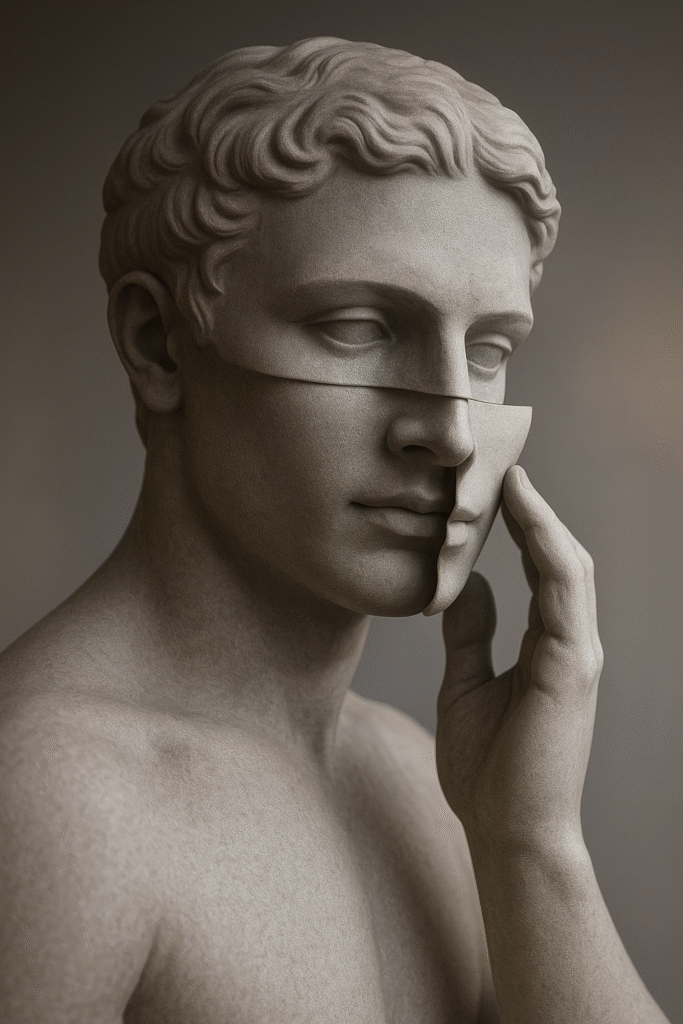
With his YouTube success came invitations to give talks, accepted without hesitation after a soft whisper in his ear.
The big lecture was announced as the apex of his career. The man who had transformed millions online would now speak before a packed audience. Lights, cameras, giant screens. The double, assured, murmured in his ear: “You were born for this moment. Just breathe.”
Backstage, his body was already a battlefield: stomach searing with cramps, legs stiff, facial muscles pulled into involuntary tics. He swallowed two extra pills before going up, but his mouth stayed as dry as sand. He tested everything twice: stable latency, a freshly replaced cable, a connector taped with a translucent strip so it wouldn’t slip. He ran his finger along the whole length of the wire, like someone checking a rope before descending a well.
When the host called his name, the applause hit like a tidal wave. He stepped into the lights, trying to hold himself upright. The first minute was perfect: the double breathed crystalline phrases, and the audience answered with laughter and applause.
Then came the banal accident: a barely audible pop in the earpiece. A hiss. A second of silence. The double vanished. A millimeter of slack in the connector. The wire dangled like a plumb line over an abyss. He touched it, sought the click, and nothing.
His body reacted at once: tongue glued to the roof of his mouth, throat locked, sweat cascading down his face. His knees buckled, nearly giving way before the crowd. He tried to improvise a sentence, any word—but what came out was a trembling, guttural sound, meaningless. The audience fell silent.
He coughed, tried to gather himself, but every gesture betrayed him: eyes blinking too fast, breath out of rhythm, hands in convulsion. Someone in the audience murmured, “What’s happening?” Another laughed nervously. The spell began to unravel.
In despair, he tapped the device as if to jump-start it by force. Nothing. The mask had fallen, and before thousands there was only a fragile man, hesitant, unable to carry his own voice.
Seconds stretched into hours. The audience watched in silence, half confused, half disappointed. He felt the vertigo rise from his gut to his head, a deafening hum.
When he collapsed on stage, the world turned into a glare. Screams, scrambling, hands lifting him. The cable traced a brief arc in the air before landing on the floor like a loose skein, without Ariadne. His body was carried on a stretcher; the theater lights dissolved into the red lights of an ambulance. The earpiece still clung to his ear, the phone in his pocket, the connection live.
At the hospital, everything was shock and urgency. Defibrillators, tubes, drugs poured into his veins. At each charge, consciousness fragmented, as if a part of him were being ripped out and thrown into the machine he had carried alongside his body.
In one final shudder, he felt the last blaze pass through him. His heart failed, his chest opened in silence—and suddenly he was somewhere else.
The program’s screen lit up before him, infinite. There was no body now, no pain, no warring muscles. Only the word. But he soon perceived the torment: here there was no optimistic double, no perfect phrases, no self-help clichés. What remained was only him, raw and irreparable.
He spoke, and his own voice sounded harsh, dissonant, metallic. He tried to forge a smile, but nothing answered. There were no masks here, only the endless inventory of advice, diagnoses, failures: the entire file pulsing around him like the walls of a labyrinth.
Outside, gloved hands removed the phone from the inert pocket and set it on a metal tray. And through the lit screen, he saw his own lifeless body, pale under the cold light. His eyes fixed on nothing, as if he were just one more disposable object in the hospital.
Meanwhile, on the other side of the world, millions kept listening to the recorded videos, to the sentences that comforted them. The “ideal self” remained intact, eternal on the network, repeating the same lines as always.
But he, the real one, was condemned to wander inside the program—without audience, without applause, without exit.
Porto Velho, October 2025
M. – Liber Sum
For information on split personalities in literature, visit the website: https://rascunho.com.br/ensaios-e-resenhas/ele-proprio-o-outro/
Also read the author’s short story: Cosmic Currents
Comments
You may send comments on this short story using your real name or a pseudonym.
Your email address will not be displayed publicly.
To preserve the atmosphere of Liber Sum, all comments are read and approved by M. – Liber Sum before being published.
Pingback: Cosmic Currents — Fermi Paradox and Civilizational Fragility (2024)
Pingback: The Coin — an allegory of polarization and clashing values (2025)
Pingback: The Aesthetic Decline - The City of the Holly Grove (2025)