
In Amerindia, a modern empire tries to reconcile war, efficiency, entertainment, and forgetting. But every named death exacts its price.
Indeed, Amerindia is a rather singular country.
It is inhabited by a warlike people who have been involved in many wars, some of them quite large. And here its singularity already begins: they are so warlike that they have never allowed other peoples to wage wars within their territory. They only allow themselves to wage war against one another. Once, they fought so fiercely that they nearly split in two.
There, people are not in the habit of enacting many laws; they prefer custom.
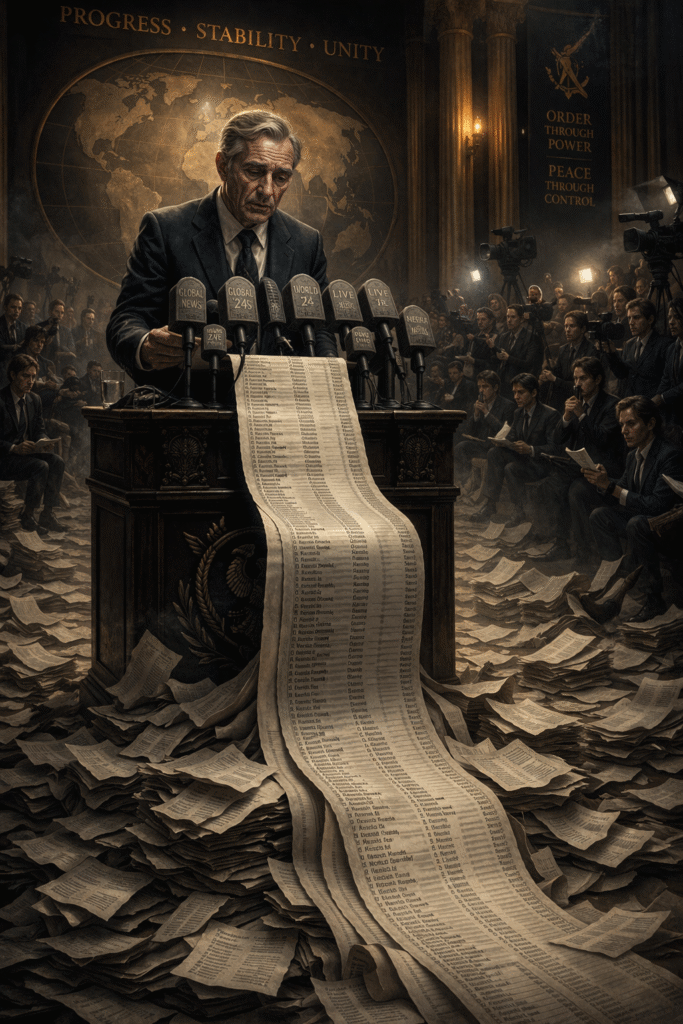
Thus, I do not know whether by law or by custom, but after so many battles a singular rule was created: whenever a president of Amerindia orders its powerful armed forces to attack a target, he is required, once the special operation is over — that is what they call these interventions — to hold a press conference and read out the names of all the people who died in the conflict.
Shortly after the rule came into force, a somewhat embarrassing situation arose. The president of the time made a very precise calculation: if he attacked Susiania, he would prevent the country from developing weapons capable of threatening the world order and would also overthrow the tyranny that ruled it. The main objective, however, was something else: to create serious obstacles to the Middle Empire — Amerindia’s chief rival — securing its energy supply.
The special operation was precise, with few casualties from Amerindia, but many on the attacked side.
During the mandatory press conference, the president began to spell out the names of the dead. They were difficult to pronounce in his language. Sweat came, then fatigue, and his voice began to fail. At last, he lost his patience and shouted at the top of his lungs: For God’s sake, in the next operations, kill fewer people!
The reaction was not very good, and from then on he authorized no similar operations until the end of his term, nor did he even run for reelection.
Presidents elected afterward were intimidated by that episode and became more restrained, practically authorizing no new operations.
But time passes, and little by little everything is forgotten, especially what disturbs us.
Other presidents took office and were not so restrained, though they always demanded the lowest possible number of casualties, so that their press conferences would not drag on for too long.
Then a new rule appeared — do not ask me how — at press conferences: journalists could ask the president to tell the story of one of the enemy casualties.
Thus, in every special operation, the intelligence services were required to prepare detailed reports on every person killed, since they did not know which one would be chosen by the journalists for the president to perform the singular ritual of telling that person’s story.
Then came an operation in a narrow strip of desert territory, with hundreds of victims named one by one by the president.
A journalist then asked for the story of a sixteen-year-old casualty. The staff quickly handed the dossier to the president, and he began reading the life story of one who no longer had a life.
There was nothing special about him. He had an ordinary life, like any sixteen-year-old in Amerindia, with siblings, parents, grandparents, uncles, aunts, and cousins. The president himself had an eighteen-year-old son whose story was very similar to that of the young collateral casualty of the attack. In a slip of the tongue, the president called the dead boy by the name of his own son. His eyes filled with tears as he narrated the moment when the parents buried their son, with relatives gathered around them.
He thought of his wife, his children, and his relatives at that funeral. He imagined his own son, in a suit, lying lifeless in a coffin.
He did not finish reading the story. Those nearest to him heard him say, with his hand covering the microphone and pushing it away, as he turned his face aside and lowered his head slightly: My God, what have I done!
He then abandoned the press conference, which had to be concluded by the spokesperson.
The result: special operations ceased during his term — and so did his political career.
From then on, the press office, based in the presidential palace — known as the Diaphanous House — began to control the narrative of these stories, so that they would not be too dramatic.
Furthermore, there was suspicion that some members of the intelligence services and the military did not look favorably upon most special operations, for they did not enjoy meddling in foreign affairs and wanted to use their forces only to defend their own territory.
But presidents needed great effort to get elected, and part of that effort was borne by devoted campaign supporters, many of whom liked these special operations. Presidents did not want to be ungrateful to people who had helped them so much.
In short, it fell to the press office to make the stories of the dead “on the other side” more palatable.
These advisers were very efficient at their work. One example will show just how much. They had to deal with a pregnant woman killed in a hospital being used as a hideout by a terrorist group that tormented a neighboring country allied with Amerindia.
The situation was somewhat complicated because the military did not provide them with very relevant information. They merely said the operation was justified from a military standpoint, since it was the terrorists’ responsibility for having deliberately chosen a hospital as their hideout.
“How so?” said the official journalist. And she added: “Those calculations of yours may be perfect for justifying an attack, but they are a disaster before journalists at a press conference.”
In the end, they managed to polish the story so thoroughly that the journalists did not even notice that tragedy. They ended up choosing, for the president to speak about, a preschool teacher who had died in the same hospital.
After telling his story, the president took a liking to him and thought to himself: Well, I could easily have gone fishing with that fellow and had a fine barbecue with him on the weekend.
One president, prodigal in ordering attacks, as well as delighting in raising walls and increasing tariffs, grew tired of bearing alone the ritual of reading the names of the dead and their stories. So he decided to share the burden with the press.
Although there was no custom there of legislating about the press, he decided to create a law, since he considered respect for tradition to be nonsense.
So the press also became required to count the dead in every report it produced, not only about wars and military operations, but also about any accident or natural tragedy.
The obligation to tell the stories of the dead was set at 10% of the total. The people of Amerindia are practical and fond of the exact sciences.
The president laughed at the reports, with their endless lists of names and stories.
Once, in a meeting with his press office, he remarked that he could hardly wait — he was speaking while rubbing one hand against the other — for a great tragedy, something like a tidal wave in Southeast Asia, just to see what the reports would be like about thousands of dead.
That was a bit too much for his chief adviser — who often lamented the fact that her boss had, in her words, “the sensitivity of a backhoe” — and she immediately resigned, claiming that those calculations were making her somewhat mad and that she intended to emigrate to another country, where she would seek to recover her nearly lost sanity. And so she went to live in Costa Rica, because it too was a singular country: for decades, it had dispensed with armies.
And the wars and military operations continued at full steam under that president.

But let us leave wars aside and speak of more amusing things, not least because Amerindia is prodigal in amusement. Indeed, it has many spaces dedicated to that end, which there are called amusement parks.
Perhaps because of its warlike spirit, Amerindia needs so many amusement parks. A people who publicly count the dead of their wars must forget as quickly as possible that they ever existed.
And this is another of its singularities: despite having the largest and most beautiful amusement parks in the world, as well as many other spaces devoted to entertainment scattered in abundance across its immense territory, it appears to be remarkably lacking in happiness.
I have never understood this very well, but I think that a practical and warlike people like that does not intend to occupy its precious time with happiness — happiness requires delay, interiority, and some risk; amusement does not.
Moreover, since everything in life requires its opposite — for if there is to be light, there must be darkness to be illuminated — happiness also needs its opposite. So, in order not to run risks or lose time, perhaps the people of Amerindia leave aside that nonsense of happiness and unhappiness and prefer to anesthetize themselves with amusement.
Singular too are its restaurants and its food. At the same time that it has several of the best restaurants in the world, the people of Amerindia have one of the worst diets I know on this vast planet.
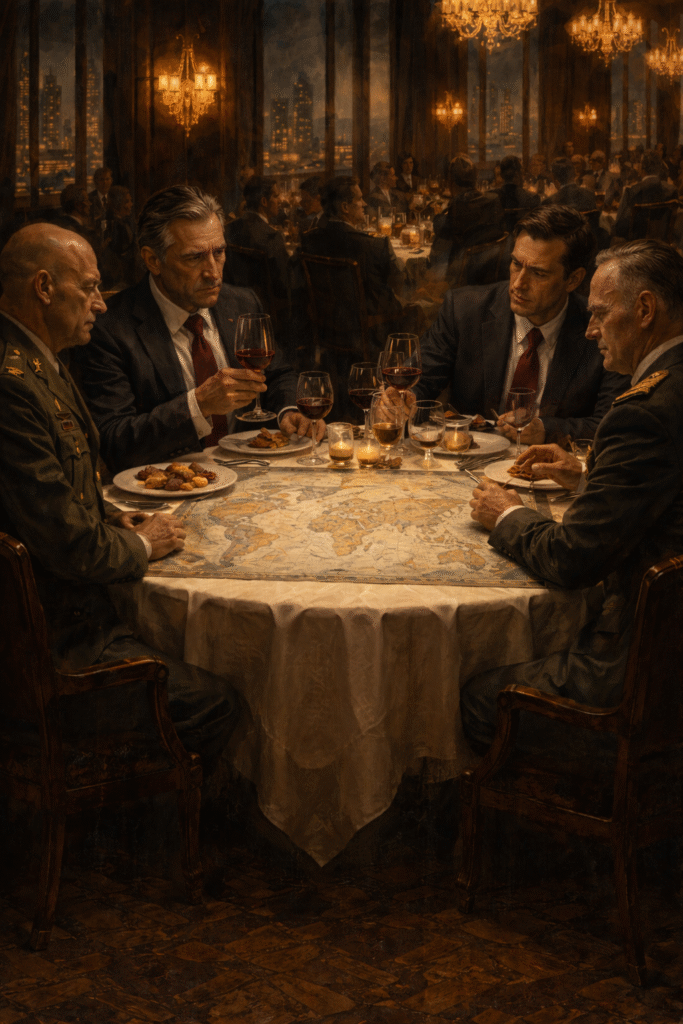
The Lords of War are frequent patrons of those fine restaurants. In this they differ from most people in Amerindia, for they appreciate good food. It is true that only they, and a few others, have the time and money to pay the bills at those expensive establishments.
The majority, whether by custom, taste, or price, prefer the quick and cheap food of fast-food chains.
It is indeed strange that a people so advanced, so technological, with some of the best universities in the world at its disposal, should be so primitive in the act of eating: in this respect, they seem still to live on the merely biological plane — they eat only to satisfy hunger.
I have traveled much throughout this world, and in most countries the act of eating is a true celebration, not a practical and merely biological gesture.
But a people accustomed to war learns early to value speed, results, and efficiency. Perhaps that is also why they eat as if fueling a machine.
And, thinking better of it, even in this the people of Amerindia prove cleverer than other peoples. In order to wage so much war, they need those who propose and organize it. Those who propose and organize it need reflection, not haste. And there is no better place to reflect than a good restaurant, drinking good wines — but they are expensive.
So it happens that the few who can afford them are those who reflect, while those who eat like machines are better adapted to battle, not least because one cannot eat so well or drink fine wines in the middle of a battle.
In short, one can see how practical they are in everything they do.
And so, amid fast food, much amusement, and press conferences, will this modern empire march down the same road as all the others that preceded it in command of the world? Will it make that journey alone, or will it drag us all along with it?
Porto Velho, April 2026.
Libersum
This story also echoes a moral intuition championed by Every Casualty Counts: the dead of war should not be reduced to statistics — names, not numbers; people, not collateral. In this narrative, that principle becomes an imperial ritual: whoever authorizes death must also pronounce it.
Also read by the author: THE COIN – an allegory about political polarization.
Pingback: Kiko, the Madman — Memories of a Small Town – 2026
Pingback: The Selection (The National Team) – 2026