
Caio had everything his legal career had promised him: a partnership in a large law firm, a comfortable life in São Paulo’s Perdizes neighborhood, a secure future. Until the day he simply abandoned everything and became a road wanderer, walking westward along BR-364 toward a lost kilometer where his silence began to say more about us than about him.
In little more than ten years of practice, Caio had already achieved everything he had ever wanted in the law: he was a partner, albeit a minority one, in the major firm where he had started as an intern; his income far exceeded his expenses; he had an apartment in the neighborhood of Perdizes; a new car; beautiful girlfriends. He believed it had all come too soon. He had calculated that it would take him twenty years to reach the position he now occupied, and this delighted him.
He arrived at the office, on Paulista Avenue, at around eleven o’clock, after yet another successful hearing in a major corporate case.
At 11:30, he went downstairs with his briefcase and began walking along Paulista Avenue. His secretary noticed nothing unusual, except that he had gone out to lunch earlier than usual. She attributed it to the resounding success he had achieved in that substantial case, whose outcome was awaited with great expectation by the senior partners.
He simply went on walking, wholly absorbed in his journey.
A boy bumped lightly into him and ran off with his briefcase. Caio gave a faint smile at being rid of that dead weight.
He entered the Santa Cecília neighborhood. A young man on a bicycle accosted him aggressively, pointing a knife at him and demanding his watch.
Caio handed over that expensive object, now utterly useless to him, laughing as he did so, for it served only to count hours and days.
The thief rode away with the watch, thinking to himself: “Madman.”
Caio kept walking steadily and entered Pirituba, already on the outskirts of the city. There he was approached by two men on a motorcycle. The passenger, gun in hand, demanded his wallet and cellphone. He handed everything over in an orderly fashion, but let out another burst of laughter, which earned him a blow to the forehead with the butt of the gun.
He continued walking, undisturbed by the blood streaming down his face and staining his clothes.
The blood had to content itself with clotting on its own, without the help of medicine or even a hand pressing the wound to stop the flow.
With the cut still open, he crossed streets and intersections without even slowing his pace to look at the traffic. Insults, horns, vehicles braking and swerving sharply so as not to run over that resolute pedestrian, obstinate and indifferent to the movement of the city: nothing shook him. It was as if he were invisible to everyone, and everyone — with all their rules — were simply invisible to him as well.
Night fell, and he kept moving in a straight line, without the slightest fatigue.
He took the road toward São José do Rio Preto and walked until late into the night. His legs faltered, and he lay down right there, by the side of the road, to sleep. His suit became his pillow.
He had not had such a peaceful night’s sleep in years.
He had become a road wanderer!
He woke with the sun and resumed his journey. Water never failed him, whether from rain puddles or from stops at houses, repair shops, and tire shops. As for food, he took whatever he found along the way.
He found nothing strange in the fact that he always managed to get water when he was thirsty and something to eat when he was hungry.
He walked under the sun, sought shelter when it rained, and slept in the open whenever he felt tired.
His hair and beard were now long, his skin parched, his rags no longer remotely resembling the fine suit he had worn for the last time when he entered Rondônia by way of BR-364.
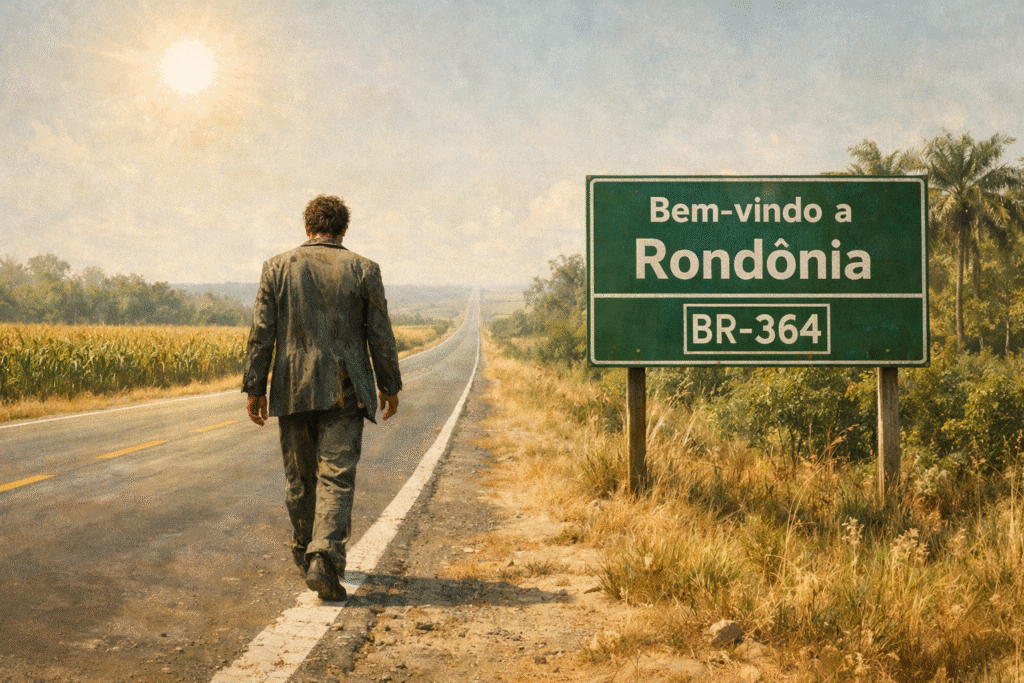
When he reached kilometer 840, between Porto Velho and Rio Branco, he had an epiphany: if he reached kilometer 841, he would die immediately; the same fate awaited him if he went back to kilometer 839.
He settled there, determined to stay, after so many years of stopping only at night to sleep.
It was July. The sun was relentless. There was no human presence nearby. No dwelling. On one side of the road, juquira — as people in that region called the wild scrub growth; on the other, a marshy area, now almost completely dried out by the Amazonian summer.
He made himself a small hut with pieces of wood and thatch, and gazed at the horizon.
Before long, a vehicle stopped and left him a good amount of food.
He went to what remained of the marsh and drank water, after pushing a little mud aside with his hands.
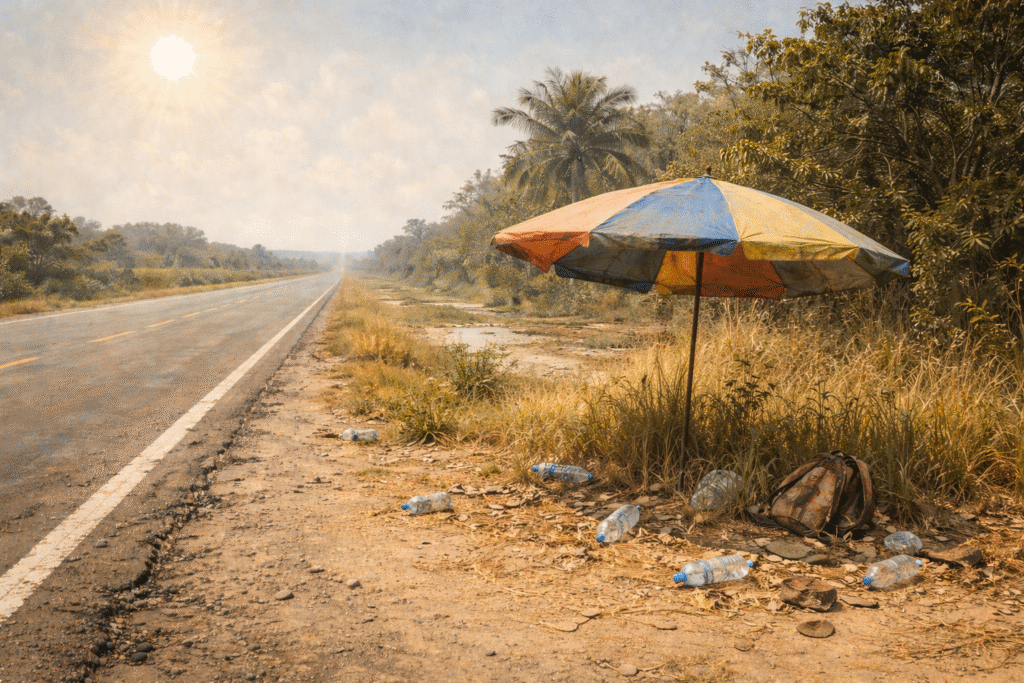
He slept peacefully, as always. When the sun rose, he remained there, seated in his improvised hut. Another car stopped, and he was given a beach umbrella.
And so followed several nights of good sleep and days of fierce sun. Some car would always stop and left bottles of water, food; he was even given cachaça, as well as clean clothes, medicine, books, prayer cards, cigarettes, small electronic devices, little notes with advice. Except for the water and food, he left everything else in a corner, until it was lost in the dust and the juquira.
When they asked him what he was doing there, he merely repeated his epiphany. When they asked his name and where he came from, he only made a questioning face, shrugged, and said nothing.
A wealthy rancher from the surrounding area, after making a great deal of money from the compensation paid for his lands because of the flooding caused by a hydroelectric dam, had the brilliant idea of giving the road wanderer a gift, “anything at all, regardless of the price.”
He announced his beautiful plan on every social media platform and went to meet the wanderer, now stationary. The wanderer was admiring the sunset when the rancher disturbed his silence with the noise of his very expensive pickup truck. He got out, placed himself between the wanderer and his view of the sun, and said:
“I want to give you a gift. Ask for whatever you wish.”
The Cynic spirit of Diogenes1 seemed to descend upon the wanderer, who replied:
“Give me back my view of the sunset and get out of here.”
The rancher left sad and ashamed, understanding nothing. He thought: “There is no point in trying to help these people. They do not know how to value things.”
The wanderer returned to his silence. Night came. He was sleeping peacefully when he was awakened by the rare song of a uirapuru2. He listened attentively to that melody when thunder began, announcing the change of season, despite the clear sky. Two shooting stars crossed the heavens, tracing movements like a cross. He felt a shiver run through his entire body, and a renewed sensation of freedom took hold of him. He thought: “Time to leave.”
The next day, a couple from Guajará-Mirim were in a supermarket in Porto Velho, buying products difficult to find in their own town. As they were already heading toward the checkout, their little girl pulled at her father’s jacket and said:
“Daddy, the food for the ‘uncle’ on the road.”
They went back to the aisles, picked up a pack of mineral water and some provisions.
When they stopped at kilometer 840, they saw only the beach umbrella and old odds and ends. Another car stopped, and then another, also carrying provisions.
Everyone was surprised by his absence. They made a brief search of the surrounding area, but found no sign of him.
One by one, they returned to the road, hoping to see the familiar wanderer walking along the shoulder.
No one crossed paths with him. Each went on to his own destination: Guajará-Mirim, Vista Alegre do Abunã, Extrema, Nova Califórnia, Rio Branco, ranches in the region. All with the same feeling of emptiness.
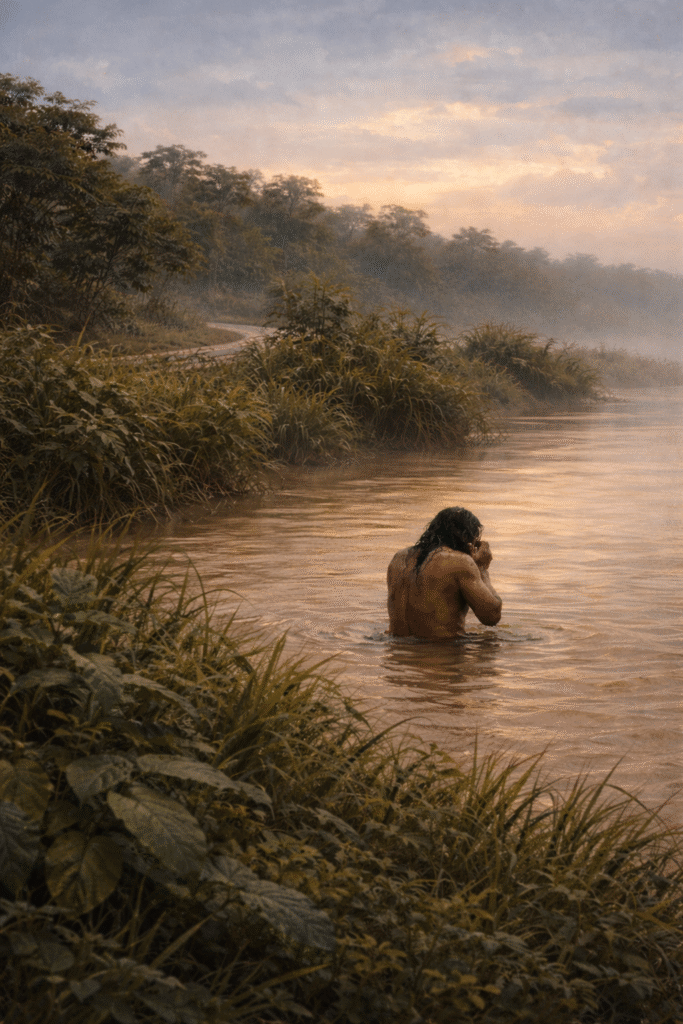
That same day, after a few minutes of walking at sunrise, without meeting a living soul, at a point where BR-364 comes close to the Madeira River, he decided to bathe and drink from the river, far from everyone’s eyes.
In Porto Velho, people say that whoever drinks the waters of the Madeira always returns.
No one ever knew, afterward, from where he would return — or where he had gone.
Porto Velho, February 2026.
Libersum
Also read the author’s short story: THE GAIA HYPOTHESIS – a cosmic report in which Earth, humanity and time are examined from the archives of the Universe.
Geographical note: The story moves across two sharply different Brazils. Perdizes and Paulista Avenue evoke São Paulo’s world of professional success, law firms, property, traffic and status. From there, Caio passes through Santa Cecília and Pirituba, tracing a gradual descent through the social geography of the metropolis — from affluent and central spaces toward older districts and the outskirts of the city. São José do Rio Preto, in the interior of the state of São Paulo, marks the beginning of his passage into the long inland roads of Brazil.
The second half of the story unfolds in Rondônia, a state in the western Brazilian Amazon, along BR-364, the highway that connects Porto Velho, the capital of Rondônia, to Rio Branco, the capital of Acre. Other names mentioned — such as Guajará-Mirim, Vista Alegre do Abunã, Extrema and Nova Califórnia — refer to municipalities, districts or localities in that Amazonian road universe: places of highways, forest edges, rivers, migration, distance and sparse settlement.
Note on the Brazilian road wanderer:
The Brazilian andarilho has no exact equivalent in English. In this story, I use the expression “road wanderer” to preserve something of that specific figure: a man of the highway, living between towns, gas stations, truck stops, bridges, forest edges and silence.
There are partial equivalents in other English-speaking cultures. The American hobo evokes the itinerant poor, historically associated with trains, migrant labor and the long mythology of the road. The British tramp is an older and often pejorative term for a wandering homeless man. The contemporary British expression rough sleeper emphasizes homelessness and sleeping outdoors, but not necessarily movement. The Australian swagman, made famous by the folk tradition of Waltzing Matilda, suggests the itinerant worker of the rural interior, carrying his belongings on the road.
The Brazilian andarilho, however, is not simply any of these. He is less a tourist, less a pilgrim, less a beggar, and more a marginal figure of the road itself — someone who has left behind the settled territories of home, work, family and civic identity, and who moves through the country as both presence and disappearance.
Notes for English-speaking readers:
For readers unfamiliar with Brazilian roads: “BR” is the official abbreviation used for Brazil’s federal highways, followed by three digits. In form, it may be roughly compared to an American “Route,” as in Route 66, or, for British readers, to a numbered A-road or motorway. But the comparison is only approximate. “BR-364” is not a poetic name; it is an administrative road number. In the Brazilian interior, however, some road numbers acquire a symbolic force of their own.
BR-364 is one of Brazil’s great interior highways. It links the Southeast to the western Amazon, running from the state of São Paulo toward Acre, near the Peruvian border, and passing through regions such as Mato Grosso, Rondônia and Acre. In the story, the road is not merely a route: it is a line of migration, expansion, solitude and disappearance. Other Brazilian highways have acquired a similar symbolic weight because of their scale and historical role, such as BR-116, the country’s longest paved highway; BR-101, which follows much of the Atlantic coast; and BR-230, better known as the Trans-Amazonian Highway.
To better understand BR-364 itself — one of Brazil’s great interior highways, running from São Paulo toward Acre and crossing regions such as Mato Grosso, Rondônia and the western Amazon — see this introductory reference on BR-364.
For a broader view of Amazonian roads and their historical, environmental and symbolic weight, see the Encyclopaedia Britannica entry on the Trans-Amazonian Highway, one of Brazil’s most ambitious and controversial road projects.
On the Brazilian figure of the road wanderer, see “A man on the road,” published by Pesquisa FAPESP, about the work of psychologist José Sterza Justo and his long study of homeless wanderers and itinerant workers who travel along Brazilian roads.
- For readers interested in the philosophical anecdote that inspired this episode — the meeting between Diogenes of Sinope and Alexander the Great — I recommend the classical account in Diogenes and Alexander. ↩︎
- The uirapuru, often identified in English as the musician wren or organ wren, is a small Amazonian bird famous for its elaborate and haunting song. In Brazilian folklore, its song is surrounded by legends: it is said to be so beautiful that the forest falls silent to hear it. In this story, the uirapuru is not merely an ornithological detail, but a sign of passage — a rare voice of the forest calling the wanderer back into movement. ↩︎
To learn more about the uirapuru, the Amazonian bird traditionally associated with one of the most beautiful songs of the forest, see this English-language introduction to the musician wren.