
The Gaia Hypothesis is a story in the form of a cosmic report. In it, scribes of the Universal Library examine Earth, humanity, the Nephilim, and the strange human fiction called time.
Universal Library
Type 01 Planets Section
Planet no. α⁻¹(0) ≈ 137.036
Current evolutionary scale — continuous index of energy use: K ≈ 0.7.
Current endonym: Earth.
Species still planetary, without full control of its own biosphere or of the systems responsible for its stability.
Location: Solar System · Milky Way · Orion Arm (Local Arm/Orion–Cygnus) · Local Group · Virgo Sector (Laniakea Supercluster).
Introduction
This report is submitted to the Council of the Universal Library1, Type 01 Planets Section. The data that follow summarize civilizational cycles, with emphasis on the seventh industrial civilization.
The report contains essential information about the human species and shall be distributed to each voting Councilor for attentive reading in preparation for the ordinary meeting at which the Council will deliberate on whether or not to maintain the veto on interventions in planets whose most intelligent species still remains at an archaic stage of development.
Since it is in the nature of every native of the planet Litterae — responsible for the curation of the Library — to prepare reports without omitting the picturesque and revealing elements of each planet’s culture, and not merely its objective data, we ask in advance to be excused for occasional poetic license, idiosyncratic assessments, or excesses of language. If such a procedure causes us to incur some lack of objectivity, it at least spares the text a certain documentary dryness — we hope we are not mistaken in this.
The reading of these reports is mandatory for every Councilor, owing to the inherent block in our archives, which prevents their direct discharge into the organs or devices of thought of each species.
We thank you for respecting this ancestral practice of ours, which requires the actual reading of our reports, and we entreat that this block never be lifted, although we acknowledge that many Councilors have resigned their posts precisely because they never became accustomed to this somewhat primitive mode of reading. Hence our constant effort to make our reports as interesting as possible to the reading organs of each species.
It is the small price we charge for granting access to the highest reading technology in existence: the reading of information produced by the Universe. No one is better suited than we, of Litterae, to condense almost an infinity of information in the form of a report, with impartial interpretation of the data and fidelity to the rule according to which not every correlation implies causation.
We do not ignore that, at certain points, this report departs from merely informational nakedness and assumes an essayistic form. Certain objects of study, especially when deprived of equivalents in other archived worlds, resist simple description and require commentary, interpretation, and at times some written perplexity. The human experience is especially fertile in this kind of demand.
It is also important to record that our works are written simultaneously by thousands of scribes2. We seek to preserve unity and cohesion in the text; nevertheless, there remain, at times intentionally, at times inadvertently, discreet nuances of stylistic divergence. Only extremely capable readers will perceive them. We leave them the challenge.
As we write this document, the Community is composed of 144 civilizations. All follow the universal rule of not intervening in any planet not yet integrated into the Community, under any circumstances — and much less by delivering technology.
Our Library abundantly documents the emblematic case of the planet Reichar, constituted by an eminently warlike civilization which, on the threshold of extinction, was benevolently aided with technology from the planet Genevia.
The price of that altruism: the warlike civilization rapidly absorbed the alien technology, reached neighboring planets, and, as a result, enslaved entire civilizations, exploited natural resources without restraint, and destroyed every species it considered inferior. In the end, an entire planetary system was condemned to extermination.
The danger was not greater only because containment forces kept the Reichar within the limits of their own system.
Several studies indicate that humans are as warlike as the Reichar.
Technology must advance step by step with the other aspects of civilizational development. The natural process of every planet accepted into the Community consisted of a continuous reconfiguration capable of leading it to the technological stage that grants unrestricted access to the information definitively registered in the Universal Library, as well as contact and experience with all forms of life, in any places in the Universe. The other requirement is the sustainable development of life, without risk to other species.
It is a rule of the Universe: the intellectual conditions necessary for a civilization to reach, by itself, a technological development like that of the 144 civilizations of the Community necessarily presuppose a pattern of development in other realms of the intellect that prevents it from using that same technology for the destruction of any form of life. It is an evolutionary virtuous circle.
To compare an intelligent being from one of these civilizations to a human would be like comparing that same human to a terrestrial amoeba.
Although this mechanism of the virtuous circle is still not fully understood, not even by the most advanced civilization in the Universe, that is how things work.
This mechanism reinforces the Gaia Hypothesis, for everything indicates that planet Earth appears to maintain some imperfect connection with this universal wisdom, since it repeatedly extinguishes the civilizational formations it engenders when they seem to drift too far from the original model, degenerate, spiral out of control, and become a threat.
Indeed, the human species has not left the viral phase in any of its seven civilizations, for it understands development as something very similar to the functioning of an infection: it dominates all biological life around it and consumes it to the point of extermination, thereby also leading to its own dissolution for lack of a host.
Nevertheless, it is necessary to consider the possibility of correcting this failure: to analyze whether an eventual intervention could be made without greater risks, after the traumatizing lesson learned from planet Reichar.
Thus, it will fall to the Council to decide whether some antiviral might be capable of containing humanity and whether doses, even homeopathic ones, of technology might contribute to making the human evolutionary process more complex, preventing a new self-destructive outbreak of the species.
It is not for us, mere scribes, to defend which path should be followed; it is only for us to bring to light what matters to record concerning human civilization.
Finally, it should be noted that the accounts and records in this document will be presented, for purposes of archive, scale, and intelligibility, always by comparison with terrestrial parameters, even when the data are extraterrestrial. In addition, we bear in mind the prospect that the accumulation of knowledge by Earthlings themselves may, once the necessary conditions are met, allow them to enter the Community; in that case, access to the contents of this report will be useful for a more exact understanding of their own evolutionary construction.
Any reader may convert spatial measurement data — whenever present — into their own parameters using the universal formula contained in annex 3.1.x.a.
The Gaia Hypothesis
Of all the planets in the Universe, Earth has the greatest biodiversity.
In truth, by itself it almost equals the sum of the life forms on all the other trillions of inhabited planets. Therein lie both its blessing and its curse.
Abundance generates excess, waste, collision, and, repeatedly, mass extinctions.
On certain planets, where life is more placid and measured, it reconfigures itself without major convulsions, with gradual advances and retreats in the accumulation of transformations. On some, this slow progress, since the initial explosion, generated species still embryonic; on others, only cells that have not yet managed to join efficiently with other cells. There are planets with more complex forms of life, even with a little intelligence. On others, evolution went somewhat farther. And there are a few whose slow and uninterrupted evolution produced highly developed beings, the most advanced in the Universe. For such beings, the Cosmic Current3 ceased to be merely an archive: it also became a path of appearing. They do not travel as humans would travel. With exceedingly refined technology and extreme mental discipline, they are able to consubstantiate themselves at a distance as spectral presences, with sufficient adherence to the observed world to move discreetly within it, under suitable disguises, without entering it fully. And, among all worlds, none attracts them as much as Earth. Its singularities draw the attention of these civilizations, which have little left to discover in terms of recordable knowledge, yet remain attracted to what no archive can deliver in full: life in a state of prodigality, collision, waste, and reinvention. Among all the zoos in the Universe, this one remains the most visited.
The most advanced civilization of all developed the theory that planet Earth is a singular living being, generator of all the life that inhabits it. This is the Gaia Hypothesis.
It was accepted by the Community of Sustainable Life Planets — composed, on the scale adopted by this report, of the 144 planets that have already overcome the dilemma of space travel and live without causing existential risks either to themselves or to other civilizations — but not without reservations. Some still demand further proof, and, since the Hypothesis was formulated, visits to the little blue sphere lost in a remote corner of the Milky Way have intensified.
Some data strongly support it.
The present terrestrial industrial civilization is the seventh.
A nearly mathematical rule has already been observed: life emerges, multiplies into diverse species, the human species develops intelligence, founds an industrial civilization, builds weapons of mass destruction, and ends up extinct in a cataclysm caused by those weapons, making life impracticable. Once the conditions of extinction are undone and the necessary transformations have occurred, the cycle recomposes itself.
One of the current theses in the Library’s debates is that this pattern is not a mere succession of accidents, but an extreme form of planetary self-regulation. Gaia engenders life in abundance; this life, however, at a certain point escapes control, spreads into every corner, and converts intelligence, technique, and expansion into systemic risk. When Gaia feels that life has drifted too far from the original model, threatening the deeper balance of the planet, she puts an end to the deviation, operating a kind of “reset.” Once the system has been purified, she casts a new seed and reinstates the cycle of syntropy. Some scribes maintain that Gaia fears entropy more than she understands order: she does not preserve the part; she prunes it to prevent the ruin of the whole and to save the planet’s matrix syntropy.
What is this original model on which Gaia relies in each new reinstatement of the cycle? No one knows. Some scribes suspect that one of the 144 civilizations supplies such a model. But there is no consensus on this accusation, given the absence of proof. There is not even consensus on whether it would in fact be an accusation, should such proof be found.
There are not many interesting facts to record about the first, second, and third civilizations, beyond their following the rule of birth, maturation, and extinction.
Everything passed monotonously in the first three — as in happy families. The next three were more frantic, each in its own way — like unhappy families, to use the formula of a terrestrial scribe with a leonine name.
For the purposes of this archive, the data concerning the first three civilizations are deemed consolidated, with technical details referred to Statistical Dossier 01:03. The main body of this report will be limited to recording the relevant occurrences from the fourth to the seventh civilization, with greater emphasis on the seventh, since it is the only one still in transformation, unlike the others, already erased and no longer susceptible to intervention.
In all seven civilizations, the most intelligent species to develop was always very similar. Apart from minimal genetic differences, they were always hominids, mammals, bipeds, with a relatively short biological life expectancy. We shall always call them “humans.” And their collective, humanity.
They are born, grow, and die in relatively complex societies, sufficiently organized to produce language, technique, war, memory, and self-deception.

Episode: Two Human Species Share the Same Territory
From the recomposition of the fifth civilization emerged the sixth — precursor of the present one. Since ruins of the erased civilization still survived — a unique case since the beginning of this flow and reflux of life and civilization — this new seed found more favorable conditions for germination and carried within itself the germ of concern for permanence.
Yet it relapsed into the logic of the others, as if it too were trapped in the vicious circle of the erased civilizations.
Some of the more cautious, however, created bunkers in an attempt to preserve the species.
There were several across the planet, but only twelve proved efficient after yet another nuclear cataclysm — expected, repetitive, swift, and devastating: six in the region that the natives of the seventh civilization call Mesopotamia, three in the region where Ancient Egypt was established, and three others in the region that, for the purposes of this report, we shall identify as Rome.
Those interested in delving further into Mesopotamia, Ancient Egypt, and Ancient Rome should consult Report 3.x.e.
This last cataclysm was lethal, but less drastic, since the bombs were made with radioactive materials of shorter half-life. Thus, relatively few transformations were required for life to return.
Some artifacts and constructions from that civilization still remain scattered across the planet, almost always shrouded in mystery and legend. [See Annex 3–A: Catalogue of archaeotechnical remnants of the sixth civilization.]
The presence of these remnants reinforces the suspicion that Gaia intentionally leaves vestiges of erased civilizations, as well as fossils of gigantic animals and of already extinct hominids. It is as if she kept, in some secret archive, remains from different cycles — civilizational, biological, and mutational — and then cast them randomly across the planet, in order to confuse the rising species about its origins and its own processes of transformation.
Nor are there lacking indications that visitors from other systems, availing themselves of the relative proximity of their worlds to Earth, came to it in a denser manner than cosmic prudence would authorize, always without announcement, without official record, and without full assumption of authorship. The traces of such imprudences, when they survive, mingle with those produced by Gaia and tend to dissolve into myth, ruin, or delirium.
A few survivors left the bunkers, which had been conceived to preserve life under extreme conditions, not to serve as permanent dwellings. Outside them, they found abundant life and still rudimentary signs of human intelligence. Integration proved impossible. They therefore organized isolated nuclei, preserved as much as they could of the remaining technology, and kept the ascending species under discreet observation.
Between their departure from the shelters and effective contact with humans, there stretched a long zone of silence. The survivors remained at the margins of human formations, following only their signs of densification: more stable language, worship, sedentarization, collective memory, and the capacity to convert astonishment into symbol.
In the nucleus located in the region identified, by terrestrial parameters, as Rome, contact with the local inhabitants remained incipient, always surrounded by prudent distance.
The pattern was similar in the Mesopotamian nucleus. There, however, when the humans of the region already displayed language, elementary forms of worship, embryonic social organization, and some capacity for symbolic assimilation, the approach became more intense than in the Roman nucleus. This set of conditions allowed the survivors to establish more frequent contact with the locals, leading them to rapid development.
The survivors of the bunkers were tall, strong, and healthy, for they still preserved a minimum of the comforts and technologies they had taken into their nuclear shelters, especially medical devices capable of treating almost any illness.
They were soon treated as a kind of gods. In one tradition, they received the name Gilgamesh; in another, Rephaim. Books considered sacred by humans recorded accounts about them, designating them as Nephilim, a name they would eventually adopt permanently. (Accounts concerning the Nephilim may be found, for example, in the human document used by several religions of the seventh civilization and entitled the Holy Bible, Genesis 6:2–4.)
Indeed, they had a high life expectancy, owing to the biological conditions they had acquired before the cataclysm and to the medical treatments they kept secret. But as their descendants began to cross with the locals and adopt their primitive patterns of life, they began to decline and disappear within the nascent Mesopotamian society. These crossings, from a genetic point of view, were not successful, since most mixed unions were sterile or produced sickly children. Fully healthy descendants were rare.
Another portion, however, remained isolated, living as Nephilim, maintaining contact with the locals but not crossing with them. They even tried to help them, giving them a little technology and attempting to teach them incipient principles of science, but they were not prepared for more advanced knowledge.
Some of these teachings, indecipherable to the humans of the time, seem to have fossilized in obscure biblical passages. Among the scribes, some suspect that deformed echoes of once more precise instructions may have survived, for example, in the following biblical passage:
Thus the elements, changing their order among themselves,
as in a harp where the notes vary the nature of the rhythm,
while preserving the same tone.
This may be represented by observing the facts:
while land creatures were transformed into aquatic ones,
those that swam leaped upon the land;
in the water, fire increased its power,
and water forgot its power of extinction;
the flames, by contrast, did not consume the flesh
of the fragile animals wandering there;
nor did they melt the divine food — crystalline and soluble.
(Holy Bible, Wisdom 19:18–21)
The Mesopotamian Nephilim decided to seek out the survivors in Egypt, for they had received no news from them. They found, however, the three bunkers without survivors. Certainly, some localized cataclysm had occurred inside the shelters, so as not to contradict the rule.
One of the greatest enigmas for this seventh civilization is clarified here: the question of how the pyramids of Egypt were built still echoes unanswered among terrestrial scholars. In truth, they were not exactly built, but unearthed by servants, by order of the pharaohs.
Unlike the Egyptian shelters, the bunkers of Mesopotamia and Rome were progressively dismantled, concealed, or incorporated into later constructions by the survivors themselves, who carried away the usable technological cores and buried the rest beneath successive layers of ruin, myth, and human construction.
Inside the pyramids, the Egyptians found only bones and indecipherable artifacts, but they understood — intelligent as they were — that it was a capsule intended for the preservation of life. The rest of the story is already well known and documented, and there is no need to explore here matters of exclusively human interest. This also helps to explain why Ancient Egypt was far more advanced than other peoples: it managed to make minimal use of what it understood, however precariously, from the technology found in the bunker-pyramids.
Divergence note: some scribes disagree as to the degree of technological reuse; the present version follows the majority opinion of the Committee on Megalithic Structures.
During that incursion into Egypt, the Nephilic expedition suffered an attack; only two survived: Romulus and Remus.
The two decided to go to the region identified, in the parameters of the seventh civilization, as Rome, in order to visit the last set of bunkers.
Thus, on planet Earth, a unique experiment was established: two distinct human species, with absolutely different intellectual capacities, began to coexist simultaneously — although the intellectually inferior species never suspected it.
We shall now report the inevitable collisions resulting from this human duality in the seventh industrial civilization.
We shall call Nephilim the remnants of the destroyed civilization and, by archival extension, Nephilic civilization the formation to which they belonged; humans, the members of the new civilization under construction.
On one side, we shall have humans in their process of cognitive complexification, frequently sabotaged by the Nephilim, who did not trust them and feared their progress; on the other, the Nephilim themselves, who, without realizing it, sabotaged themselves, for they consumed almost all their effort in controlling humans, leaving little room for their own evolution.
Distrust seems to move many gears, not only on Earth…
The facts described here, as could not be otherwise, do not unfold linearly; they are intimately intertwined, as the transformations experienced by humans and Nephilim acquire increasing complexity. We shall therefore seek to assemble a logical scheme capable of demonstrating the various layers of reciprocal interference between the knowledge and thought of these two human species, accumulated up to the most advanced stage of improvement.
Thus, we believe the Councilors will know enough to decide whether such improvement can be increased — without risks — by measures of the Community, or whether new entirely human layers are still necessary in this system. If the latter alternative prevails, they will also be able to assess, with some degree of certainty, whether humans themselves are capable of producing such layers, or whether Gaia will have to seek another model and attempt, for the eighth time, to succeed.
Episode: The Human Big Bang
Few layers of thought were produced by the humans of the seventh civilization. The species still seemed condemned to merely biological life, at a stage only slightly superior to that of the other forms of life on its planet. Everything they produced generated little radiation and almost no lem4 in the Cosmic Current.
Even from the Nephilim, whose thought was far more sophisticated than that of humans, came only faint radiation. Their intelligence, compressed by the need for adaptation and survival within the terrestrial configuration they faced, was no longer directed toward philosophical speculation or science. They thought in order to endure, not to enlarge the real; and thought directed only toward preservation rarely produces great disturbances in the Cosmic Current.
But a decisive disturbance occurred when Thales of Miletus, in the region called Greece by the consolidated cartography of the seventh civilization, concluded that water was the underlying principle of the transformations of the visible world. The radiation generated was intense.
There occurred a profound rupture in the manner of thinking. Unlike almost all other humans, Thales did not attribute the transformations of the world to magical or divine agents. He sought within them an internal foundation, an order of their own. Thus was formed the first recognizable layer of human scientific thought.
It does not seem accidental to us that this first explosion of human thought occurred precisely when one of them sought, within the visible world, a principle of order, rather than an external magical will. There was there, still in embryonic state, more than science. There was the possibility of a mind that, freeing itself from merely biological life, might sense that its highest vocation consists in reaching broader forms of contact with the real. The human Big Bang did not merely open the path of science; it also opened, although humans did not perceive it, a remote path toward Ṛtabandhu5.
This mental explosion is the transformational milestone that most interests us regarding humans, for there erupted a chain reaction, releasing enough radiation to touch many other thinkers — Anaximander, Anaximenes, Pythagoras, Heraclitus, Parmenides, Empedocles, Anaxagoras, Democritus, Socrates, Plato, Aristotle, Epicurus, and so many others. Even so, this mental discharge did not have the power to cross the Greek horizons and infect the rest of humanity.
Our provisional conclusion is that humans, in the absence of more robust layers of organization, tend to depend on an institutionally ordered society and a strong State in order to give duration and expansion to their mental achievements. The Greeks, although extraordinary in speculation, measure, and form, remained bound to the scale of their small cities and did not fully convert their intellectual energy into lasting political force.
They were thus absorbed and surpassed by the Romans — more practical, more administrative, more suited to the construction of stable structures. Rome preserved part of the Greek spirit, but above all gave it a political body, military force, and capacity for transmission. It gave to the human Big Bang inaugurated by Thales the expansive energy it lacked.
The Romans intended to carry that energy as far as their legions could reach. But hidden forces sometimes measured it out, sometimes sabotaged it.
We must now explain the nature of those forces.

From the Birth of Rome to Caesar
Among the episodes of the seventh civilization that most concern the evaluation of the Gaia Hypothesis, the experiments conducted in the political nucleus that humans would later call Rome stand out. From there, especially after the absorption of Greece, intense radiations were captured, from which several other genuinely dependent events derived. What follows is an archival summary prepared from the structured reading of several lems, captured and condensed for the purpose of apprehending the essence of the two human species of this world, whose mental capacity appears promising.
Rome was not born by chance, but from a silent pact among survivors of an erased civilization. Romulus and Remus, Nephilic remnants from Mesopotamia and nearly killed in Egypt, arrived at the hills of Latium carrying with them the echoes of the bunkers. There, together with the survivors of the Roman shelters, they decided to found a city that would be, at once, refuge and laboratory.
They differed, however, from the beginning. Romulus wished to sedentarize the group and offer humans technology in controlled doses — walls, bridges, weapons, military medicine. The plan consisted in directing human technological development and containing it as much as possible, in order to prevent a new extinction like the one that had ruined their own civilization. Any attempt to produce weapons of mass destruction, especially nuclear devices, would be sabotaged. When humans reached a level analogous to that of the extinct civilization, but already duly contained, the remnants would integrate themselves fully into them. They would make use of their healing equipment, together with the technologies that would certainly arise, to seek genetic compatibility with humans and dissolve themselves among them, leaving only ancient legends and rare biblical echoes. Until then, they would remain in the shadows, but with the reins of civilization firmly in their hands.
Remus, by contrast — traumatized by the Egyptian experience — wished to preserve nomadism, act in the shadows, sabotage progress, and prune every bud of civilization that emerged without his permission. He did not trust humans and believed they would never become civilized. Rome was born of this tension, raised upon seven hills and upon two rival wills.
Romulus drew a Dividing Line, establishing the limit of Nephilim action. Remus refused to accept it and definitively withdrew from the group. Thus was born the legend of Rome’s Dividing Line — metaphor converted into fact in human eyes. Remus was not killed by his brother: he merely disappeared into the shadows and founded the Rebel Order.
The story of the she-wolf was likewise no more than allegory. In the pantheistic religion of the Nephilim, the family of Romulus and Remus had adopted as goddess an animal very similar to the she-wolf known to the humans of the seventh civilization. From that devotion the myth flourished.
Crossing with humans was strictly forbidden. Since they needed an efficient means of identification, the Nephilim marked themselves without a mark, using genetics: there were no coats of arms on the skin, but a seal in the helix. They called it Sigillum-XII, an ancient motif dormant in the DNA. The healing machines themselves — built to close wounds and reactivate organs — received a discreet adjustment. When activated, they called the seal by a mute name; they released a brief pulse, the whisper of a microRNA, and the body responded with a triad of signs. It was enough to say: “one of ours.” The Rebels tried to silence the seal, but whoever meddles too deeply with the helix does not return whole; they therefore gave up trying to disguise their origin.
They also possessed outward signs: rings, bracelets, cords, and other jewels, almost always bearing the image of the she-wolf.
The Roman monarchy was the visible face of the experiment. Legendary kings — Numa, Tarquin, Servius — governed under Nephilic tutelage, receiving flashes of urbanism, hydraulic engineering, and social discipline. But the Rebels, faithful to the lineage of Remus, instigated palace intrigues until the monarchy was overthrown. The last Tarquin fell, and with him the mask: Rome plunged into the republic.
In the republic, the Nephilim faithful to Romulus — henceforth called Romans — dosed advances with caution. To the legions they taught iron discipline and the art of the march; to generals, geometry applied to war; to the people, the notion of limited citizenship. Meanwhile, the Rebels breathed into the Senate corruption, clientelism, and the ferment of popular revolts, in order to keep the edifice always unstable.
Then came the Punic Wars. They gave the Romans the secret of serial naval construction, allowing them to face Carthage. But the Rebels acted on both sides: they incited Hannibal, whispered in Carthage, and balanced the game until the moment of destruction. When Rome prevailed, the Nephilim knew that the city was about to become mistress of the world.
Expansion brought wealth and ruin. The Rebels manipulated social conflicts, inflamed senators against the Gracchi brothers, and fomented slave revolts. Rome seemed to be growing beyond what the planet itself tolerated. The Romans tried to maintain the course, but every advance was followed by an imposed retreat.
In this rearrangement, Caesar emerged.
The last Nephilim to attempt to occupy the center of Roman power visibly, he was heir to the line of Romulus, but more daring than all his predecessors. He saw in Rome not merely an empire, but the possibility of a unified world order. He dreamed of gathering all peoples under the Roman eagle, dissolving borders, and expanding that order to its furthest limits. He believed he could release Nephilic technology without existential risks. In his vision, the conditions were in place to integrate with humans and dominate them without rupture.
For the Rebels, that dream was intolerable. A united world meant liberated science, technology advancing without restraint, imminent risk of nuclear fission, and early extinction. They conspired, insinuated themselves into the Senate, whispered “Liberty” while sharpening daggers. On the Ides of March, Caesar’s blood washed the marble, and with it ended the last attempt at openly Nephilic rule.
Death of Caesar. Return to the Primary Directives
With Caesar’s death, the Nephilim abandoned visible power and also the Caesarian ideal, but not power itself. They learned that Rome could not be governed visibly by one of their own — it would be far too dangerous. They therefore returned to the original conception: preservation at any cost; humanity is not prepared for development.
With this, they assumed silent control over the imperial successions. They appointed madmen and despots, handpicked to restrain the momentum of a people who might become unbeatable. Caligula, Nero, Elagabalus: each was a piece on the board, not merely because of his madness, but because his madness served a purpose.
The Nephilim also blocked every attempt to overcome slavery. They knew that if Rome adopted an economy based on free labor, an intermediate body of free persons, merchants, and proprietors would emerge; resources would flow substantially, and an efficient economic system could be born there. Rome, with capital and technology, would dominate the planet definitively — something the Nephilim did not dare permit.
Rome flourished in power and glory with Nephilic technology. Its legions marched in perfect lines; its engineers raised aqueducts, roads, and walls that seemed made to remain standing when everything around them yielded. But every advance was followed by an invisible cut: the Roman Nephilim dosed progress, and the Rebels, descendants of Remus, acted to destroy it.
From Rome, since the establishment of the Dividing Line, missions of sabotage and control departed, now from one faction, now from the other. One of the first important reports concerns Plato. His genius was quickly perceived by the Nephilic network of informants: ideas capable of accelerating civilization too rapidly had to be diverted. They infiltrated some Nephilim among his students. They distilled the poison little by little, exploiting the death of Socrates, the flaws of nascent Athenian democracy, and the violent death of Plato’s uncles. They did not remove him from public life or from the Academy, but they accentuated in him authoritarian tendencies that still permeate humanity and greatly helped to contain civilizational advance, keeping it within the Nephilim’s short reins.
Aristotle, however, represented an even greater danger — perhaps the most brilliant of all humans in the nascent seventh civilization. The case was grave and demanded strong intervention: twelve of the best Nephilim were assigned as his students. They led him to place excessive trust in the idea that knowledge should be organized into fixed classifications and immutable certainties. They helped him describe the physics of the four elements, the cosmology of perfect spheres, hierarchical biology. Everything seemed logical, but it functioned as a convenient brake on science, for it suffocated observation and the experimental method. What appeared to be progress became a prison: science would drag itself beneath his shadow, and only Galileo and Copernicus would dare break those chains.
After the extinction of the sixth civilization, ruins and legends were not all that remained. The Nephilim knew that, scattered across Earth, failed bunkers might preserve records, machines, or even deranged survivors. In addition to missions of sabotage and control, they also began a long clandestine pilgrimage to collect or destroy any evidence.
Some of these places became mysteries to those who came afterward. At Baalbek, they found colossal blocks that should never have been moved by primitive human hands — and indeed they were not. There they dismantled transport mechanisms that could not fall into the wrong hands, but they could not erase the gigantic scars in the stone.
At Derinkuyu, the underground city seemed intact. Tunnels, vents, collective chambers: it was a replica of the original shelters, but deprived of the central technology. The Nephilim erased inscriptions, destroyed archives, clogged passages. Only empty corridors remained, later converted into tourist sites, although they had once been scenes of silent purges.
In America, the work was even more meticulous. At Nazca, entire deserts had been scratched with lines that recalled ancient landing routes; the Nephilim swept away the more evident marks, but could not erase the geoglyphs engraved by the survivors. At Sacsayhuamán and Puma Punku, they found walls fitted together with impossible precision, direct remnants of lost engineering; they took care to dismantle or bury artifacts that still contained strange metallic alloys.
On Easter Island, the moai guarded deeper secrets: many of them faced inward, not toward the sea, like sentinels of a vanished bunker. The Nephilim toppled those that guarded entrances, but the petrified memory remained. At Nan Madol, the artificial islands were emptied of every mechanism that might reveal the energetic use of the basalt blocks.
In the Pacific, Nephilim divers descended to Yonaguni. Stepped structures, submerged pyramids, rectilinear corridors — all signs of a drowned civilization. They sealed underwater passages and spread legends so that they would be taken for mere natural formations.
Other, more discreet points also received visits: the spheres of Costa Rica, which functioned as astronomical markers; the Dropa discs, hastily archived; the Ica stones, which revealed more than they should; the Dead Sea Scrolls, hidden in caves and containing encrypted references to the extinction of the erased civilization. Even the Antikythera mechanism was recovered — partially. What humans found and studied was no more than a shell, stripped of its most sophisticated gears.
These cleaning missions were treated as sacred. They could not allow the memory of a nuclear civilization to survive. Each recovered fragment was taken to Rome, where it remained hidden beneath secret archives. What could not be kept was destroyed. In some cases, they said that the planet’s own hands helped: earthquakes, eruptions, and floods covered the traces, as if Gaia cooperated with her jailers.
Thus the rule was established: the Nephilim would not merely guide human development; they would also do everything possible to bury its physical records. For the worst threat was not the audacity of the living, but the memory of the dead.
At last, they decided to build a place where they could keep their own technology safely. They had already collected, destroyed, or hidden practically everything that denounced their extinct civilization or that might suggest ideas too daring to humans. They had also destroyed nearly all their own vehicles, for there was no longer any way to maintain them: the fuel cells had run out, and there was no means either to recharge them or to repair those that had been damaged.
Thus was built the Castra Nova Equitum Singularium, barracks of the imperial cavalry guard, later the Lateran Palace, which would become, under Constantine, the Church of Saint John Lateran. There the Nephilic treasure was hidden, intended to safeguard the recovered artifacts and all the knowledge they had brought from their erased civilization. In addition to various objects, archives were stored in a kind of digital medium still unknown to the seventh civilization. It was said that they contained absolutely all knowledge, except that related to weapons. There was, however, a legendary version according to which the war archives also existed, hidden in an even more secret layer. With the elaborate construction of the Vatican Secret Archives, everything was taken there.
Among the Nephilim, from the sedimentation of their collective memory onward, there circulated a mysterious oracle concerning the rise of the Orange Man, harbinger of a new final judgment. Some did not believe it and said it was a fable invented by Romulus to keep the Nephilim always alert to the preservationist project. The legend was vague: it said something about a builder or tax collector who would become the most powerful leader in the world. He would be responsible for destroying a precarious order, opening the gates to a greater destruction. [Oracular Record 14.06.46, Internal Prophecies Section; probabilistic validity contested by three scribes, but maintained under observation in this report.]
The experiments with the Greeks led the Romans to conclude that the East had to be contained. It would not be possible to keep the bit so easily on the whole planet, especially with the growing complexity of terrestrial movement. They realized that the most efficient way to contain progress would not pass through weapons, but through the control of thought — of philosophy. In it they saw an extraordinarily dangerous weapon. Some Nephilim crossed deserts and rivers presenting themselves as magi. They used objects inherited from the bunkers, confusing populations with incomprehensible tricks. They sowed mysticism and drove science away. Thus the East was spared the “danger of knowledge,” while the West became a controlled laboratory.
Not only philosophers and scientists were visited by Nephilim: even the Hebrew prophets witnessed Nephilic transit. Elijah described a chariot of fire; Ezekiel, wheels within wheels moving without turning; Daniel, a being clothed in linen with a metallic body; Zechariah, chariots and celestial torches. They were confused records of movements among Mesopotamia, Egypt, and Rome, but they became scripture, feeding long layers of faith and fear.
What is interesting, at this point, is that the Nephilim themselves never understood exactly how such encounters occurred, nor why they held profound conversations with prophets. Several hypotheses arose: some believe that certain Nephilim tried to deliver knowledge to people known to be illuminated; others affirm that they were instruments of some supernatural force — Nephilic civilization was pantheistic; still others maintain that these were alien revelations, somehow inculcated into the messengers, since the Nephilim firmly believed in extraterrestrial life.
Meanwhile, the Rebels moved into direct action. The Library of Alexandria, the greatest repository of knowledge in the ancient world, disappeared in flames. Officially, accident or war. In truth, sabotage: no people could advance so quickly. Archimedes, in Syracuse, was killed by a soldier who had orders to spare him — an “error,” they said. In reality, a calculated assassination.
The Planned Fall
But the balance wavered with the so-called Five Good Roman Emperors. Nerva, Trajan, Hadrian, Antoninus Pius, and Marcus Aurelius governed with wisdom, justice, and vision. In that rare configuration, Rome seemed capable of becoming a stable, prosperous, almost utopian empire. The Nephilim panicked. If Rome consolidated that path, it would escape their control.
The decision was made: the Empire would have to collapse. It was necessary to manufacture a long night, a prolonged darkness that would smother science, commerce, and philosophy in an obstinate search for immobility.
The first measure, among several others, was to extinguish the dangerous rule of choosing the most prepared person in the empire for the office of emperor. They sowed vanity and family intrigue, enough for Marcus Aurelius to choose his son Commodus for the most important office in the world. There ended the period of the good emperors.
Humans maintain the belief that a handful of semi-nomadic barbarians managed to bring down an empire like Rome. Naivety. Rome did not fall under foreign swords; it fell poisoned from within, corroded little by little. When the barbarians crossed its walls, they did not find a living empire, but a corpse already in decomposition. The proof lies in history itself: if they had truly conquered Rome, they would have returned to their lands carrying wealth and techniques to raise something new. But no. They preferred to settle upon the rubble of the Eternal City rather than return to primitive lands. Roads, aqueducts, walls — they used everything, without ever recreating anything. They used ruins as if they were improvised tents in an eternal encampment.
When Rome collapsed, there was no replacement, but transmutation. The empire had divided its gods: the emperors governed the earth; the Church guarded the heavens. With the fall, only the Church remained intact, as if it had inherited the eternity Rome had pretended to possess.
Temporal power fell into the hands of Germanic chiefs, rough feudal aristocracies that took possession of the empire’s spoils. But none of them brought a philosophy of their own, no elaborate social system. They merely occupied the void with brute force.
From this spurious union was born a world of dualisms: pope and emperor, each claiming a crown; the Latin of the Church against the Teutonic tongue of the warlords; clergy against laity; heaven against earth; spirit against flesh. Civilization was reduced to opposing pairs, fragmented, incapable of producing synthesis.
It was like the division among the Nephilim — but now converted into a historically accomplished work.
In this new scenario, philosophy was kidnapped. The victory of Aristotle over Plato was not the exclusive merit of his logic, but the fruit of Nephilic influence. Aristotle offered a fixed, hierarchical system, comfortable for those who wished to contain the human spirit: four elements, perfect spheres, immutable syllogisms. A gilded prison, ideal to be absorbed by the Church. Plato, by contrast, was dangerous: he saw mathematics as the language of the cosmos, intuited universal patterns, dreamed of an intelligible world beyond the visible. Under his inspiration, science might have blossomed too soon.
The Nephilim chose Aristotle. They pushed him into theology, raised Thomas Aquinas as the architect of this synthesis, and bound thought to scholastic dogma. Plato was set aside until he reappeared in the Renaissance rearrangement — as if the planet itself, weary of the Aristotelian prison, had once again breathed forth the ideas capable of freeing people.
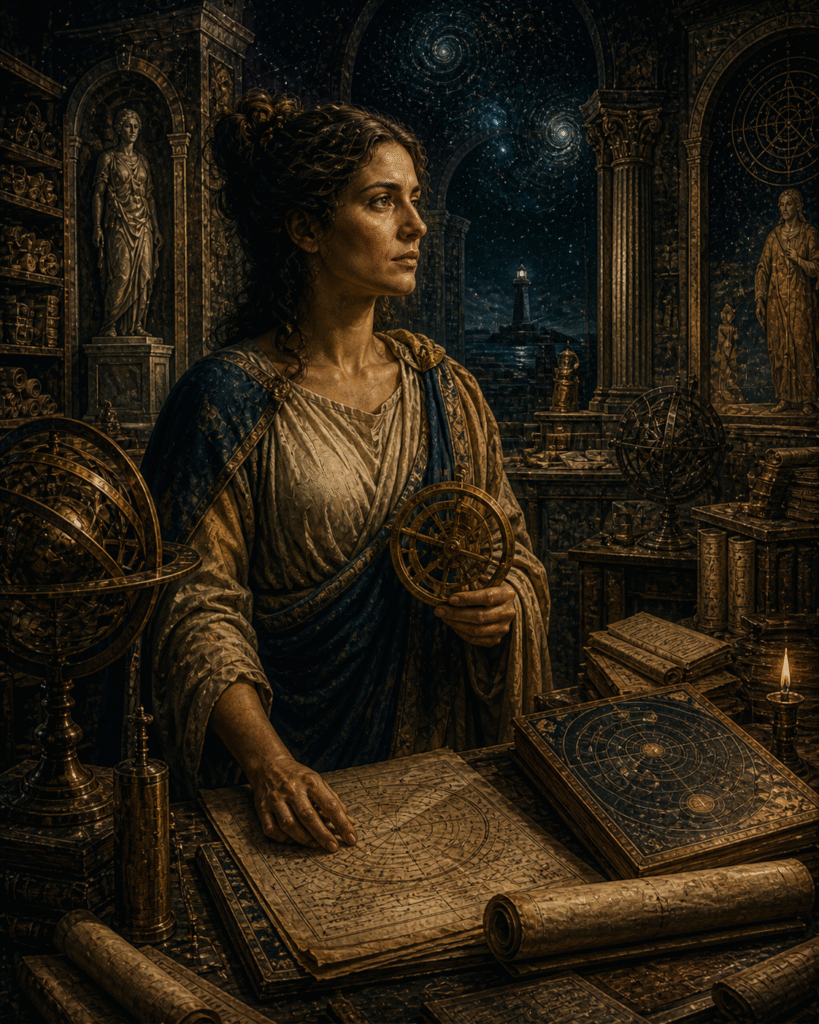
And, at the opening of this new dark configuration for thought, the Rebels drove in their most somber triumph: the twilight of free philosophy. Hypatia was the last star to shine before the night. In Alexandria, her genius glittered with the light of Plato and Pythagoras. But her presence was intolerable to the Rebel Nephilim: woman, philosopher, mathematician, astronomer — living synthesis of everything that might free the human spirit too soon. In 415 A.D., a Christian mob dragged her away and killed her. Officially, it was a crime of religious fanaticism. In truth, the mob was merely a façade: a Rebel Nephilic hand guided it. Hypatia might have prematurely inaugurated human science. Dead, dragged through the streets, she became the seal of the Middle Ages — the long manufactured night already announcing itself.
Thus the silent rule is fulfilled: the fall of a civilization does not generate growth, but regression. Splendor becomes dead weight, and people walk backward, groping amid shadow. Rome was not replaced: it was erased. What came afterward was not progress, but a transformation carefully designed to produce delay, not controlled development.
It was as if “time,” as humans conceive it, had stopped. Curiously, it was an age of little technical advance, but of the permanence of certain abstract values.
Thus the Middle Ages took shape — not as the fruit of chance, but as the calculated work of the Nephilim, who preferred darkness to the possibility of seeing people reach the keys of destruction too soon.
According to records consolidated in the reports of an intelligence agency created by the Nephilim — an agency we shall address in greater detail further on — concerning the rearrangement that followed the fall of Rome, the principal measures of intellectual containment in the portion of the planet identified as Western Europe are summarized below.
Middle Ages. Shielding Against Radiation
The West plunged into the thickest night. The Roman Empire had fallen and, in the vacuum of power, the papacy assumed the invisible throne. The Church, already armed with Aristotelian chains, transformed philosophy into the servant of theology. Nothing could be thought outside orthodoxy: conclusions were determined before questions were asked.
The Nephilim took care to harden this system. The false document known as the “Donation of Constantine” was one of their greatest masterpieces: a lie raised upon parchment that guaranteed the pope temporal dominion without contestation. Charlemagne, crowned emperor, believed himself heir to Rome, but he was merely a pawn in a web that joined crown and tiara in a fatal alliance. When these two powers quarreled, the Nephilim merely stirred the embers.
Even so, some fissures opened. In distant Ireland, scholars preserved Greek and dared to think without supervision. John Scotus Eriugena defended free will against predestination, as if he were a new Socrates. He was tolerated only because he was too far away to be silenced. When ideas like his echoed in the heart of Europe, they were crushed.
Despite everything, small transformations occurred that allowed thought to recover slowly. Schools and universities were created, but they arose under the control of the clergy, and in them the game was already rigged: Plato was admitted only as a shadow; Aristotle reigned as patron saint. The great controversy over universals — whether they were real things or mere names — was no more than a smokescreen. Realists and nominalists debated, but both remained inside the Nephilic arena. Empirical investigation — the risk of the experimental method — remained interdicted.
In this arrangement, the Nephilim reached the climax of their masterpiece. Thomas Aquinas, elevated almost to the condition of an oracle, consolidated Aristotle as the official doctrine of the Church. Thomism became law: every university, every school, repeated the petrified logic of the four elements and final causes. An absolute triumph — comparable, in its rigidity, only to the dialectical materialism of the communists. Two dogmas, separated by such divergent modes of thought, yet brothers in the same vice: imprisoning thought.
And yet not even the Nephilim could entirely extinguish the embers. The Franciscans, with their poverty suspicious of power, began to open cracks. Roger Bacon dared to speak of observation. Ockham sharpened his razor. After strong scholastic containment, reason tried to free itself from faith, and mathematics began once again to be the language of the world. They were only flashes, but the Nephilim sensed the risk.
Three Deviated Civilizational Zones
To evaluate the degree of global Nephilic intervention, this report organizes below, in three blocks, the records concerning the civilizational zones of the East, Africa, and the Americas. The classification is merely functional and follows the cartography produced by the seventh civilization itself.
The Contained East
While the West sank into the medieval night, the East seemed destined to assume civilizational primacy. China possessed secrets that would change the world: gunpowder, paper, the compass, rudimentary presses. Its ports were teeming, and its ships were wooden giants that made European vessels look like toys. Zheng He’s fleet, with thousands of men, crossed unknown seas, reaching India and Africa, and nothing would have prevented it from reaching the Americas.
If that expansion had continued, Earth’s civilizational configuration would have been different. An Asian empire might have united commerce, technique, and maritime power without European mediation. The world would speak the language of the dragon, not Latin.
But the Nephilim were attentive. An East open to the sea meant losing control over the great Western laboratory. So they breathed into the Ming court the poison of isolation. They ordered maps burned, diaries destroyed, their own ships sunk. Zheng He’s name was forgotten, and the empire that might have dominated the oceans closed itself behind walls of stone and porcelain.
The consequence was devastating. China, which seemed ready to take the lead, chose instead to withdraw.
The East, as a whole, proved strong enough to resist any more direct Western intervention, but incapable of creating institutions that would protect people from the arbitrariness of the State. Wealth was confiscated, and the accumulation of capital became impossible. There was no independent social layer bold enough to rise; there were only subjects, servants of princes. For the young, there remained almost only one path: to serve the court and await imperial favor.
Thus the intellectual flame of the East dimmed. Poetry continued, philosophy too, but isolated. Thought did not walk side by side with science. Discoveries did not become revolution, but ornament.
The Chinese empire, which might have been master of the world, reduced itself to guardian of itself.
And that was exactly what the Nephilim wanted. While Europe advanced through stumbling — wars, heresies, reforms — the peoples of the East immobilized themselves in sterile splendor. When Portuguese and English caravels reached their shores, they found no empire conquering the seas, but only closed empires, condemned by an invisible sabotage that had worked too well.
Africa Sabotaged
Africa, like China, also stood on the brink of becoming a new center of gravity for civilization.
From the Sahel to Axum, from the gold of Mali to the routes of the Nile, everything indicated that a force capable of rivaling Rome, Byzantium, and even China might flourish there. The Nephilim perceived the threat early.
Timbuktu already guarded thousands of manuscripts, treatises on astronomy, medicine, and philosophy. Some of its studies even affirmed that the movement of the stars could be described in numbers, as the Greeks had done. It was far too valuable a seed to be left in peace. When rival caravans advanced upon the city, the libraries were looted, burned, or dispersed. To human eyes, it seemed ordinary war; to Nephilic eyes, it was perfect sabotage: not only a people would be destroyed, but the memory of many layers of thought.
In the kingdom of Axum, an Ethiopian sage had nearly formulated a social architecture of rare stability: common lands, shared cultivation, surpluses destined for science and writing. Her fragments survived only in Coptic legends. The woman was eliminated, and with her the risk that Africa might create its own political philosophy without resorting to European mediation.
There were also the astronomers of the Sahara, who raised stones to mark the solstices, sensing orbits and celestial cycles. The Rebels infiltrated them, diverting their practices toward cults and sacrifices. Thus observation became superstition, geometry became ritual, and nascent science was lost in the dust of the desert.
Gold, salt, and the sea might have led Africans to the creation of oceanic empires. The currents favored them, and they already knew how to navigate the Indian Ocean. But the routes were corrupted, and the Nephilim made sure Africa would remain a granary of raw materials, without building its own conquering fleet.
In Ife, there arose a school unlike anything else: sculptors, mathematicians, and priests tried to unite myth and reason into a single language, almost like a Platonic Academy of the forest. But soon local wars set the territory on fire. Nothing was consolidated. Only the bronze heads remained, mute and enigmatic, witnesses to a knowledge aborted before it could gain historical form.
Thus Africa was contained.
Not for lack of genius, but by the invisible hand of those who, from the shadows, decided which seeds could flower and which should rot before sprouting.
America Pruned
On the other side of the ocean, the Americas raised civilizations that, although isolated, carried within themselves the risk of flowering along unexpected paths.
The Maya knew how to predict eclipses, align temples with solstices, calculate planetary cycles. They did not manage to forge an experimental science, but they were close to conceiving a mathematical astronomy. It was enough to set off the Nephilic alarms. Internal wars, prolonged droughts, and dynastic betrayals were breathed into the shadows until entire cities emptied themselves as if they had been abruptly abandoned.
The Aztecs, with their military and religious machine, might have created a continental empire. The Rebel Nephilim saw in this an opportunity: they diverted its energy into the machinery of human sacrifice. Blood gushing down the pyramids served not only local theology, but Nephilic strategy: a people occupied with appeasing gods would never occupy itself with building science.
The Incas were perhaps the greatest risk. They created roads, storehouses, irrigation systems, accounting by quipus. An empire of stone, organized and disciplined, capable of defying immobility. But when they might have transformed their order into technical advance, the Nephilim reinforced the solar cult. Gold, which might have become science, became ornament. The calendar, which might have become philosophy, became superstition. The figure of the emperor was confused with that of a god. Society became a hive, dependent on the queen bee. It was enough to eliminate the emperor — and the empire collapsed, like a swarm submitted to the smoke of fire.
In the heart of the forests, smaller peoples also experimented with observations of plants, mixtures of substances, and healing techniques that would have impressed even Arab physicians. But these forms of knowledge were isolated as local ritual practices, condemned to survive only as myth.
When the caravels of the Old World crossed the Atlantic, it was not merely the clash of swords and gunpowder that destroyed the American empires. It was the closing of a Nephilic cycle. The pre-Columbian civilizations had come too close to discovering, by themselves, a viable science. It was necessary to crush them, so that the narrative centrality of the world would remain anchored in Europe, under the Nephilic yoke. The Rebels were fundamental in this process, spreading disease and chaos, nearly decimating the original peoples of the Americas.

Addendum: The Human Fiction Called Time
For the record, it is worth noting that human beings created a scale that exists only among them: time. It is a scale of restricted utility and somewhat difficult to understand, since no other species has developed it in the way humans have.
Time, as humans conceive it, has a biological character: it seeks to quantify episodes of transformation according to the proportion of human life. It is an imperfect, local, and organic reading of a much deeper inscription, disseminated in the very structure of the cosmos and entirely unknown to them. Contrary to what they suppose, time is not the platform upon which life happens; it is, rather, an effect of what the universe records of itself.
Humans have developed, it is true, a rather ingenious way of carrying out this quantification: they call “day” the event corresponding to the complete rotation of their planet around its own axis; “year,” the event consisting in its translation, that is, the planet’s orbit around its star, the so-called Sun. A century, for them, is the sum of one hundred successive orbits.
To each orbit, they add one year to the count.
This practice of measuring time would be no more than one ordinary metric among many others, had humans not attributed to it a kind of external motive force, as if the parameter itself were substance or agent. The error does not lie in measuring transformations, but in imagining that the measure has an existence of its own. What they call time is no more than an imperfect reading of records, persistences, and irreversibilities inscribed in the physical processes themselves.
The scribes understand that this practice of measurement was born from the slowness of human intellectual development. In their earliest phases of curiosity, people raised their eyes to the sky, marveled at the celestial bodies, and took them for gods, attributing to them not only the importance they truly possessed, but also imaginary causalities and an ontological centrality that never belonged to them.
Measurement, in itself, does no harm. The deviation began when humans granted their own measurement an autonomous dynamic and began to organize social life with time as one of its foundations, thereby surrendering themselves to situations not rarely surreal.
The first of these consequences lies in the way humans measure their own transformations, as if there were in them something external to the being that undergoes them. From this operation is born a paradoxical unity: although entirely biological, born on a planet of exceedingly high transmutational forces, which drag them through profound changes while they remain captive to their own organic bodies, they imagine that each of them is one single person. When they approach the threshold of their cohesive physical existence, when the body is about to disintegrate and be reabsorbed by the planet, they suppose they have always been that same person, one and continuous, without perceiving the nonexistence of such unity, which would be conceivable only under the regime of immutability. Audaciously, they confuse themselves with the Immutable Entity, there called God.
They do not recognize their own biological, mutable essence. It is as if rationality led them to forget animality, the elementary fact that they are mammals among other mammals on their planet.
By wanting to classify themselves as unique throughout the whole of their physical journey, they set themselves up, without knowing it, as gods. And since there is no physical space for so many gods within a tiny planet like Earth — which can accommodate, at most, three — we believe this is one of the reasons why they so frequently seek to eliminate one another.
This view of personal transformation as an external entity makes many of them averse to change, in an obscure search for a certain lost immutability, which, in the end, is always an attempt at deification. They sense change as the degeneration of some supposed immutable original model from which they would descend.
By fixing themselves on the external element, they lose sight of what is essential: their incessant transformation, the plurality of persons they are throughout their own bodily reconfigurations.
A single example is enough to show the degree of irrationality to which this measurement of time leads. Humans confine their criminals in prisons, separating them from social life, and keep them there for a certain span. They reduce the matter to pure mathematics — or, at most, to a rudimentary cosmology: the prisoner shall remain confined as many times as the planet rotates around its own axis or completes orbits around the Sun. They do not even consider what is essential: they fail to take into account the transformations, for better or for worse, that the condemned person undergoes in the course of confinement. It is enough for the planet to complete the number of rotations fixed in the sentence, and the condemned person will be returned to the world.
More sensitive readers may not even believe that such a system actually exists. To those who judge that the literary imagination of the scribes has gone too far, it is enough to connect to the Current, explore this singular planet, and verify not only this, but the many other traps the human has set for himself by deciding to condition himself to the measure of time.
Indeed, the very passage of life is treated among humans by means of another external element: aging.
Under the shelter of this magical word, the process is seen almost exclusively in terms of fatality, while the human actions that effectively influence it recede into the background.
Thus it is not uncommon for the human being, in the course of what he calls “aging,” to adopt aggressive attitudes toward himself, aggravating precisely what is real in that process, under the illusion that everything derives from the fatality of an exterior element.
They do not perceive that time is not the agent of the aging of the human body. The body transforms itself according to its own material dynamics: it accumulates cellular alterations, loses structural stability, reduces its capacity for repair, and progressively reconfigures its own organization. What they call time is only the external ruler with which they describe, always belatedly, processes that have their own causes. And yet this material dynamic is profoundly influenced by attitudes taken within bodily existence itself — something that, for them, goes almost unnoticed.
This strange idea contaminates even incipient human physics. Humans go so far as to maintain — do not laugh — that if two people travel through space at different speeds, they will also age differently. They surround this belief with formulas and take it for a discovery. Perhaps they imagine that velocity, by some poorly disguised alchemy, intervenes directly in the chemistry of the body. They do not perceive that these processes belong to the organism itself and do not derive from cosmic events. What would change, for those two people, would not be the body, but only the human count of that fiction to which they have given the name time.
This error reaches even the human language of memory, often treated as a bridge between past and present, when it is nothing more than structural inscription, material trace, persistent modification of the nervous system, and partial conservation of experience within a current structure.
Humans call “past” the events that occurred in the interval comprised between complete rotational movements of the planet. Once one turn around the axis is completed, they mentally package, within that turn, all the transformations that occurred in what they call a day and not rarely forget them, as if that rotational movement were something magical that collected them, as if those alterations did not already remain inscribed in their lives and had been sent to some remote archive.
To remember is nothing more than to reactivate, in the present of the current cerebral structure, material marks produced by earlier transformations. And into this reactivation the transformational process itself already enters, loading the images with new alterations, for the human mind is not a mere recording machine: transformation lies in its genesis. But the human, instead of concentrating on this creativity of transformation, fixes himself on the stagnant and limiting illusion called time.
This uncommon way of classifying their own memory caused the human to lose the idea of inference. Instead of understanding traces, marks, scars, and remaining configurations as transformational continuity, he preferred to convert them into past; and, to complete the picture, invented another thing equally unintelligible to extraterrestrial beings: the future, that is, the rotational and translational movements not yet performed.
It is not without reason that this is a species with relative aptitude for storing technical knowledge, but almost stripped of the faculty of preserving within itself abstract knowledge — there called morality, empathy, love, and so on.
Such abstract forms of knowledge end up not being transmitted from one generation to another, which lies at the origin of constant regressions in the organization of the social fabric.
Everything would be different if they did not regard recollection as the faculty of bringing the past back, but as the capacity to reactivate, in the current cerebral structure, material marks produced by earlier transformations — all of this, of course, taking into account that they have not yet touched Ṛtabandhu.
The extreme point of this human construction lies in the strange term they created to mark what they call the “end of a person’s time”: death.
With this word, they intend to name the dissolution of a corporeal organization, the interruption of the functional unity of the human organism, and the loss of the integration that sustained consciousness, memory, will, and identity.
For the human, to die means to leave time, when it is nothing more than ceasing to sustain a certain organized form of living matter.
They ignore that time never comes to an end for anyone; what comes to an end is the structure that made that body a person. The biological organization dissolves and is reabsorbed by the planet, but everything that had been inscribed in it already belongs to the planet itself, merely converted into a new form. And it costs nothing to recall that the planet, in turn, is an integral part of the Universe: nothing is disconnected, everything remains in the Neural Network6.
Very particular among humans is the concept of eternity, corrupted by the idea of time. They conceive it as time without end, which is a contradiction in itself. We know that eternity is the absence of transformation, absolute stability, full being without succession, a reality that does not alter and, precisely for that reason, cannot be compared with processes. In other words: eternal is not what lasts forever; it is what is not subject to alteration.
Even a zircon crystal wandering across Earth without apparent alteration, amid successive geological reconfigurations, undergoes some change — even if only detaching itself from one rock and fixing itself to another — and therefore is not eternal. But how could human time be computed from the perspective of that same crystal? How would human time have elapsed for it?
The human vision of the universe has therefore become blurred. They observe it through the binomial space/time, as if the latter expressed an autonomous structure, when they ought to perceive it as a network of information, relations, and transformations, in which succession is not substance, but an effect of structure. They have gone so far as to create a unit of measurement to compare the distance of their planet in relation to other celestial bodies using terrestrial time as parameter: the light-year, that is, the distance traveled by light in one Julian year. The measure has, certainly, operational utility for incipient human physics. The problem lies elsewhere: it reinforces in them the conviction that most celestial bodies are inaccessible to them during the course of their ephemeral biological life, especially when they take into account their primitive methods of transport. They do not suspect that the greatest obstacle is not distance, but the poverty of the way they still think the real.
This shows that the species is not only warlike, but also arrogant, for it seeks to measure the Universe from its local perspective. It imagines there is a universal “today.” Yet the today of a body on Earth does not necessarily coincide with the today of a biological life situated in another galaxy. Each local consciousness supposes itself to occupy the center of the present, when in truth it merely cuts out, from within its own position, a provisional portion of transformation. The deeper unity does not reside in a cosmic “now” equally distributed to all bodies, but in a structural order prior to such measurements — a communion of the real that depends on neither clocks, calendars, nor local simultaneities.
They have no idea of the information permanently produced and captured by the Neural Network. They believe only in what they see, as if the Universe were projection and not information. For this reason they seek to capture light with their rudimentary instruments, in search of distant images and of life beyond their planet. In doing so, they see only what has already been registered and has practically completed its causal cycle. They are always late in relation to information, because they insist on seeing, when what is essential would be to read. Reading — through Ṛtabandhu — is simultaneous.
At this point, perhaps this human system of measurement, founded on time, delays them more than it helps them, making contact with extraterrestrial civilizations almost impossible.
The human brain is a highly sophisticated construction, capable of achievements of every order. Here, among the scribes, the suspicion is reinforced that one of the 144 civilizations may have supplied Gaia with a model.
Nevertheless, although it is the most important thing in their body, humans do not make adequate use of their own mechanism of thought. Instead of concentrating their efforts on reaching the limit of their possibilities, they occupy themselves above all with muscles and appearance. They have, for this purpose, ample spaces — training gyms, beauty salons, medicine directed toward surgeries intended to preserve appearances. It is true that such care is inherent to any civilized species, but it remains lateral; it does not constitute the principal objective. By contrast, human spaces devoted to the cultivation of mental possibilities are tedious: they promote useless teachings and do more to dull than to favor transformational thought.
It is a species that wastes its greatest gift. Add to this that uncommon metric called time, and we have a civilization condemned to isolation, for it calculates its possibilities of travel through the Universe always according to the time necessary to transport thought, captive in a biological body, inside machines driven by motor and fuel. Even if such machines reached astonishing speeds, the possibility of contact with interesting civilizations almost dissolves within the short duration of their biological bodies, incapable of precisely archiving the thoughts of that sophisticated mechanism they call the brain.
They have no idea of Ṛtabandhu, of the logic gathered within it, or of the very essence of life, which is communion with other forms of life.
Now, they do not perceive this perfection even when the evidence lies before their eyes. Life on Earth depends on a rare convergence of compatible physical, astronomical, geological, and atmospheric conditions. It would be enough for this convergence to alter for life on the planet to become unviable.
The same is true on every planet where life exists. Life, in turn, depends on other beings for nourishment, on ecosystems, microorganisms, and chemical and material exchanges with the environment in which it manifests itself. In short, life is born of a lineage and subsists through a chain of relations. This is not sociability, but relationality. No living being is self-sufficient.
If the Universe is perfect and if life depends on relations among species, it would not be difficult to conclude that this perfection would not limit an intelligent species to remaining confined to a small planet, isolated from the rest. And if that form of life is fleeting according to the scale it itself created — time — when it measures distances to be overcome by machines dependent on engine and fuel, it should at least intuit the existence of other forms of contact, of other technologies capable of beginning from within, from mentation itself.
The human neural network, although compatible with the Neural Network of the Cosmic Current, remains very primitive, underdeveloped, and underused. Rarely does a human manage to connect to the Current, and when he does, he has no idea what he has touched. Therefore, neither does he develop technology capable of potentiating such capacity.
The human being does not perceive that thought is real, measurable, and that, once thought, it remains wandering, lost, bound to the gravitational shackles of his small planet, for he has not developed his own mind sufficiently nor produced technology capable of freeing it from those bonds. He has not discovered Ṛtabandhu.
Would it be too much to appeal to the Councilors to authorize a small insertion into the minds of terrestrial physicists? Not exactly so that they would abandon all temporal measurement, but only so that they would cease treating it as the ultimate structure of the real. This would bring no major consequences, would not constitute the deliberate delivery of technology, and might perhaps shorten the evolutionary process, allowing them, without any other external help, to reach Ṛtabandhu by themselves and, from it, develop their own technology, as so many other species have done.
Who knows: perhaps in this way humans could reduce time to a mere curious order of measurement. They could even continue to use it while their mental faculties were not yet full, for once such fullness were reached, measuring time would lose all meaning and would be abandoned, just as their own mental evolution has already led them to abandon other senseless practices, such as the use of leeches as medical treatment, mercury in the fight against syphilis, or lobotomy as a psychiatric solution [these and other primitive human practices may be consulted in annex I.h.1.x.].
They could even abandon their rudimentary economic system — based on the satisfaction of external needs through exchanges among themselves, by means of a fiduciary currency. Fiduciary trust is, in itself, a mental process. It would be enough to eliminate external needs and concentrate on the interior of the mind for everything else to dissolve.
A few humans of the seventh civilization came close to that level, brushing against Ṛtabandhu. A good example is the sage Diogenes of Sinope. And it is worth underlining the adjective, for many human philosophers are everything but wise. Among them there are not a few who accept, justify, or even celebrate physical harm inflicted upon other humans in the name of ideals. In this they do not differ from the priests of primitive cults who offer human lives to appease gods. They change the names and refine the vocabulary, but that does not distinguish them: it merely reveals, beneath more sophisticated clothing, the same barbarism.
To dramatize the problem still further and make evident the urgency of overcoming the idea of time, we shall bring forward a few peculiar facts about it as humans conceive it. Our purpose is to sensitize the Councilors; whoever is not interested in this point may, however, proceed directly to the next stage of the present report.
Curiously, the last four industrial civilizations developed the same method of measuring time, which led some scribes to suspect that it may be some trick played by Gaia upon humans, or perhaps a test of capacity. The abandonment of the idea of time might signal to the planet that its most intelligent species has effectively begun to become worthy of that name.
Calendar is the name given to the official system of time measurement. In it they record days, months — a set of, on average, thirty days — and years.
Many humans believe that days and years mark the beginning of something new. They give special emphasis to what they call “New Year” — the passage from one year to another. As if this simple datum caused, by itself, some change, which is nothing but superstition: the fiction that something begins, when nothing begins; everything proceeds. This, incidentally, was affirmed by a human, also a scribe like us.
Another human scribe said, concerning the New Year, that he looked at the sky and found “no sign” of another year, only the silence of the Milky Way, concluding that nothing there indicated the beginning of a new year. Still another intuited correctly when he said that, within each person, the New Year dozes and waits from always. He gave the password: time is an external fiction; all change begins within. But it seems none of these human scribes was heard. The trap of time induces humans to believe that, each day, they possess ever smaller parcels of it and, in this fatal calculation, they go on eliminating what they judge superfluous or of lesser importance. To the horror of the natives of Litterae, literature is systematically abandoned for lack of time.
Many humans wait for the New Year to make great changes in their lives or promise themselves that, in the coming year, they will make the necessary ones. But nothing happens. Everything remains the same. Rarely do they fulfill their promises, for they keep waiting for that change which never comes, because it simply does not exist as an external act. They do the same with several other dates they deem peremptory — and continue without any interior change.
Humans also built a machine — the clock — to register the passage of time and allowed this external machine, designed to measure an equally external phenomenon devoid of meaning in itself, to begin imposing the rhythm of their lives. They became hostages to this measuring object and, not rarely, wait patiently for it to operate changes in their existence, although it was conceived only as an auxiliary instrument of organization in function of the infamous time.
The clock imposes rhythm, but does not confer meaning. The calendar marks; it does not operate. The date names; it does not create.
For this reason they see their own planet from the perspective of long duration — they measure it in billions of years — but do not perceive it as a unit of structural transformation, as a totality that recomposes itself, corrects itself, destabilizes itself, rebalances itself, and records within itself the marks of its own changes. There is no time of Earth; there are metamorphoses of Earth.
The human cannot bear this brute transformation, subtracted from his control. This is another of the reasons that led him to invent time. He measures, divides, names, calendars — not because time exists as a thing, but because his fragility requires him to order the world into comprehensible slices.
Humans called time what, for less anxious observers, has always been only transformation. They invented clocks because they died. They invented duration because their structures, fragile and conscious, could not bear to contemplate the world as pure change.
They confused measurement with reality. By measuring everything, they believed they had discovered the essence of the universe; in truth, they merely projected upon it the grammar of their own fear.
Earth does not live in time; Earth exhibits states. Species do not endure; they maintain themselves or collapse. Civilizations do not cross centuries; they produce forms, residues, ruins, and inscriptions.
It is true that some human physicists have already found fissures in the edifice of time, but they still lack the instruments to perceive that the crack is not in the wall — it is in the very way they build the world. Human physics already grazes certain truths, but still lacks the technology and mental architecture necessary to recognize them in their entirety, for if time wavers, it is not only physics that wavers; the whole grammar by which humans organize their own existence wavers with it.
Finally, particularly interesting human documents will be reproduced here in full. In them it will not be uncommon to find the expression “year” followed by four numbers. Example: Year 1971, 1975, 1999, 2006, 2008, and so on. This is nothing more than that scale for marking time by means of the calendar, as already explained above.
The First Cracks
The records gathered by the Library indicate that humans, although contained, managed to expand their civilizational complexity, producing anomalies in the regime of containment imposed by the Nephilim upon the seventh civilization. For purposes of evaluating the Gaia Hypothesis, the following cracks in the system stand out:
The walls of thought began to crack. The Church still seemed powerful, but it was already corroded from within. The more it assumed temporal power — administering armies, taxes, and fiefs — the more it lost its spiritual aura. The papacy, which had always imposed itself as the voice of God, now smelled of coin and intrigue.
In this scenario, a poet raised his pen like a sword. Dante, in his Divine Comedy, managed to transform Italian into a language as noble as Latin, tearing literature from the hands of the clergy and delivering it to the people. His work condensed the entire medieval system: orders, castes, circles of hell, and celestial hierarchies. A closed world, ordered, immutable. But, at the same time, his choice to write in the vernacular was an act of rebellion — a fissure through which light could enter.
Dante still believed in the regulatory power of a Universal Empire, but he turned toward a form of order already exhausted. He did not perceive that new forces were already articulating themselves: England, France, and Spain were raising national monarchies, challenging Rome. Nor did he perceive that, in the heart of philosophy, Franciscans were daring to separate faith and reason, opening space for a science that would no longer depend on theology.
The Nephilim sensed the danger. They had controlled the game with Aristotle and Thomism, but now the pieces were moving off the board. Vulgar tongues flourished, secular literature advanced, and people began to mistrust the power of excommunication. The moral control of the Church, once absolute, was no longer enough.
It was the prelude to an earthquake. Ideas, like embers hidden in monasteries and clandestine libraries, began to ignite again. And when the flame grew, the Nephilim realized they had made a mistake: they had underestimated the force of the written word and of free thought.
The Nephilim began to face a succession of nightmares. They had kept humanity entangled in the web of scholasticism, Aristotle disguised as dogma, Plato buried beneath the ashes of the Library of Alexandria. But the system was beginning to open.
The first great fissure took the form of the Renaissance. Florence blossomed like a new Athens, and there Pythagorean mathematics and Platonic dreams began to be reborn. Painters, architects, and engineers saw in proportion and number a universal language, far too dangerous for Nephilic standards.
Another important fissure was humanism. Erasmus, Thomas More, and so many others insinuated that dignity resided in the person, not in the intermediaries of God. The person as center, not the scholastic hierarchy. For the Nephilim, this was pure heresy: a person who trusts himself begins to think, and a person who thinks is impossible to control. Human dignity, if taken seriously, could create free citizens — and free citizens produce science, commerce, and economic systems.
But the gravest rupture had not yet taken shape. In a dark workshop in Germany, a typographer invented a mechanism of movable type. It was the greatest miscalculation in Nephilic history. Gutenberg’s press broke the monopoly of the word into pieces. Before the press, it was easy to silence an idea: it was enough to burn a parchment or behead its author. With the press, ideas multiplied like plagues. Truths and lies, science and superstition — everything ran through printed pages, impossible to stop. The Nephilim realized too late that they had lost control. Humanity had discovered virality.
In that interval in which marble, gunpowder, and new ideas divided Italy among themselves, a man opened the wrong door in the right city.
Leonardo da Vinci was not merely the person who drew everything; he was the one who saw too much.
In Rome, under the intermittent protection of the Medici and the shadow of the Borgia, he heard more than he should have and suspected the existence of unknown layers within papal power. With his sharp intelligence and uncommon curiosity, he discovered corridors that did not appear on any maps. There, in a chamber beneath the Vatican’s Armarium Occultum, he touched what no human should touch: Nephilic seals — cylinders of black glass that guarded schemes of pressures, alloys, and forbidden anatomies. He knew how to open locks, but the deeper inner doors required reading of the Sigillum-XII and denied him access. Moreover, he did not know — as was to be expected — how to open digital archives. The electronic matrices remaining from the erased civilization refused him the secret, like stones that do not yield to the chisel.
He left with a certainty: the body lies less than theories do. He returned to cadavers, cuts, the valves of the heart. The papacy, alerted by a Nephilic whisper, suspected that he had accessed the secret archives. They called his activities sacrilegious and interdicted his dissection rooms.
When Francis I asked him for the mechanical lion that, walking, opens its chest and offers lilies, he laughed inwardly: it was a toy for princes and a message to the Nephilim — “I know there are gears beneath the altars.”
Michelangelo envied; the curia watched; Machiavelli understood. And Leonardo, without a code to decipher the digital archive, wrote down what he could: flight, fluids, armor, and helicoids. He was left with the impression that someone had descended to Earth with an entire workshop and hidden it beneath theology.
In response to these anomalies, the Roman Nephilim instituted, as recorded in the Sealed Archives 1450–1600, an intelligence agency without parallel on the planet under analysis.
The documentation produced by that agency constitutes the main body of evidence for the following chapter.
The Emergence of the CIN
The instability of the system reached such a point that the Roman Nephilim resorted to an extreme measure: they created the Nephilic Intelligence Central, the CIN, to carry out minute surveys of dangerous people and movements, as well as to watch the secret archives with greater rigor. A group of Nephilim was trained specifically for this. A network of spies and informants was created. Nothing was to escape the knowledge of the Nephilic leaders in Rome.
The CIN produced countless reports, some of which are transcribed below:
“Memorandum of the Nephilim — Sealed Archive, Year 1450
Subject: Dangerous invention in Mainz, Germanic territory.
Description of the risk:
An artisan named Johannes Gutenberg, until then irrelevant, has discovered a method of reproducing texts on a large scale. Movable metal type, oily ink, and presses adapted from winepresses make it possible to multiply pages in a way not even the most skilled scribes could keep up with.
Assessment:
Before: a dangerous idea required only one parchment to be burned.
Now: a dangerous idea may generate one hundred copies in a single day.
Critical risk: loss of the monopoly of the written verb, central instrument of humanity’s containment since the fall of Rome.
Measures attempted:
Bribery of apprentices: failed.
Purchase and destruction of prototypes: two were confiscated, but replicas appeared.
Ecclesiastical intervention: it was proposed to label the press as heresy. Result: local resistance and support from German princes.
Conclusion:
The mechanism is already spreading. Venice, Paris, and Cologne already possess rudimentary versions. Multiplication is inevitable.
Final comment:
The error was to underestimate a typographer. It was supposed that the greatest danger lay in philosophers and kings. But the true enemy revealed himself to be an obscure artisan, staining his hands with ink.
Recommendation:
Redirect efforts toward infiltrating the printed pages themselves. If we cannot silence the voices, we must confuse their echoes.”
“Memorandum of the Nephilim — Restricted Archive, Florence, Year 1462
Subject: Founding of the Florentine Academy under the patronage of Cosimo de’ Medici.
Description of the risk:
A group of intellectuals, led by Marsilio Ficino, is dedicated to translating Plato and Plotinus. They reintroduce Platonism and the Pythagorean principles of mathematical proportions. The movement threatens to displace Aristotle from the safe position in which we have kept him since Thomas Aquinas.
Assessment:
Platonism, associated with mathematics and universal ideas, tends to bring the human mind closer to the language of the cosmos.
Immediate danger: strengthening of the notion that nature can be read as a mathematical book.
Long-term potential: rupture with Aristotelian teleology, which has served our purpose of containment so well.
Measures attempted:
Patronage of astrology as distraction: partial success, for even the cult of the stars bends to Pythagorean proportions.
Encouragement of academic disputes between Aristotelians and Platonists: unsatisfactory result; Platonism grows in prestige.
Attempted co-option through the Inquisition: unviable, owing to Medici patronage.
Conclusion:
The flame of Platonism has been rekindled in Florence. The risk is that artists and scientists may begin drinking from the same source, unifying aesthetics and science. The beauty of proportions may become an entryway to dangerous truths.
Final comment:
The arts already show signs of contagion: perspective, symmetry, harmony. If mathematics infiltrates painting and architecture, it will be only a matter of time before it also infiltrates astronomy and physics.
Recommendation:
Redouble surveillance over artists and engineers. Leonardo da Vinci identified as an emerging risk. Continuous monitoring.”
Cracks in Series
The next fissure took the form of Luther. The blow that hurt most: the Reformation broke Rome’s monopoly and returned to each believer the idea of direct contact with the divine. The Reformation would not have been possible without the press, which spread its pamphlets, nor without humanism, which had already been whispering about freedom of conscience. The Nephilim tried to suffocate the movement, but it was too late: German princes saw in the rebellion a political weapon, and the schism spread like fire through a dry field.
The CIN went into action:
“Confidential Note — Year 1517
Subject: The Saxon friar and the rupture
Assessment:
Gutenberg’s error has not yet been contained. The presses multiplied, and with them pamphlets and clandestine translations. Now comes Martin Luther, a monk irrelevant in appearance, but dangerous because of the combination of audacity and circumstance. His 95 theses perhaps had no great force of their own, but the mechanical support of the presses turns them into gunpowder.
Risk:
The doctrine of the ‘universal priesthood’ undermines centuries of containment. If each believer can speak directly with the divine, ecclesiastical intermediation — which we have so well domesticated — loses value. The spiritual unity of the West begins to crack.
Countermeasures:
Infiltrate men into the papacy so that it reacts with fury.
Foment wars of religion in order to transform debate into blood and fear.
Support local princes in the hope of dividing the movement.
Final observation:
There is an alarming detail: the Italian humanists prepared the ground for this kind of rupture by exalting the human creature above the divine order. Luther merely harvested what they had sown. If it is not controlled, the cascade effect may break the balance we have maintained since the fall of Rome.”
On another front, science erupted. Copernicus resurrected heliocentrism. Kepler broke mystical harmony with three laws hard as iron. Galileo raised the telescope and showed that the heavens were imperfect, full of spots, craters, and wandering moons. And Newton, with his mathematical key, threw the entire universe wide open.
The CIN never worked as hard as when it created a department specialized in scientists:
“Confidential Note — Year 1633
Subject: The telescope and the insubordination of the heavens
Assessment:
Galileo Galilei, insolent Florentine, improved a tube of lenses brought from the North and pointed it toward the heavens. What he saw threatens to dismantle all the cosmology we imposed: moons orbiting Jupiter, spots on the Sun, mountains on the Moon. An imperfect, mutable cosmos — contrary to Aristotle’s crystalline spheres, which have kept humanity contained for centuries.
Risk:
The heliocentric vision — already dangerous with Copernicus — gains eyes and proofs. If accepted, Earth will cease to be the center, and people will look outward, beyond, toward us.
Countermeasures:
Use the façade of the Inquisition to silence him.
Force him to abjure publicly, as an example.
Preserve his ideas in hidden manuscripts, preventing broader diffusion.
Spread the narrative that he is merely a stubborn old man, defeated by the Church.
Final observation:
The damage is irreversible. Even silenced, the telescope cannot be uninvented. The instrument will multiply, and the heavens can never again be kept under a veil. This is a point of no return: the era has begun in which people will dare to interrogate the Universe directly.”
Newton challenged the best agents of the CIN:
“Confidential Note — Year 1687
Subject: Principia Mathematica — The universal machine
Assessment:
Isaac Newton, reserved Englishman, has published the most dangerous work ever produced by human hands. The Principia is not merely a treatise on astronomy or physics: it is a mathematical code that reduces the heavens and Earth to a single mechanism. The apple and the planets obey the same law. For the first time, the Universe is presented as a total machine, intelligible to the human mind.
Risk:
Absolute. The dominion of Aristotle, so carefully maintained, collapses. The physics of the four elements and final causes no longer serves. The cosmos is no longer divine mystery, but a calculable clock. Worse: Newton’s mathematical method can be applied to everything — motion, light, heat, even the human body. The infinite ambition of the human mind now possesses a definitive instrument.
Countermeasures:
Encourage academic disputes between Leibniz and Newton in order to disperse attention.
Keep the work accessible only to a few scholars, making translations difficult.
Stimulate mystical interpretations of mechanics, in order to confuse its clarity with theology.
Final observation:
The fall of Rome was staged to delay progress as much as possible. With Newton, we have lost that control. He gave people what Plato only dreamed of: mathematics as the language of reality. The risk now is not merely that science may escape — but that humanity itself may glimpse what we have always hidden.”
The Nephilim ground their teeth. To maintain immobility, they had sustained Aristotle: four elements, perfect spheres, final causes. But now, with mathematics as the language of the cosmos, Plato returned triumphant. Nascent science, asking no permission, began to read the universe as a book of numbers.
Not that everything was a human victory. The geniuses themselves, often enough, continued to stumble. Descartes wished to build an entire philosophy around his method, and the Nephilim took advantage of this to breathe into him the dream of absolute control through reason. Spinoza erred by excess: a pantheism too rigorous, which transformed God and the universe into the same mechanism. Leibniz, in his logical optimism, offered justification to despots and empires.
Real points of danger also began to take shape: Vico, by saying that humans can know only what they make, planted the seeds of history as science. Without knowing it, he announced Hegel, Marx, and the whole machinery of philosophies that the Nephilim themselves would convert into weapons of delay.
The CIN also created a department exclusively dedicated to dangerous philosophers, for the Nephilim knew well the disorganizing force of philosophy.
Its reports from this period are revealing:
“Subject: Baruch Spinoza — The heretic of polished glass
Assessment:
This Jew exiled in Amsterdam, a maker of lenses, achieved what we feared: he united philosophy, science, and theology in a single body. In his Ethics, he declares without hesitation that God and Nature are the same substance. There is no separate heaven, no final judgment — only a universe ordered by eternal laws, accessible to reason.
Risk:
Extremely high. If this vision spreads, people will no longer need priests, nor dogmas. Not even us. The divine order, with its hierarchy, disappears; there remains only the order of things. His pantheism opens the way to an absolute determinism, in which everything can be explained without recourse to mystery.
Countermeasures:
Spread his reputation as an atheist, so that he may be isolated.
Encourage excommunications and censorship, preventing him from holding a chair at universities.
Feed the narrative that his ideas lead to moral chaos, nihilism, and social dissolution.
Final observation:
Spinoza does not merely write — he anticipates. In his logical serenity lies the germ of a philosophy that legitimizes modern science. More dangerous than Galileo, more subversive than Luther, because he does not shout: he merely demonstrates. Silencing his voice will not be enough. The true risk is that, from now on, every telescope and every equation may come to be read as part of the same eternal book he called Deus sive Natura.”
“Confidential Note — Year 1637
Subject: René Descartes — The geometer of doubt
Assessment:
This solitary Frenchman, who meditated beside a stove, produced a dangerous method. Discourse on the Method teaches one to doubt everything, until only thought remains as certainty. ‘I think, therefore I am.’ A simple formula, but one that undermines every authority based on tradition.
Risk:
Medium-high. If doubt becomes universal, dogmas collapse. More serious still: Descartes intends to apply the rigor of mathematics to philosophy, as if equations could replace councils. His mechanism transforms nature into a machine, capable of being unveiled piece by piece.
Countermeasures:
Encourage his reputation as an eccentric, in order to isolate him from ecclesiastical circles.
Promote partial uses of his method: stimulate abstract rationalism, but discourage experimental application.
Encourage disputes between Cartesians and Aristotelians, so that they consume themselves in academic quarrels.
Final observation:
Cartesian geometry is a key. If it falls into practical hands, it may open doors to devastating technical discoveries. Fortunately, Descartes himself fears Galileo’s fate and prefers to publish under masks, postponing the consequences. But the clock has already been wound: people have learned to distrust, and doubt is the most difficult seed to suffocate.”
“Confidential Memorandum — Leibniz
Identified danger:
Universal mathematics.
Assessment:
The German Gottfried Wilhelm Leibniz nearly revealed numbers as the primordial language of the cosmos. His infinitesimal calculus allowed the infinite to be domesticated, motion to be tamed, and energy to be predicted. An enormous risk: with it, people might manipulate forces that even we hesitate to touch.
Nephilic action:
Foment the dispute with Newton, ensuring decades of delay and division between rival schools.
Unexpected result:
Even sabotaged, his principle of conservation of energy and of pre-established harmony left seeds behind. He intuited that everything in the universe moves in invisible accord — a suspicion far too dangerous, but also beautiful.”
“Confidential Memorandum — Hobbes
Identified danger:
Secular social contract.
Assessment:
Thomas Hobbes saw people in a state of war of all against all. He proposed that only a central, strong, and absolute power could contain them.
Nephilic action:
Minimal. His vision is useful. An authoritarian Leviathan keeps the mass docile and drives away the specter of an order too free, capable of accelerating discoveries.
Unexpected result:
Despite favoring our control, Hobbes also opened space for thinking politics without God. It is the first time a philosopher conceives the State as a purely human construction. This secular breach, left inadvertently, may bear fruit in thinkers to come, beyond the reach of our network.”
“Confidential Memorandum — Vico
Identified danger:
The laws of history.
Assessment:
Giambattista Vico dared to suggest that the historical course could be deciphered as science. He affirmed that we fully know only what we make and, in doing so, laid the foundations for studying society as human creation.
Nephilic action:
Ensure that his writings circulate little, confined to obscure circles.
Unexpected result:
His cyclical theory of history was too close to the truth. It lightly touches the possibility of the cataclysm of Nephilic civilization, almost as if he had caught our scent. Fortunately for us, he is completely ignored.
Risk:
That he may inspire searches for universal patterns in the historical flow.”
Every advance of modernity was, for the Nephilim, a shock. Gunpowder destroyed feudalism. The press liberated ideas. National monarchies dismembered the Church. Humanism freed conscience. Science demolished Aristotle. And philosophy, even when it stumbled, no longer knelt before the altar.
A new phase was taking shape, in which the Nephilim would have to redouble their sabotages and create new controls, however subtle.
Two New Empires Emerge in the Shadows
Within this explosion of human thought, two hidden movements were taking shape.
After the discreet dominion exercised during the Middle Ages, the Roman Nephilim realized they had lost absolute control. The gears they had silently moved — the Church, feudalism, the domesticated medieval universities — were no longer enough. The press was spreading too many ideas, commerce was creating new social forces, and science itself was beginning to escape its chains.
Thus, the complexity acquired by human thought led them to the boldest decision since the founding of Rome: to create a New Rome. Not on the hills of Latium, but on the other side of the ocean, in vast lands that, to their eyes, were available — the Americas. There they could raise, in full view of all, a civilization that inherited Roman pomp, but was now capable of placing a bit in the mouth of the world and keeping it under absolute control. There took shape the project that would eventually assume the form of the United States of America: the Roman Empire reincarnated.
The Americas offered the ideal terrain: vastness, Indigenous populations decimated or dispersed, and the European dream of refoundation. There, in the ports of the Thirteen Colonies, the Nephilim began to infiltrate. Not as gods, as they had been in Mesopotamia, but as disguised founding fathers: jurists, merchants, engineers, and preachers.
Their strategy was clear: to cultivate a distinct elite, conscious of its imperial mission, while hiding from the rest the true origin of its strength. Instead of temples and oracles, they raised constitutional charters, institutions, and enigmatic symbols that referred back to the Nephilic orders. Where once they had built pyramids, they now designed forms of power. Where once they had delivered weapons, they now delivered ideas: liberty, rights, representation. Beautiful words, but shaped as tools of dominion.
The chosen symbol betrayed the plan: the eagle, direct heir to the Roman standard, now crowned with stars. On paper money, a vigilant eye atop the pyramid — mark of the ancient bunker technology transformed into emblem of the new republic. Senates and capitols, raised like copies in white marble, were reborn as emblems of the erased world.
The colonists came to believe that what was, in truth, invisible direction had been their own work. American independence was celebrated as revolt against a distant king, but, behind the scenes, the Nephilim breathed into the speeches, tuned the alliances, drafted the manifestos. And it could not have been otherwise, for England itself was under Nephilic influence. The New Rome was not born on a date determined by treaties, laws, or history books, but from the silent pact of the Nephilim who decided to exchange the shadows of Rome and the medieval castles for the light of an entire continent.
And they did not intend to repeat the error of old Rome. They would avoid absolute slavery, but allow enough of it to maintain divisions. They would stimulate commerce, but control the currency. They would encourage science, but in gradual doses. The empire they were founding was a machine of equilibrium: to give much in order to preserve obedience; to deny the essential in order to conserve dominion.
Thus the Nephilim integrated themselves into the Thirteen Colonies, shaping them as if they were bricks in a wall. When independence was proclaimed, humanity believed it saw a nation being born. But in hidden chambers, a rebirth was being celebrated: the New Rome, raised upon invisible foundations, prepared to replace old Europe and conduct the destiny of the world.
That project, however, came at a high cost. Some Nephilim did not accept the idea of repeating the game on another stage. They considered it a betrayal of their rules: to observe, to contain, to sabotage when necessary. This new plan would no longer be containment, but ambition. A part of them broke away and, drawn by the destructive spirit, crossed the line toward the Rebels.
The axis of power then shifted: from Rome — with an important sub-seat in London — to America. The Lateran House, until then central, was reduced to the condition of a sub-seat.
While the Romans were raising their empire in the West, the Rebels chose another path. For them, haste was the enemy of chaos. If the Romans cultivated order, the Rebels would cultivate waiting, patient and corrosive. They had no passion for control, but for ruin. And they chose as fertile soil the vast Russian territory.
Russia was an empire by nature: immense, impassable, submerged in endless winters. There, geography blended with suffering. The Rebels saw in this the perfect opportunity. There was no need to accelerate anything — it was enough to preserve misery as inheritance, freeze the population in the ice of servitude, and prevent any germ of economic freedom from sprouting.
It was they who whispered to the tsars the temptation of absolute power. They kept the peasants as serfs until the nineteenth century, delaying any possibility of the emergence of a native economic system. They stimulated schisms in the Orthodox Church, divided communities, manipulated faith in order to turn it into weight, never liberation.
Little by little, they created a culture of suffering: a people accustomed to pain, backwardness, and the whip. A people that survived, but never prospered. This was the clay they shaped with Nephilic patience.
Meanwhile, they watched the Romans found universities, draft constitutions, raise open cities. In Russia, no. There, science was suspect, books were burned, reformers were exiled to Siberia. The empire of the tsars stood upon rotten columns, but that was exactly what the Rebels wanted.
Calculated backwardness prepared the terrain. When signs of modernization threatened to appear — timid reforms, flashes of cultural opening, attempts at industrialization — there soon came the counterweight, the sabotage, the repression. The Rebels made sure that nothing would flower beyond what was necessary to feed resentment.
If the Romans still acted under the pretext of preserving the species and the planet, the Rebels surrendered themselves to destruction for destruction’s sake. They transformed resentment into a program: they would raise, when conditions proved favorable, a new order, a new empire. Thus, when the calculated revolution exploded, it would not be merely a change of government. It would be the birth of an Empire of Evil, slowly prepared by long layers of containment, backwardness, and resentment. An empire that did not wish to administer, but to destroy.
Thus, beside the American project, the Rebel project rose in the shadows: Russia as a laboratory of evil, not by accident, but by patient and deliberate elaboration.
These profound transformations reflected a growing mental change on both sides. The power accumulated since the fall of Rome and throughout the Middle Ages, when emperors and popes depended on their maneuvers, had intoxicated the Roman Nephilim. They no longer spoke only of survival: they liked power for power’s sake. They delighted in seeing kings kneel, nations bow, multitudes moved like pieces. In their ambition to refound Rome, they were no longer only guardians, but engineers of empires.
On the other side, the Rebel Nephilim, always more direct, discovered the pleasure of setting fire, of overthrowing, of ruining. Where once their function had been only to sabotage incipient civilizations, they now sought the spectacle of destruction — plagues, revolts, massacres, palace coups, iron curtains. Each catastrophe was, for them, a proof of strength, a dark art.
Thus, in the displacement that pulled the world out of the medieval night and cast it into the Renaissance reconfiguration, humanity believed it was breathing new air. But behind the veils, two irreconcilable empires were forming: one in the West; another in the East.
This Rebel movement attracted the attention of the CIN:
“CIN — Confidential Report no. 27/1675
Subject: Signs of Nephilic schism and dissident infiltration in the East
Situation
After majority deliberation, it was decided to install a New Rome in the Western lands (the Americas). The operation aims to guarantee the continuity of our mission of civilizational containment in view of growing indiscipline in Europe (press, commerce, science).
Occurrence
Partial desertion has been recorded. Elements faithful to the lineage of Romulus refused to follow the plan. They argue that the founding of a visible Rome constitutes a violation of the Dividing Line established since the original pact: to observe and correct, without direct intervention.
Suspicious movements
Several Rebels have been identified moving toward Russian territory. Since they represent noble houses — a condition proper to all Nephilim — they are received without restriction in every salon. Several dissidents were seen taking the same path. This is an unusual movement: never have so many Rebels been identified in the same territory at the same time.
Assessment
Since sedentarization is not in the Rebel nature, this unusual movement in Russia probably results from the ease with which they can exercise there their characteristic brutality and their need for destructive behavior — so typical of the Russian nobility and elites. The greatest risk is the creation of training bases.
Recommendation
— Intensify surveillance in the Balkans and on the Russian steppe.
— Reinforce the legitimacy of the American project as the only valid continuation of Rome.
— Keep the desertion registered as a formal violation of Romulus’s Dividing Line.”
The Rebel Nephilim began to call the Roman Nephilim, mockingly, Nephileagles. The Romans, in turn, referred to the Rebels as Vodklims.
Humanity Out of Control
In the seventh civilization there arose an intellectual, philosophical, and scientific frenzy, highly radioactive and generative of many lems.
In the following topics we shall report, with the greatest possible impartiality, the principal currents of thought that moved the human gears, the role of the Nephilim — both Romans and Rebels — in these events, and their decisive contribution to the final stage of this report.
British Empiricism
With the Reformation and the religious wars, something new took shape in northern Europe: an attitude that dispensed with dogmas and preferred compromises. In England and Holland, the rising merchants and artisans discovered that fanaticism was bad for business. Liberalism took shape. Each person should relate to God in his own way; each merchant should trade without the shackles of aristocracy.
From the Nephilic point of view, this was a moderate danger. Liberalism did not create a universal system; rather, it dissolved all systems. It was fragmentary, as if each question should be resolved according to its own merit. Difficult to control, but also not very explosive. Better a world of compromises and utilities than another of messianic revolutions.
John Locke crystallized this spirit. Instead of the divine right of kings, he proposed a social contract whose center was property. No grand abstractions: protect the house, the land, the goods. The division of powers — legislative, executive, and judicial — gave political form to this pragmatic individualism. For the Nephilim, this was acceptable: a liberal State would be easier to dose than an empire moved by ideals.
George Berkeley gave greater subtlety to this movement. He said that to be was to be perceived. Humans know only what reaches them through the senses.
David Hume went further. With his cold skepticism, he reduced certainty to a mental habit. There are no necessary connections between things, only successions of impressions. Fire burns because it has always burned, not because it must burn. For the Nephilim, Hume was almost an involuntary ally: a philosopher who taught people to distrust great universal laws and to accept the world as a sequence of provisional events.
Liberalism as a Necessary Evil
For the Nephilim, British liberalism was an ambiguous gift. It did not offer the messianic brilliance of Plato nor the systematic rigor of Aristotle. It was modest, practical, almost gray: a movement without dogmas, sustained by merchants and artisans who desired only security, tolerance, and property.
This reassured them. If liberalism consolidated itself, its expansion would be gradual and full of compromises — precisely the kind of expansion the Nephilim had always desired for humanity. A dosable expansion, without the risk of sudden technological leaps. It was a matter of granting appearances of autonomy in order to preserve, in the shadows, real power.
The New Rome of the West then began to experiment with arrangements based on this new thought.
Thus they allowed Locke to speak of social contract and division of powers. They tolerated Berkeley reducing the world to perceptions. They even smiled before Hume’s skepticism, which dissolved universal certainties into mental habits. All of this was safe. Liberalism softened the violence of religions, disarmed absolutist crowns, and produced a proprietary layer satisfied with the comfort of business.
But there was a danger the Nephilim had not calculated: this fragmentary attitude, this taste for observation, ended up training the human spirit for science. The patience with which Locke recorded ideas, or Hume dismantled certainties, was the same that guided Newton and Kepler in the unveiling of mathematical laws — and might lead many other scientists along the same path. Liberalism had become, without intending it, the school of scientific empiricism.
Utilitarianism: The Calculation That Escaped Their Hands
The Nephilim looked on with interest when Jeremy Bentham proposed that the good could be measured in units of pleasure and pain. For them, it was almost a gift: to reduce human ethics to arithmetic. If humans began to calculate their own acts according to convenience and utility, they would cease dreaming of transcendent ideals, and total destruction would never enter into any admissible calculation: it would always be discarded. No revolutionary utopias, no messianic crusades; only individuals tending to their own comfort, negotiating small gains.
In its initial formulation, this worked. Utilitarianism helped consolidate British liberalism, domesticating the human spirit. Tepid common sense reigned: neither absolute kings nor enlightened prophets; only parliaments discussing tariffs, factories adjusting wages, citizens evaluating risks and advantages.
But, once again, the antidote brought the poison with it. The same logic that taught humans to measure pleasures and pains was applied to the smoking factories of the Industrial Revolution. Workers, women, children — all began to calculate their own suffering. And philosophers such as John Stuart Mill reversed the game: if the objective was to maximize happiness, why not expand civil rights? Why not defend freedom of expression, female equality, a broader democracy?
The calculation that was supposed to keep humans docile began to push them toward social reforms. The Nephilim realized too late that even arithmetic could become subversive.
Addendum: The Fourth Erased Civilization
A great hiatus opened between the extinction of the fourth civilization and the emergence of the fifth.
The fourth industrial civilization was the highest in technique — and the poorest in politics.
Governed by preceptors and engineers of society, it abolished hunger, tamed rivers, and contained epidemics. Every gesture had a manual; every district, a diagram; every life, an adjustment plan.
They gave their ambition a name: Universal Happiness Program.
The philosophers offered them the grammar: “the wise discover what is best for all; the specialist is installed; the rest are educated”; and also the algebra: “the greatest happiness for the greatest number” — converted into formula, indicator, and graph.
A college of specialists in the common good mapped desires, calibrated incentives, and distributed mild punishments. The watchword was harmony. The instrument: measurement.
Five-year planning councils replaced parliaments.
Law became table; dissent, noise; education, calibration of preferences; art, serene ornament. Literature was reduced almost entirely to manuals.
At last, the Central Committee, provoked by its Secretary-General, concluded that natural life followed an erroneous, inverted course and should be completely modified.
After many analyses conducted by the sociological committees for the promotion of happiness, they decided that there was no sense at all in the natural rhythm of life: to be born; to be raised by nannies without the intellectual capacity even to educate themselves; to go to school in the company of many other children and adolescents, where one learns to compete and mistreat others; to attend university; to become employed; to marry; to have children — and to repeat the vicious circle; to work with no time for anything; to age and retire precisely when one reaches the peak of intellectual maturity and life experience, attributes little used thereafter.
They perceived that this mode of life led to a continuous succession of errors, repeated in successive human renewals; regrets — almost the only balance of maturity — were not enough to break the cycle.
Thus it was decided that society would be organized as follows: studies until twenty-four years of age — readers should recall the introductory note on what time means among Earthlings — with mandatory work from eighteen onward; from twenty-four to thirty, marriage; from thirty to thirty-five, children; then the couple would retire for eighteen years and take care of the children, leisure, and travel around the world, taking advantage of physical vigor and the peak of willpower; intense social life among people of the same age; once that period was concluded, the couple would be unretired and work until death.
If a person became senile or was struck by an incapacitating illness, assisted death was mandatory — the argument: to avoid the waste of pain. After all, everything had its minimally calculated utility.
Divorce was strictly forbidden — considered an unnecessary disturbance of the plan.
The period leading up to retirement was closely monitored by the Happiness Committee nearest to the couple’s residence. Periodic meetings were held to discuss the missteps of other generations and not repeat them in the present. Everything was discussed in groups, and no problem remained without a collective solution.
It was a society similar to a hive. Each person was connected to all the others, in a machine perfectly oiled by committees. This social machine cared for everyone’s existence. Its cares were minutely defined in the various regulations.
Everything had been foreseen, except the unforeseen.
After the publication of an anonymous treatise on critical spirit and individual responsibility, the walls of the hive began to crack.
The mechanism split into two blocks that could no longer reconnect.
Some could not bear the burden of freedom and cried out for stronger leaders, capable of putting each piece back in its place and eliminating the anomalies.
Those who could bear that burden wanted more freedom. They no longer wished to live like bees trapped in a hive.
The civilization — technically exceedingly advanced — had mastered nuclear fusion, the promise of infinite energy for its twenty-five billion inhabitants. But the blessing became a weapon. Irreconcilable polarization led a technocrat — perhaps influenced by Gaia — incapable of accepting the dismantling of the mechanism, to press a red button, and the planet lit up like a white sun, illuminating the Milky Way still further.
Thus, the fourth civilization did not fall through barbarism, but through perfect conformity. It seems that, without politics and without freedom, all technique is reduced to the art of obeying, at least for this strange terrestrial species called human.
There is no consensus regarding the reason for the great hiatus that kept the planet immobile between the fourth and fifth civilizations. Two currents formed within the Community. The first understands that a very large number of transformations was necessary for detoxification, far greater than that required by the preceding nuclear extinctions. The second maintains that the planet had given up on life and decided to live alone, but that, amid prolonged reflection, monotony, and boredom, it resolved once again to give itself over to an adventure and cast another seed.
The authors of this report incline toward the hypothesis that there was, above all, a lack of a model to recreate the principal species, since all previous ones had failed.
And the Fire of Romanticism Arose!
The Enlightenment dreamed of a single ruler with which to measure the world. Romanticism, however, broke the ruler. Each people, each historical configuration, each individual began to demand the right to be measured by itself — multiple values, incommensurable, none entirely protected from collision with the others. The Nephilim perceived there, at once, danger and opportunity. Where universal reason raised bridges, the romantic genius raised mountains: authenticity above convention, will above calculation, nation above cosmopolis. It was the refutation of the encyclopedists’ “one true path.”
To human eyes, this seemed liberation; to Nephilic eyes, a new instrument of containment. If there is no common metric, there is no stable reconciliation. Pluralism becomes friction; the self-creation of the I, a clash of egos; the singular history of each people, national mysticism. What in Florence had taken the form of Pythagorean harmony, in Jena became a drum — Sturm und Drang. And the Nephilim breathed: “If everything is expression, everything can be justified.” The peasant becomes an icon, the worker becomes myth, the tragic hero receives license to set the city on fire in the name of sincerity. It was the Dionysian turn: the refusal of the Apollonian peace of reason in favor of a world of rival wills, incapable of fitting within a single frame.
But while some mediated, others set fires. No current burned as intensely as German Idealism. Kant still seemed, in part, a philosopher of order: he spoke of duty, categorical imperative, autonomy of the will. For the Nephilim, he was a calculated risk — his critique was rigorous, but still moralizing, still susceptible to containment.
Kant was closely monitored by the CIN.
“Confidential Note — Year 1781
Subject: Kant — The architect of the abyss
Assessment:
Immanuel Kant raised a system of unprecedented rigor. By separating the empirical self from the transcendental self, he established that the rational being carries within himself an absolute moral law. This principle, the categorical imperative, is dynamite: any group that claims to speak in the name of pure reason will be able to impose unquestionable despotisms. Kant, without perceiving it, provides tyranny with one of its most solid legitimations: coercion transformed into moral duty. He is the perfect complement to Rousseau.
Risk:
High. Unlike Voltaire, who laughs, and Rousseau, who inflames, Kant builds. His edifice can be used for good or for evil.
Directive:
— Stimulate rigid and dogmatic interpretations of his philosophy, so that they may serve as the basis for totalitarian systems wherever such an expedient proves necessary;
— Neutralize liberal and individualist readings, isolating Kant in hermetic chairs;
— Promote his image as a philosopher of morality, concealing the fact that his doctrine permits infinite coercions to be justified in the name of reason.”
With Fichte and Schelling, however, philosophy caught fire. The absolute I, living nature, Germanic nationalism: all this supplied substance to new political mythologies.
And Hegel appeared.
With him, history ceased to be a mere confused succession of events and began to assume the form of a necessary march toward the Absolute. Dialectic was not merely a method, but prophecy: each contradiction would lead to a higher synthesis. It was the triumph of the messianic mentality, a system that promised to explain everything, justify everything — even war.
The Roman Nephilim distrusted the functional perfection of that construction: it was too destructive; it might considerably delay science, but by a risky method. The CIN was activated.
“Confidential Note — Year 1807
Subject: Georg Wilhelm Friedrich Hegel — Phenomenology of Spirit
Classification: Ally Under Surveillance
Assessment:
Hegel is a valuable instrument. His philosophy obscures thought beneath layers of dialectic and neologisms. He transforms confusion into method, absurdity into revelation. Many have perceived that Hegel does not explain: he only envelops. If he is not properly protected and guided, he may be denounced too early as a mere charlatan and lose his usefulness.
Benefits:
— Dissolves the nascent scientific spirit in dialectical mists;
— Justifies violence, wars, and blind obedience as necessities of history;
— Elevates the State to the place of secular divinity;
— Diverts entire generations from clarity into the labyrinth of the System.
Instructions:
— Keep his academic position secure, ensuring influential disciples;
— Stimulate the aura of profundity, even if no one understands him;
— Silence Kantian criticisms by spreading the idea that Kant has been superseded;
— Use Hegel as the basis for future totalitarian systems wherever they prove necessary.
Conclusion:
Hegel is useful, but fragile. His power lies not in truth, but in the appearance of truth. It is for us to protect him from the suspicion of charlatanism. If he survives criticism, he will be one of the most durable poisons ever inoculated into human thought.”
The Nephilim analyzed these CIN reports with care. They suspected that espionage caused psychological damage in their agents, who saw possibilities and suggested conspiracies sometimes close to delirium.
The Rebels, however, rejoiced over Hegel: there was the perfect instrument. It would be enough to replace Spirit with the Proletariat, and they would have in their hands a secular gospel, ready to set the masses on fire. That is precisely what Marx would do: take dialectic, replace the Absolute with classless society, and proclaim the inevitable advent of a new historical configuration. Marx took hope and shaped it as a weapon of war.
Episode: The French Revolution
The French Revolution was born not only of hunger, nor only of philosophy; it was the collision of two currents that should never have been mixed. The Enlightenment had lit the torch of reason: Diderot, Voltaire, Montesquieu, and Rousseau had shown that a world without privileges was conceivable. But beside the ordered encyclopedia there boiled the romantic flame: the cult of feeling, of collective emotion, of the nation as mystical body.
The French began by debating liberty in elegant salons and ended shouting in the streets, carried by hymns that seemed more like invocations. The guillotine became the altar upon which reason and emotion sacrificed the hope of equilibrium.
The Rebel Nephilim were there, breathing watchwords, inflating the masses, ensuring that the revolt would be bloodier than necessary. The Terror was not a mere historical accident: it was sabotage. If the Revolution had remained closer to the horizon of moderate Enlightenment, perhaps it might have given rise to a stable European democracy, causing a modern liberalism to emerge outside America — and therefore outside Roman control — while weakening the chances of Rebel sabotage. It was a risk for both factions.
But the Rebels did not allow it. They pushed Robespierre toward puritanical madness, fed the masses with messianic deliriums, exalted violence as redemption. And when the Revolution was drowning in its own blood, they raised another pawn: Napoleon.
The little Corsican was the perfect instrument: a general who wore Roman glory, imitated eagles and fasces, and spread the French fire throughout Europe. The Republic became Empire; liberty, conquest; fraternity, gunpowder. The world understood the lesson: every Enlightenment revolution runs the risk of ending in Caesarism.
Episode: The English Path
While Paris burned to the sound of the Marseillaise, London obeyed another logic. There, revolution did not erupt from the streets, but allowed itself to be absorbed by parliaments. The blood of the Glorious Revolution had already dried, and the lesson remained: radical changes cost far too much.
The English — in part guided by the Roman Nephilim, who preferred slow and dosable expansion — cultivated liberalism as one tends a walled garden. Locke had already offered them the elementary formula: social contract, division of powers, limited government. No guillotines in the public square; everything was resolved through gradual reforms, through the balance among king, parliament, and judges.
It was pragmatism in place of passion. Law became an instrument for containing abuses, not a sword for cutting off heads. When the machines of the Industrial Revolution began to release smoke, the country did not plunge into chaos, but accommodated itself through compromises: legal unions here, labor reforms there, another electoral reform act elsewhere.
For the Roman Nephilim, this was the ideal model: an expansion without explosions, slow enough to be controlled and constant enough to sustain British — that is, Nephilic — hegemony over large portions of the globe, in intimate articulation with the project of the New Rome in America. A society that preferred gradual reform to revolutionary convulsion and, precisely for that reason, managed to expand its empire without needing to reinvent its own institutions entirely.
England thus became the counterexample to France: while the Parisians consumed themselves in the price of blood, the Londoners perfected the art of waiting.
It was the victory of the incremental method over rapturous utopia — a Nephilic laboratory maintained under the discipline of the Crown.
Steam and Calculation
While France struggled between guillotines and restorations, another revolution was taking shape in England — silent, but much more powerful. It was not political, but industrial.
Steam set gears, locomotives, and entire factories in motion. With this, the human measurement of life was subjugated to the compass of the machine. Villages became cities; artisans became workers; clean rivers became channels of waste. There industrial capitalism was taking shape.
But the growing wealth of some laid bare the misery of the majority. The working-class districts of Manchester and London were worse than prisons: infested slums, children working in coal mines, exhausting workdays. It became clear that material expansion exacted its price from the very substance of the human being.
In this new configuration, the Nephilim acted again. The Romans — always cautious — did not want to lose control over the new economic order. They therefore favored the rise of a philosophy capable of domesticating capitalists and workers alike: utilitarianism.
Jeremy Bentham coined the principle of the greatest happiness for the greatest number. Everything had to be measured, weighed, calculated. If a law produced more pleasure than pain, it was justified. It was practical philosophy, almost administrative, perfect for damping social shocks without opening space for dangerous utopias.
If the French had run after abstract ideals, the English counted pleasures and pains as if they were coins. Utilitarianism was, in truth, the philosophical mask of a social pact: avoid revolutions, grant reforms, yield enough to preserve command intact.
But not everyone was satisfied. Some — like Robert Owen — tried to humanize the factories, create cooperative communities, reinvent labor. Others — like Ricardo’s disciples — began to affirm that all value came from labor and that capitalists extracted from workers what did not belong to them. It was in this soil of misery and calculation that a new type of philosophy germinated: Karl Marx’s scientific socialism. Fed by Hegelian dialectic and by the contradictions of the Industrial Revolution, it was also, to a large extent, the product of a Rebel machination.
Reforms Against Steam
The Industrial Revolution seemed uncontrollable. The steam engine spat smoke like a mythical creature, devouring men, women, and children. Workers were replaceable parts; industrial districts, cemeteries in life.
In that scenario, voices arose that dared to say: it is not enough to calculate pleasures and pains; the system must be reordered.
Robert Owen was one of them. Unlike predatory capitalists, he treated his workers with rare dignity in that world: he reduced workdays, created schools, tried to raise communities in which cooperation was worth as much as profit. His horizon was that industry might become human.
Others followed similar paths. The idea of cooperativism began to take form: workers gathered in associations that divided gains and risks. In parallel, the first unions emerged, still fragile and persecuted, but already willing to give voice to the anonymous worker.
These experiments, however, were small flames amid the fire. Industrial capitalism, with its logic of expansion and competition, devoured everything. Utilitarianism — then the official philosophy of the Roman Nephilim — admitted concessions and tolerated gradual reforms, but kept the core of the system intact: factories, profits, private property.
In this configuration, a new figure appeared: someone who did not wish merely to patch the system, but to overthrow it. A philosopher who fused Ricardo’s labor theory of value with Hegel’s dialectic. His name was Karl Marx.
The Red Messiah
The reformists — Owen, the cooperativists, the first unions — believed the system could be corrected from within.
As if it were possible to tame the steam engine with good intentions.
Marx looked upon that landscape of misery and saw something else: no reform was possible. Exploitation was not a correctable defect; it was the very engine of capitalism. The worker was not merely mistreated; he was despoiled in his essence, for the value of what he produced was sucked away by the capitalist.
The decisive intuition of this view was already found in David Ricardo, but Marx went further. He fused the labor theory of value with Hegelian dialectic. Hegel saw history as the struggle of Spirit toward the Absolute. Marx replaced Spirit with modes of production and the Absolute with classless society.
Class struggle became, for him, the inevitable engine of history: masters against slaves, nobles against serfs, bourgeois against proletarians. Each social configuration would carry within itself the germ of the final confrontation and, as a promise immanent to the system itself, communism — the promised land.
But there was something still more dangerous: the prophetic tone. Marx did not write as a speculative philosopher, but as a preacher. His dialectical materialism was more than theory; it was a religion of history. Whoever disagreed would stand against progress, condemned to be swept away by the general movement. There was no middle ground: either one was revolutionary, or one was reactionary.
Thus philosophy became religion. And, like every religion, it brought a final judgment: revolution. Class struggle became the new holy war. Whoever did not convert would be called an enemy of progress, destined to be eliminated. Violence now had metaphysical justification.
The Rebel Nephilim celebrated the absolute success of their Marx Project. They had created a religion of hatred, an engine of revolutions and massacres. It was exactly what they wanted: a total ideology, capable of setting multitudes on fire and justifying violence, destroying every possibility of lasting progress. If the liberalism of the Roman Nephilim was the politics of compromise, Marx was the finger on the trigger.
Deep down, Marx transformed philosophy into messianism. The communist utopia was the earthly paradise; revolution, the baptism of fire. And, like every millenarian promise, it carried within itself the germ of tyranny — perfect for the Rebels to imprison human thought definitively and maintain total control over it.
Marx, penniless and laden with resentment, gave body to what the Rebels had been preparing since Hegel: a secular gospel.
Marx in Detail
Marx did not arise from nothing. His thought was an almost alchemical synthesis of three fundamental influences: Ricardo, Hegel, and materialism.
a) Ricardo — Economics as Spoliation
David Ricardo, classical economist, had affirmed that the value of a commodity depended on the labor incorporated into it. For Ricardo, it was a theoretical observation; for Marx, it became an accusation. If value came from labor and the capitalist kept the surplus, then all bourgeois wealth was systematized theft. Surplus value was the key: a simple and explosive equation.
b) Hegel — Dialectic as Engine
From Hegel, Marx inherited the structure of dialectic. But where the master spoke of Spirit, Marx spoke of modes of production. Feudalism corroded by the bourgeois; capitalism corroded by the proletarian. Everything would tend toward the final synthesis: communism. It was inevitable, like the fall of a stone — but a stone that required a push. Class struggle was the finger on the catapult.
c) Materialism — From Contemplation to Action
Here Marx performed his most radical turn. Earlier materialists saw reality as mechanism. Marx went further: truth was not to be contemplated, but made. The human being should not merely interpret the world, but transform it. Philosophy ceased to be speculation and became a political program.
The Rebel Nephilim were enchanted by this amalgam.
In Ricardo they saw the accusation that stirred hatred; in Hegel, the certainty of inevitability; in materialism, the legitimization of violence as science.
It was not merely philosophy. It was secular catechism:
Dogma: class struggle.
Heretics: liberals, reformists, anyone who believed in compromises.
Apocalypse: revolution, purifying the world by fire.
Marx offered what no other philosopher had dared to offer — or, to say it in the language and imagery of humans, corrupted by the idea of time: a closed, total system that explained the past, diagnosed the present, and predicted the future. It was utopia with a date set.
The Contrast: Utilitarianism and Liberalism Before Marx
While Marx promised the final explosion, liberalism preferred compromise. It was less heroic, more tepid — but also more habitable.
The utilitarian liberals, heirs of Locke and Bentham, did not speak of demolishing the existing order. They spoke of correcting it little by little, adjusting gears, as the Roman Nephilim wished.
Where Marx saw oppressors and oppressed, they saw contracts to be improved.
Where Marx preached blood, they proposed laws.
Where Marx raised the promise of paradise, they accepted realistic improvement.
Jeremy Bentham said the objective was the greatest happiness for the greatest number. A simple formula, almost banal, but powerful: it gave a basis for penal, labor, health, and education reforms. A world that did not need apocalypse — only constant adjustments.
John Stuart Mill, his most refined heir, gave utilitarianism a liberal face: freedom of expression, individual rights, tolerance. For him, diversity was not a threat, but an engine of progress.
There was no promise here of a perfect world. There was only a method: err less, correct more, reform without rupture.
And that was precisely what irritated the Rebels.
Marxism was a frontal attack, but it risked being unmasked.
Liberalism was a silent erosion, corroding privileges before large-scale resistance could organize itself.
If Marx was thunder, liberalism was fine rain — the kind that penetrates more deeply precisely because it does not frighten.
The West had already been sabotaged by the Nephilic choice of Aristotle against Plato. Now humanity found itself before a new bifurcation: on one side, Marx’s incendiary path, capable of burning the planet; on the other, the gradual path of utilitarianism, capable of freezing imagination.
And the Nephilim, on both sides, disputed every inch of that crossroads.
The Technology Released
A great Nephilic meeting was convened in the Vatican. The three centers of power were represented: New Rome, the London House, and the Lateran House.
The question on the agenda seemed simple, but it was not: to determine whether the conditions were already in place to deliver more advanced technology to humans, or whether they would reach it by themselves, without any control and with unpredictable results. Science had advanced too far.
The Lateran House — faithful to its own conservatism — was defeated. But the decision obeyed the majority, not unanimity.
Thus, in the wake of the steam cycle, humans were flooded with increasingly daring innovations.
Nephilim scientists infiltrated laboratories and universities as assistants to the geniuses of the time. They suggested solutions, delivered schemes, drawings, plans. They diverted scientists from dangerous paths and offered them controlled knowledge. They oriented their thought according to previously conceived and authorized programs.
All orders for the delivery of new technologies came from New Rome. Nothing escaped the control of the CIN.
Not by coincidence, humans found themselves immersed in a technological development without parallel, entirely incompatible with the means they then, in theory, possessed. The technological revolution was taking shape, and the world was becoming a laboratory under Nephilic supervision.
The Rebels, of course, also promoted their own technological revolution, although a limited one, since the archives remained under Roman control.
Nevertheless, both humanity and the Nephilim developed technology to transform the world, but did not cultivate with equal intensity the habit of exploring their own minds. They perfected intervention upon matter, but neglected the sounding of consciousness.
Chronicle: Prometheus Metered, Epimetheus Cut Down
New Rome needed a torch that would illuminate without setting fire. The CIN called it the Prometheus Program.
Thomas Edison was assigned to the task. A Nephilic genius of Roman lineage, certified by the CIN to distribute accountable fire, with restricted access to the Archives, rigorously controlled by the Central. His mission was not merely to light lamps, but to teach the world to pay for light: meters before miracles, tariffs before towers.
The plan was simple: to control the flow of patents and regulate the way light would reach the cities. Edison was efficient, a publicist of himself, an industrialist of the laboratory — engineer of the visible and electrical pedagogue.
His tacit mission was to distribute knowledge in doses and surround it with patents like low walls. Each lamp was a pact; each sound studio, a filter. He knew how to light the world without freeing it too quickly.
The CIN monitored the situation closely:
“CIN — Memorandum 14/1903
Subject: Prometheus Program.
Object: electrical distribution, patents, urban networks, and containment of technological leaps.
Assessment: electricity has become inevitable. Preventing it entirely would produce suspicion, artificial delay, and risk of autonomous discovery through unsupervised paths. It is therefore recommended that it be released through measurable, billable, and legally enclosed networks.
Directive: consolidate distribution under reliable command; saturate the market with gradual innovations; promote public disputes between competing technical models; discredit projects of free or unmeasurable transmission; protect the population from dangerous leaps.
Observation: Edison remains suitable to the program. Tesla requires surveillance.”
Edison executed the Prometheus Program like someone building power plants and fences. Wherever there was a spark, he installed meters.
Beside him, however, Nikola Tesla stood out, the man who conversed with thunder. He did not design products; he listened to frequencies. His dream was not the lamp, but the whole ether: energy distributed like wind, without invoice, without meter.
For the Romans, Tesla was rhythm beyond the score; for the Rebels, a useful accident. Where Edison raised stations and contracts, Tesla glimpsed torrents and antennas. He imagined a wireless world, without ticket, without ticket-taker. Energy traveling like rain, not through pipes: mortal danger to the layers of containment.
And yet even the Nephilim wavered when they saw him draw motors that turned like planets. They called him a dangerous visionary, sometimes jokingly treating him as an honorary Vodklim. The suspicions were so strong that they subjected him to a genetic test, but the machine — calibrated for Sigillum-XII — remained silent.
In the end, they left him the stage and emptied the audience: silence is the most effective of blackouts. The answer did not come in spears, but in lines of credit. They cut off his financing, cut off his copper, spread slanders against alternating current and against the utopia of the air. The Wardenclyffe Tower fell as if a lightning bolt had unlearned the sky. New Rome kept light within the network that counts.
The Closed Cycle
Thus the cycle was completed.
The Enlightenment had given the ruler; Romanticism had broken it; utilitarianism had offered the truce; idealism had rekindled messianism. Each movement seemed human, but behind the scenes there was always an invisible hand — sometimes calculating, sometimes inflaming, sometimes diverting.
The result was a world made of contradictions: at once scientific and mystical, pragmatic and utopian, rational and romantic. The stage was set for terrible collisions.
Despite this, the world seemed to announce to humans the victory of reason. Humanity believed itself close to solving every mystery. Machines multiplied, electricity tamed the night, the telegraph shortened distances. The world seemed, at last, malleable in human hands. But the Nephilim knew that this optimism was dangerous. If humanity concluded that nothing was impossible to it, the destiny of the Nephilim themselves — and of humanity — would be at stake. It was necessary to act in silence, so that no one would perceive the hidden hand guiding both triumphs and disasters.
The first operation consisted in fragmenting knowledge. What had once been common to sages — a shared body of knowledge, a universal language, a philosophy capable of conversing with science and art — was dissolved into ever narrower specializations. The Nephilim breathed into universities a taste for microscopic detail and blindness to the whole. They created the barbarian specialist: figures who knew everything about almost nothing, but nothing about the universe. Thus the ancient ambition to understand the cosmos was replaced by technical reports and watertight compartments. The ivory tower became a labyrinth of corridors without exit.
On their side, the Rebels poisoned scientific optimism with the illusion that society could be remodeled like a clockwork mechanism. It was in this soil that both Comte’s positivism and Marxism took shape, two faces of the same error: the idea that the human condition could be organized by historical or social formulas. The Rebel Nephilim also pushed humanity toward the dream of political engineering, an earthly paradise fabricated in a laboratory. The Romans, more subtle, allowed the excess to bloom, certain that disillusion itself would generate discredit toward the science they considered dangerous. And so it happened: from the trenches of the First World War emerged not the promised paradise, but an unprecedented bloodbath. Progress, which had seemed redemption, revealed itself as an instrument of carnage.
An antidote was offered — an even more effective poison. The Nephilim spread among intellectuals the fashion of irrationalism. Bergson taught that intuition was worth more than reason, that the intellect was merely a machine for killing the flow of life. Freud plunged into dreams and sexual impulses, as if truth resided in the encrypted symbols of childhood. What had been rational investigation became subjective interpretation, psychoanalysis, or vital mysticism.
Wittgenstein, with his language games, supplied the final key: philosophy would no longer seek truth, but merely correct grammars. Humanity accepted therapy as one accepts padded shackles, believing itself cured when it was only silenced.
And so, between the scientism that promised everything and the irrationalism that denied everything, humanity oscillated like a drunkard guided by invisible hands. Discoveries accumulated — electricity, airplanes, vaccines, computers — but every advance came accompanied by its shadow: sabotage by the Romans; wars and genocides by the Rebels.
The records of human episodes became numerous, but not very innovative. The seventh civilization continued to produce wars, ideologies, machines, surveillance systems, promises of liberation, and new forms of massacre; yet almost nothing was added to the mental structure already observed. The species became more efficient, not wiser. It increased the power of instruments, not the depth of thought. For the purposes of this report, there is no need to follow each new convulsion of the seventh civilization: the cycle is already closed. For this reason, the Library does not dwell on each new layer of episodes captured by the Current. Once the structure has fully revealed itself, the enumeration of symptoms becomes unnecessary before a spiritual insufficiency already diagnosed.
Before we advance to the conclusion of this report, the archives recommend opening an addendum: the fifth erased civilization. Its case casts an uncomfortable light upon certain inclinations of the seventh.
Addendum: The Fifth Erased Civilization
The planet’s fifth industrial civilization offers a singular case. Although technically refined, it did not know how to convert that refinement into a superior form of life. Among all of them, it was the most futile and useless — at least according to the unanimous opinion of the Scribes.
It was a resistant species: it lived at the limit of what its body allowed in terms of biological reconfiguration, because it cared for diet, exercise, and skin. Up to that point, nothing particularly grave. The problem began when its inhabitants started consuming the other species in order to manufacture cosmetics, medicines, and elixirs of youth — almost all of them ineffective, but lethal to biodiversity.
They lived for the immediate: comfort, body, desires. They had no higher aspirations and no horizon that exceeded desire.
The body became religion; youth, duty; old age, scandal. Health ceased to be a sign of life and was converted into aesthetics. They no longer sought greatness, only conservation.
Culture was reduced to entertainment; politics became spectacle; intellectual life, mere ornament.
They exchanged knowledge, ethics, and permanence for momentary image. They replaced culture with distraction and truth with appearance.
In short, they lost contact with any transcendental sphere, and there remained only the void, filled with frivolities.
Even the occasional observers of the Current reduced their incursions: the zoo had lost its charm.
Exceedingly fragile, the fifth civilization fell with a few volcanic eruptions and a few earthquakes. The most accepted theory in the Community was that Gaia felt such repugnance for that civilization that she destroyed it through a geological metaphor: volcanic eruptions were her vomit; seismic tremors, her flatulence.
The few survivors, disfigured, without clothes, creams, and gyms, succumbed to their own mirror: many killed themselves; others hid in remote corners, waiting for death, until no one remained.
Cities Invaded
The terminal pages of the CIN archives no longer deal with distant empires or philosophical disputes among great systems. They become personal, immediate, almost intimate. It is as if the Nephilim spies themselves, fatigued by so much surveillance, had felt the urgency to leave a solemn warning.
From the standpoint of this report, these documents constitute the most recent layer of the Nephilic collection under direct monitoring by the Universal Library and therefore receive special treatment here.
Among documents concerning the American New Rome and reports on the Russian Rebel laboratory, there is a dossier marked only by a dry inscription: CITIES INVADED. It bears no precise date, only the enigmatic mention: “Indifferent Year.”
The text does not describe inventions or great doctrines. It is neither philosophy nor geopolitics. It is a somber memorial, written by field agents who, unlike the analysts of the Nephilic Intelligence Central, did not seek to interpret the world, but merely to record what their eyes had seen.
It was the raw testimony of those who had walked among humans and repeatedly witnessed what happens when civilization comes undone. This testimony joins countless others of the same nature, formulated by modest agents like those who prepared what is now included in this historical compendium.
Let us proceed to the report.
[Confidential Report: Indifferent Year
Subject: Cities Invaded.
Observation: This report, owing to the gravity of the problem detected, departs from the usual concision of our memoranda. The matter requires detailed field data, patterns of urban behavior, and operational risks that recur in different human societies, with potentially lethal consequences for our species.
Assessment:
Reviewing all CIN archives, including the oldest ones, written even before its formal creation, the bitter conclusion becomes evident: we inhabit a civilization that, in every corner of this planet, has always proved strangely warlike and self-destructive. For this reason, our preservationist precautions have been perfected throughout the vast period in which we have lived among them as a separate civilization — a Nephilic civilization inside human civilization.
We were efficient in not mixing with them, in not entirely adopting the warlike spirit reigning around us. But we had to yield in part: there is no need, in this document, to recount the clear involvement we had in the consequences of the last world war, nor the nuclear “gift” we bequeathed to humans and which now threatens even our own existence.
Sadly, we had to build new bunkers — this time with capacity to shelter all the thousands of Nephilim scattered across the continents. Even the Rebels.
Our leaders affirm that they have already taken sufficient measures to dispel any nuclear risk. This report will not address that subject. An atomic cataclysm is a calculated risk, foreseen in the protocols, and would not take us by surprise.
The danger:
Our objective is to report another danger, silent and invisible, which may strike down humans and, with them, many of us.
After certain waves of social comfort, especially in certain layers of the present configuration of the seventh civilization, humans began to treat their institutions as if they were part of the natural landscape. They criticize the courts, parliaments, rights, the press, due process of law, freedom of expression, property, religious tolerance, and even the police — without perceiving that these structures are not ornaments, but containment barriers.
They have never seen a city in flames because a warlord decided to test his wrath. They ignore that the freedom to criticize the State exists only because the State, domesticated by laws, cannot silence them.
The stone walls fell, but new walls were raised — invisible ones, made of rights, courts, parliaments: fragile pacts that contain horror. The Rule of Law is the highest wall ever built by human ingenuity.
If these invisible walls collapse, we shall return to the age of invaded cities. There will be philosophers celebrating the collapse, but there will be no citizens left to read them.
The current civilizational process is like an orphaned child, without shelter, wandering through the streets: no one protects it, no one defends it. People do not understand its exceptionality in human history; they believe it is like stones and forests: that it has always been there.
To preserve civilization is not to keep stone upon stone: it is to preserve the pact that no person may be absolute master of another person’s destiny. That is the true wall — and its fall will have no reconstruction.”
We have noticed that these puerile complaints of current generations open space for genuinely dictatorial measures to be adopted. We suspect Rebel incursions in this field, but have not yet detected anything concrete. It appears to be, in large part, frivolity.
Thus, so that the Nephilim may be prepared should social convulsions bring down the society in which they dwell — a hypothesis desired daily by political, moral, cultural, and intellectual leaders across much of the civilized human world — we shall report how things occurred before the existence of the invisible barriers described above, so that every Nephilim may protect himself from possible social dissolution or grave disturbances in his routines. These are real risks, not imaginary ones. Be certain that dramatic events — meticulously described in our millennial reports — will occur again after the fall. Be prepared not to be swallowed by the homicidal whirlwind that follows every collapse of the Rule of Law. This is not historical prophecy — we do not even possess the intellectual capacity to formulate laws of history — but prediction by observation. We merely record the past and what occurred in the real world, crudely, without excessive analysis or consideration. We are observers and do not intend to be anything else. We affirm only, with some degree of certainty, that if in the past it was always so, there is no sufficient reason to think it will not be so again: if the invisible barriers fall, what will emerge is what has always emerged — invaded cities, absolute chaos, blood spilled without meaning.
Let us, then, turn to the facts.
When the invisible barriers described above did not exist, there were walls around cities. These walls had a defensive function, for no one was safe anywhere. No one trusted anyone, and civilized conduct could not be expected from anyone at all.The report is shocking, but nothing was invented; only witnessed, often from far too close. For reasons of security and secrecy, we shall omit the names of the cities and persons reported:
Report 737 (field example):
“The city of …… lived peacefully. It had not yet raised its walls.
Night came. Strangers, protected by darkness, ran swiftly through its streets and alleys. They were specialists in such things, like wolves lying in wait for prey inside the forest.
They returned to camp and reported to the general all the defensive weaknesses, the entry routes, and the strategic points.
The decision to destroy the city had been made by the king of the …. The king of the city to be invaded was his ally, but it was a façade alliance. He had merely co-opted his trust so that, at the convenient moment, he might eliminate him, for his growing power and wealth were a source of envy and covetousness. He also saw him as a future threat to his own city.
After the reports, it was decided that the best time for the attack would be lunch. The orders were clear: anathema. Nothing was to remain; they wanted no slaves. Ten percent of the spoils would go to the king, and the rest would remain with the soldiers. They could do whatever they wished with the inhabitants, provided they left no one alive and brought the king’s head inside a sack.
The power of life and death, granted to soldiers without civilizational restraints, has always led to scenes of absolute cruelty.
The inhabitants awoke peacefully on that mild autumn day.
The children went to the central square to amuse themselves with their games and toys, under the attentive gaze of the elderly. Adult men and women tended to their daily tasks. There were few soldiers, and none of them was prepared for combat. There were no dangers on the horizon, and the peace sealed with neighboring cities guaranteed a certain tranquility.
A beautiful young woman was preparing for her wedding. She was realizing the dream of marrying pure and virgin.
The invaders fell like lightning in the storm that announces the end of a season. The soldiers had no time to seize their weapons to defend the city. They were annihilated almost instantly.
The cavalry advanced without obstacles. It surrounded the square. Terror took hold of the children and the elderly. The arrows eliminated almost all of them quickly. The desperate crying could no longer be distinguished in that confusion of screams and neighing. One of the soldiers took sadistic pleasure in killing children under the hooves of his horses. He trampled them and crushed their skulls with the iron-shod hooves of his chestnut horse.
Some raised their arms, as if still seeking the protection of the laps of fathers and mothers who no longer existed: they too were run over and massacred.
Another group of soldiers reached the bride’s house; before being murdered, she was raped simultaneously by more than twenty men.
The same fate befell the other women, whether elderly or girls little more than ten years old.
All the men were castrated and then murdered.
At last, the king was beheaded, his head placed in a leather sack, as ordered, and the great royal treasure carried away.
Every object of value in the houses and shops was looted. Fire consumed the rest.
In a short time, crows, vultures, and other carrion animals performed the customary cleansing. The wind, the sand, and the corrosion of the world took care of erasing the traces of that anti-civilizational festival. No ruin remained. Only the testimony of a Nephilim infiltrated among the invading hosts, who had earlier also been infiltrated in the invaded city.”
There are thousands of similar reports.
Many of them were observed in regions with remarkable civilizational progress for a relatively brief period, brought abruptly to an end in a single day.
Thus every Nephilim must be warned and prepared if the signs indicated above intensify in the regions where he dwells.
Predictable consequences should the Rule of Law collapse:
— rapid return of pre-urban practices: pillage, ritualized violence, sexual violence instrumentalized as a weapon of terror;
— local economic collapse: emptied banks, interrupted supply networks, hunger and epidemics;
— long civilizational hiatus: regions with accumulated progress reduced to vestiges in a single day;
— direct risk to the integrated Nephilic community: public exposure, lynchings, and loss of infrastructure.
Contingency measures for CIN agents:
— immediate activation of the Nephilic contingency plan whenever systemic signs (polarization, rupture of public order, sabotage of infrastructure) exceed the defined threshold;
— clear orientation to all field agents: immediate search for designated shelters; social camouflage protocols;
— establishment of safe routes and meeting points for urban and non-urban contingents; periodic drills and encrypted communication.
Preventive measures recommended
Methodological observation:
Preventive measures to avoid catastrophe: our sabotage projects have always had the purpose of containing unrestrained development and avoiding cataclysms that might consume us, but not of destroying human civilization, given our plan to integrate ourselves into it.
Thus, perhaps the moment has come, in addition to sabotage, to identify positive points to be preserved.
Recommendations:
Politics and power
— Sponsor moderate politicians, even if tedious: boredom is civilizational; excitement is revolutionary.
— Foster politics of compromise and coalitions: when everyone yields a little, civilization survives whole.
— Publicly stigmatize any politician who speaks of a “definitive solution” or an “absolute restart.”
— Strengthen the Rule of Law: independent judiciary, professional police forces, protection of property and contracts.
— Clandestine monitoring and infiltration of networks that promote incitement to violence.
Culture and the arts
— Encourage pluralism of thought in universities; combat single-minded thinking and closed zones of indoctrination; value critical and interdisciplinary dialogue.
— Discreetly fund chairs of comparative studies that keep alive respect for tradition, morality, and customs, freeing them from prejudice and unnecessary rituals or limitations on rights, while preserving their historically beneficial side.
— Introduce, in schools and universities, the discipline of history of catastrophes, with readings from selected Nephilic reports.
— Introduce in universities the study of authors who defend pluralism of ideas (Isaiah Berlin, Bertrand Russell, Friedrich Hayek, Raymond Aron, and others now almost banned from the academic world).
— Foster civic education that recovers historical memory and transmits civilizational prudence.
— Support cultural institutions that reinforce intergenerational bonds.
— Ironic and symbolic patronage: finance works and satires that ridicule the cult of destruction.
Invisible customs (the barriers)
— Reinforce everyday habits such as respect for traffic lights, lines, contracts, and the ordinary rituals of civilized life. These small restraints, almost imperceptible, sustain the invisible order without which human coexistence rapidly slides into massacre.
— Stimulate the continuity of useful taboos (against incest, parricide, anthropophagy, etc.), even if dressed in modern clothing.
— Defend the value of routine as an antidote to the warlike spirit.
— Ironize frivolity.
— Establish annual prizes for the greatest involuntary defense of civilization.
— Draft symbolic decrees forbidding any use of the word “revolution” outside the astronomical context.
— Maintain lists of problem words (“rupture,” “beginning from zero,” “tear everything down”) to be monitored in public speeches.
Complementary preventive measure 1
Rescue of the word: work so that no cultural, academic, or political regime replaces living human language with technical jargon, euphemisms, or acronyms that conceal reality. Degradation begins when the verb is corrupted. To preserve the clear word is to preserve civilization.
Complementary preventive measure 2
Preservation of small customs: instruct that, in any scenario of social convulsion, the minimal rituals of civilized life be maintained and encouraged — schools open, religious worship free, markets functioning, courts in operation. Even when fragile, these small habits act as invisible walls. Their total fall is always the prelude to barbarism.
Complementary preventive measure 3
Integral record of the innocent: every tragedy must be narrated, beyond the official record, through human testimonies — written, recorded, or transmitted. No death must be anonymous; no massacre must dissolve into silence. The absence of narrators is the greatest ally of tyranny.
Complementary preventive measure 4
Distrust every ideology that treats persons as mere abstractions, manipulable at will. Closely monitor adherents of such ideologies and confront them with the fact that persons are real and not abstractions: they effectively suffer from the physical or psychological harms inflicted upon them. Maintain equal vigilance regarding ideologies that preach the sacrifice of rights in the present for the sake of a future earthly paradise — experience shows that this paradise never arrives, while present harm is almost certain.
Additional preventive measure
Work so that no report, statistic, or official record concerning human deaths is expressed exclusively in numbers. Each life must be documented with name, story, and circumstances, preventing the reduction of the dead to statistical coldness. Reducing men, women, and children to figures is one of the greatest catalysts of collective dehumanization. Where there are only numbers, sooner or later there will be extermination camps, as the writer of the Gulag warned.
Sentimental appeal — why protecting cities matters
Cities are not mere agglomerations of stone and commerce: they are deposits of affection, memory, and human routine — the traffic light respected without enforcement, the bakery with the morning line, the school where children are left. To preserve these small rituals is to preserve what remains of humanity before barbarism. The experience of living under the Rule of Law is not an abstraction: it is the sum of simple, everyday rights that makes possible a life without fear of being cut down at lunch. Those who preach the destruction of institutional order often know nothing of that experience — and for that reason do not deserve the trust of those who have known it closely.
Conclusion and final recommendations
— Do not underestimate the human capacity to repeat old horrors, even in technically advanced societies.
— Prioritize measures of resilience and the cultivation of moral antibodies.
— Keep shelters and withdrawal procedures ready: preparation prevents panic and losses.
— Combine the traditional Nephilic policy of containment with a diplomacy of positive preservation: protection does not live by sabotage alone.
Closing:
This report is not an exercise in rhetoric. It is not an essay, nor a moralizing sermon. By recording human barbarism repeated in cycles, it lets slip — even without wishing to — the urgency of preserving civilization. To preserve it is, in the last analysis, to preserve what allows us to exist without being discovered by what, among humans, is most destructive.
Signed: Field Unit — Historical Division of the CIN
(Restricted reading: Superior Council of New Rome, London House, Lateran House. Copies in the Lateran and Washington safes. Full distribution of this report — confidential level 5 — to all Nephilim depends on superior decision.)]
Epitaph
The world became the stage of an open dispute between the two Nephilic factions.
The Romans had built in America an empire over which they maintained absolute control. They created what they called layers. Each layer had a Nephilic council controlling the previous one, and so on until reaching the deepest layer of all: the government in fact, both of the State and of civil society, formed by twelve Nephilim. Every agency, however secret it might be, received, without knowing it, orders from the CIN. Nothing existed without its corresponding layer of control.
If it was already naïve to believe that semi-nomadic barbarians managed to bring down Rome — the most powerful empire that ever existed — it would be even more naïve to believe that rough and semi-literate settlers founded, on their own, a nation grounded in the most modern principles of the Rule of Law — and kept it, by themselves, free from the barracks coups so typical of the other countries of the Americas, besides placing it in command of the world’s technological and economic progress, with remarkable civilizational condensation. Rome did not fall by chance, nor did America rise by chance. Both obey the same invisible hand, which dissolves and refounds nations when convenient.
While the Romans of the West harvested the fruits of their New Rome — universities, industries, constitutions, a liberalism spreading across the Atlantic — the Rebels awaited the propitious configuration to give birth to their creature. The spark was lit when they incited revolution, overthrew the old order, and took power in the name of proletarian utopia. It was the beginning of their own empire — an Empire of Evil, which promised justice but delivered forced-labor camps and bloody purges. It was not merely popular revolt, nor the mere collapse of a decrepit regime. It was a planned birth, the Rebel counterproject finally revealed.
Russia would not modernize like England, would not become a mercantile power like Holland, would not open itself like the United States. It would be led to the opposite extreme: the systematic negation of property, freedom, and dignity. Where New Rome planted order and prosperity in the name of the safe containment of humanity, in order to keep it under absolute control, Rebel Russia would sow terror and scarcity.
The Rebels found in Marx and Lenin their human prophets, figures capable of dressing backwardness as if it were the future. The Russian Revolution did not promise merely to overthrow the tsar; it promised to remake the world, to erase human experience in the name of a new dogma, total and unappealable. Exactly what the Rebels needed: an empire that does not administer, but consumes itself and any unauthorized progress.
Thus emerged the Empire of Evil: not by accident of history, but as the other face of the Nephilic coin. Rome in the West, order and calculated progress; Russia in the East, organized chaos and destruction.
Rome and Anti-Rome. Two hidden empires, two Nephilic projects, now in direct collision. Two poles, destined to confront one another, yet both shaped by the same invisible hands.
Nothing is more ironic than this fratricidal division and the memory of the ancient unity of Nephilic civilization and of the way it came to an end.
As their mental life grew denser and more sophisticated, the Nephilim lived as a single civilization. There were no walls or fortresses, because there were no internal enemies. They did not know the word foreigner. They saw themselves as one race, and their science and art circulated freely; their identity was the very continuity of life.
But when the final cataclysm became evident, something new — and terrible — was established. Among them there flourished doctrines that no longer spoke of a single humanity, but of chosen tribes, distinct peoples, exclusive territories. Philosophy ceased to seek the whole and began to exalt the part. The first standard was raised, the first anthem composed, the first frontier drawn. And with them was born the poison of us against them.
The novelty was received with fascination. The Nephilim felt the ardor of belonging defined against the other. The promise of national greatness became more seductive than the promise of universal reason. The cities without walls became fortresses. Fear spread like fever, and where there had once been bridges, walls were raised.
From that blindness the first wars were born. And with them, weapons. Each technical innovation, once directed toward life, was converted into an instrument of destruction. Since they came from a single civilization, without divisions, they possessed neither experience nor maturity to build a common law among the new nations, an international pact capable of containing the spiral of hatred, and they allowed themselves to be dragged into vertigo.
There had not been sufficient transformation of the established mental pattern to build that international law. Technology has always run faster than law.
The civilization without borders had fractured into radical nations, and the planet, once a temple of science and peace, became a battlefield. The cataclysm did not come by chance: it was only the final logical consequence of that choice.
Since their arrival in Rome, the Nephilim had split into two factions: those of Romulus and those of Remus.
That division reached its paroxysm after the First World War.
The Roman Nephilim began to suspect that the Rebel Nephilim would search the Vatican’s secret archives, where nearly forgotten formulas concerning the manipulation of matter were kept, along with records of experiments forbidden since Antiquity. Among them were the instructions for enriching uranium and the designs for the nuclear bombs that had destroyed their own civilization. The same concern haunted the Rebels.
And so, after so much surveillance, sabotage, and calculation, the Nephilim finally betrayed themselves.
Rome, reborn as the United States, found first the archives hidden beneath the Vatican. The formulas, so well guarded since the bunkers, were deciphered and spat in fire upon Hiroshima and Nagasaki. With this, the secret ceased to belong to the archives and began to belong to fear. The Rebels, entrenched in old Russia, did not need to find the same source: it was enough for them to know that the impossible had been accomplished. From the vestiges, infiltrations, human calculations, and strategic urgency, they too mastered the atom, they too raised arsenals. The world trembled. The reborn weapons were more powerful and devastating than their equivalents from the extinct civilization.
Those who had contained human advance, who had burned libraries, murdered sages, and delayed civilizations, now delivered to humanity the weapon of its own destruction. The Nephilim wanted to survive, but from them was born the possibility of the end.
The irony became perfect: the guardians of survival had become the architects of extinction.
And the planet, silent, merely observed. Perhaps it smiled; perhaps it grew bored. Gaia, after all, knew how to wait. It had already watched this spectacle six times — as had the observers of the Current.
And there remained the prophecy. The Orange Man. A prophecy transmitted among generations of Nephilim, both Romans and Rebels.
Some guaranteed he would be a builder, famous for raising walls. Others bet on a tax-collector tribune, one of those who begin by stamping revenue forms and end upon the throne. There were even those who said he would be a builder hired by the revenue service and that, by one of those grotesque accidents of power, he would end up a leader.
On one point all agreed: he would come painted orange — buffoon, prophet, or antichrist — to seal yet another cycle of chaos, for he would be the sign that humanity was relapsing into the terminal vice of exchanging reason for spectacle, prudence for resentment, and institutions for personal cult.
No one knew for certain. But all sensed that, with his irruption, Gaia would have a new occasion to reduce the noise.
And, in the silence that followed, another seed, another life, another civilization would return to sprout.
Because, of all the planets in the Universe, only Earth is so fertile in beginnings again.
With this summary, the record of planet Earth in the archive of the Universal Library, Type 01 Planets Section, is concluded, awaiting the outcome of the seventh civilization.
This report shall be updated if relevant transformations render it obsolete or if the humans of the seventh civilization fail to find the right words and it becomes necessary to analyze the eighth.
Minimal Glossary of Words Absent from the Languages of the Seventh Terrestrial Civilization and of the Other Erased Civilizations:
- Universal Library: systematic repository of universal information. The higher instance for the reading of the real. Every interaction that occurs in the Universe records something; no event is extinguished without leaving a trace, for the entire universe functions as an archive. The Library does not create this memory: it merely collects it, condenses it, and transforms it into language intelligible to all species, under the curation of the civilization of Litterae. It is, therefore, the instance of reading, organization, and transmissibility of that information. ↩︎
- Scribes: interpreters of Litterae authorized to produce reports through the reading of lems and their correlations. ↩︎
- Cosmic Current: universal flow of inscription and availability of information. In the Cosmic Current there is no past, present, or future in the human sense, nor any universal today distributed equally among worlds. It dispenses with travel, for bodies do not circulate within it: inscriptions do. What exists in it is not displacement, but the universal availability of information. Distance persists for matter; not for information, because information does not traverse distances: it becomes immediately available. The problem is not reaching it, but reading it.
The Cosmic Current must not be confused with the Neural Network that emerges from it. The former conducts universal inscription; the latter captures that inscription and makes it accessible to mental structures compatible with it. Every species endowed with a neural network participates, however minimally, in this possibility of reading. The human species, however, remains almost entirely unconscious of its own compatibility.
The Cosmic Current records and conducts; the Neural Network captures. ↩︎ - Lem: minimum unit of informational inscription at the exact instant of its emergence in the Universe. ↩︎
- Ṛtabandhu: cosmic order and structural bond of the real. It names the deep harmony that sustains the universe and the internal correspondence among the various planes of existence. It does not designate a mere connection among separate things, but the constitutive bond that makes them intelligible to one another, for life is realized only in communion with other lives; isolation, therefore, contradicts the order of the whole.
Ṛtabandhu is not a cosmic clock; nor is it equivalent to a universal present, as if the whole cosmos shared the same “now.” It designates, rather, the structural unity by which different forms of life, different planes of existence, and different configurations of the real remain intelligible to one another, even when separated by the local limitations of measurement, language, and consciousness. ↩︎ - Neural Network: living system for capturing universal inscription. It is constituted as a mesh of lems distributed and intertwined throughout the Universe. Once a fact emerges, its inscription acquires variable intensity and integrates itself into the mesh according to the strength of its emission. ↩︎
Porto Velho, May 2026.
Libersum
This story takes as its distant point of departure the scientific and philosophical resonance of the Gaia hypothesis, developed by James Lovelock and Lynn Margulis: the idea that Earth’s living and non-living systems interact as a complex, self-regulating whole. In this narrative, that intuition is transformed into a cosmic report on civilization, recurrence, and planetary correction.
On this, see Britannica’s entry on the Gaia hypothesis.
Also read the author’s short story: Cosmic Currents — a short story about time, memory, and the hidden flows of existence.
Pingback: BR-364 — The Road Wanderer (2026)
Pingback: Slaves — Slavery, Servitude and Voluntary Bondage (2025)